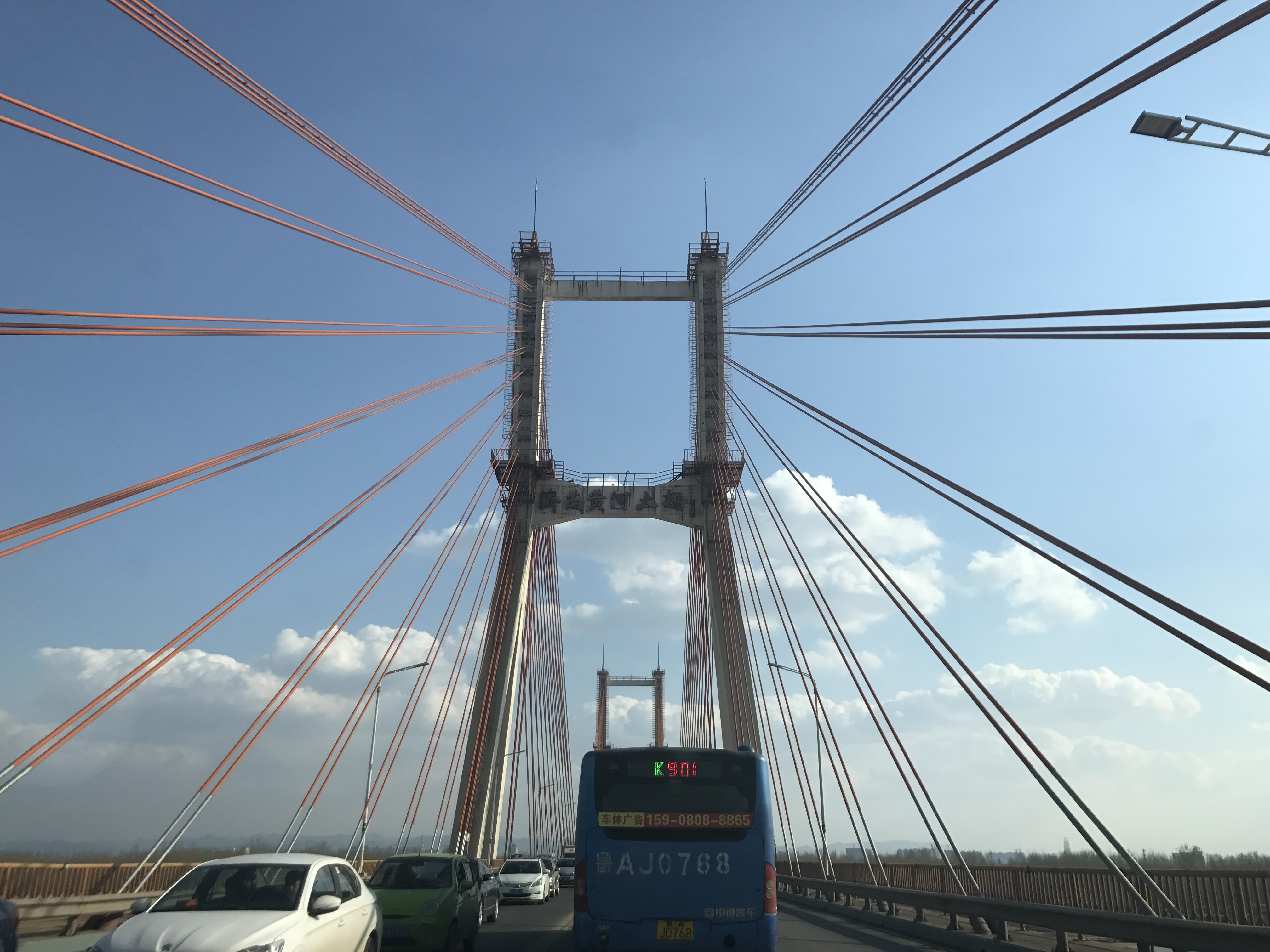
Jinan Yellow River Bridge
On December 10, 1977, the State Planning Commission authorized a bridge across the Yellow River at Jinan. Fourteen months later, construction began. By July 14, 1982, the bridge was open to traffic -- one of the first long-span cable-stayed road bridges in China, completed for 35.18 million yuan at a time when the country was just beginning to rebuild its infrastructure after decades of upheaval. The Jinan Yellow River Bridge is not the longest or the most famous crossing of China's mother river, but it arrived at a moment when such projects signaled something larger: a nation turning outward and forward.
Engineering on a Deadline
The timeline was aggressive even by modern standards. Engineers Li Shou and Wan Shanshan from the Communication Planning and Design Institute of Shandong Province began design work in February 1978. By September, the preliminary design had been approved. Test boring at the construction site started in July 1978, and the first structural work began that December. The bridge assembly was in place by December 1981, and construction was formally completed on June 30, 1982 -- three and a half years from groundbreaking to final inspection. The Communication Engineering Company of Shandong Province carried out the work under the supervision of assistant directors Song Ren and Wang Liang, with assistant commissioner Du Henggan overseeing transportation logistics. For a province building one of its most technically demanding structures, the pace was remarkable.
Cables and Concrete
The bridge uses a semi-fan cable arrangement with steel cables anchored to reinforced concrete H-pylons that rise 68.4 meters above the river. The total structure spans five sections -- 40 meters, 94 meters, a main span of 220 meters, 94 meters, and 20 meters -- giving the bridge a crossing length that, together with its access ramps, reaches 2,022.8 meters. The deck is 17.2 meters wide and 2.75 meters deep. Cable-stayed design was still relatively novel in China in the late 1970s; the technology allowed the bridge to clear the Yellow River's wide, shifting channel without requiring the massive piers that a conventional beam bridge would have needed. By 1990, just eight years after opening, the bridge was carrying an average of 14,179 vehicles per day.
Crossing the Mother River
The Yellow River at Jinan is not the dramatic gorge-carved river of its upstream reaches. Here, on the North China Plain, it flows wide and slow through flat terrain, carrying the heavy sediment load that gives it its name and its color. The river has been both lifeline and catastrophe for the cities along its banks -- its floods have killed millions over the centuries, and its channel has shifted course dramatically across the plain. Building a bridge at Jinan meant spanning not just a river but an unpredictable geological system, one that deposits silt, shifts its bed, and occasionally surges far beyond its banks. The 68.4-meter pylons that hold the cables had to be anchored in a riverbed that is as much mud as it is solid ground.
A Reform-Era Landmark
The Jinan Yellow River Bridge opened in the summer of 1982, four years into Deng Xiaoping's reform and opening-up period. China was investing in infrastructure at a pace it had not attempted since the early years of the People's Republic, and bridges were among the most visible symbols of that investment. A cable-stayed bridge across the Yellow River was not merely a transportation project; it was a statement of technical capability. The bridge connected Jinan's city center to the agricultural and industrial regions north of the river, replacing ferry crossings that had served the route for centuries. Its 35.18-million-yuan price tag was modest by later standards -- the mega-bridges of the 2000s and 2010s would cost billions -- but for 1982 it represented a significant commitment to a single piece of infrastructure.
From the Air
Located at 36.757°N, 117.032°E, crossing the Yellow River north of Jinan's city center. The cable-stayed bridge with its distinctive H-pylons is clearly visible from the air, spanning the wide, sediment-laden river. Nearest airport is Jinan Yaoqiang International Airport (ZSJN), approximately 20 km to the east. The Yellow River itself is a major visual landmark -- a wide, brown ribbon cutting across the green and gray of the North China Plain. Recommended viewing altitude 1,500-3,000 feet AGL.