Jingo-ji: The Temple Where You Throw Away Your Bad Luck
Stand at the edge of the viewing platform at Jingo-ji, a small clay disc balanced between your thumb and forefinger. Below you, the Kiyotaki River cuts through a forested gorge so deep the water is barely visible through the canopy. The instructions are simple: hold the plate like a frisbee, tilt it slightly downward, and throw. Watch it catch the air and sail out over the valley, spinning until it vanishes into the green. The plate carries your bad luck with it -- that is the idea behind kawarake-nage, a tradition believed to have originated at this very temple. Jingo-ji has been perched on Mount Takao, northwest of Kyoto, since the eighth century. It has survived fire, civil war, and centuries of neglect. It holds sixteen National Treasures. But most visitors remember the clay plates.
A Statesman's Prayer, A Monk's Transformation
The temple traces its origins to 781, when the Nara-period statesman Wake no Kiyomaro founded Takaosan-ji on the slopes of Mount Takao to pray for the peace and prosperity of the nation. He also established a second temple, Jingan-ji, in his home province. In 809, a young monk named Kukai arrived at Takaosan-ji. Kukai had recently returned from China, where he had spent years studying esoteric Buddhism, and he carried with him the teachings that would become Japan's Shingon sect. He became chief priest and lived at the temple complex for fourteen years. In 824, the two temples were officially merged into one, taking the name Jingo-ji. The esoteric Buddhist tradition Kukai established there has continued unbroken for twelve centuries. His calligraphy, a document from 812 listing the people and deities who underwent the abhisheka initiation at the temple, survives as one of Jingo-ji's National Treasures.
Sixteen Treasures and 2,317 Surviving Scrolls
Jingo-ji holds sixteen objects designated as National Treasures of Japan, an extraordinary concentration for a single mountain temple. The principal image is a statue of Yakushi Nyorai, the Medicine Buddha, housed in the Kondo main hall. Among the treasures is the Jingo-ji Tripitaka, a Buddhist corpus that originally consisted of more than 5,400 hand-copied sutra volumes. Time, fire, and dispersal have reduced the collection to 2,317 volumes -- still a staggering archive. The Buddhist sutra Bimashokyo, translated by the fifth-century Indian monk Gunabhadra, was handed down through the temple for over a millennium. These are not museum pieces behind glass; they are sacred objects in an active temple, maintained by monks who trace their lineage through the same Shingon tradition Kukai brought here in the ninth century.
Fire, War, and a Daimyo's Reconstruction
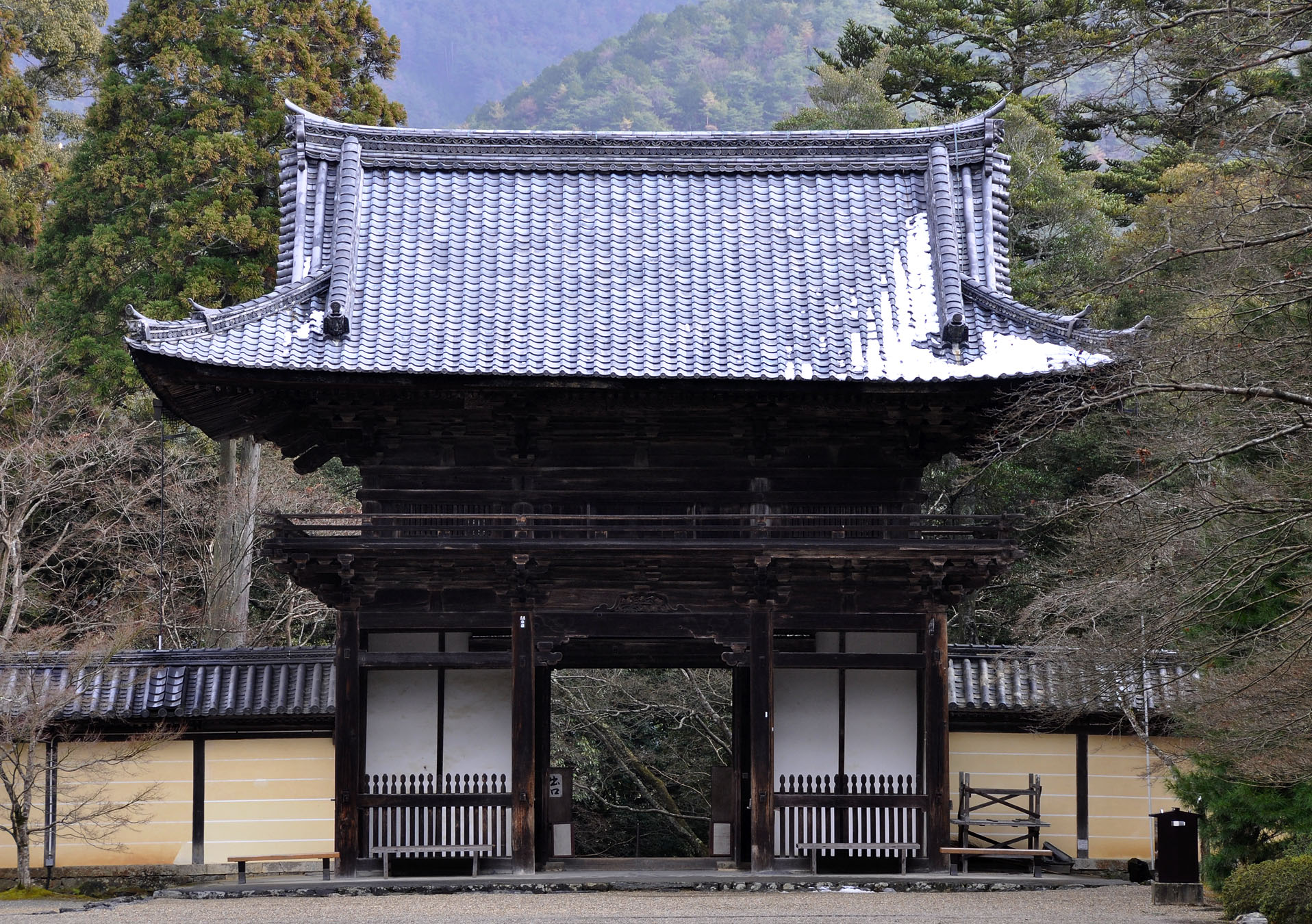
The buildings at Jingo-ji have been destroyed repeatedly by fire and war. The devastating Onin War of 1467-1477, which leveled much of Kyoto, consumed most of the temple complex. Of the original structures, only the Daishi-do -- a hall dedicated to Kobo Daishi, as Kukai is posthumously known -- survived, and even its date of construction is uncertain. The temple languished for more than a century before Itakura Katsushige, a daimyo and former Kyoto shoshidai under the Tokugawa shogunate, commissioned a major reconstruction in 1623. The Romon gate, the Bishamon-do, the Godai-do with its statues of Fudo Myoo and other wrathful deities, and the bell tower all date from this rebuilding. Another restoration in the 1930s, funded in part by Gendo Yamaguchi, added the current Kondo and the Tahoto pagoda.
Three Hundred and Fifty Stone Steps
Visiting Jingo-ji is a pilgrimage in miniature. Buses from central Kyoto drop visitors at a stop along the road, and from there a long staircase of 350 large stone steps descends to the Kiyotaki River. A short bridge crosses the water, and then a similar climb leads up to the temple gate. The ascent winds through forest that erupts in spectacular color each autumn, when the maple trees lining the path turn the mountainside into a corridor of red and gold. At the top, the temple grounds open onto a series of halls and pavilions stepping up the slope. The Kondo, rebuilt in 1934, commands the highest terrace. Beyond it lies the viewing platform where visitors buy their clay plates for kawarake-nage, the ritual of throwing away misfortune. The tradition is believed to have been born here at Jingo-ji, and it has spread to temples and shrines across Japan -- but the original cliff, overlooking the Kiyotaki River gorge, remains the most dramatic setting to watch a small disc of clay carry your troubles into thin air.
From the Air
Located at 35.06°N, 135.67°E on the slopes of Mount Takao, northwest of central Kyoto. The temple sits in a densely forested mountain area along the Kiyotaki River gorge. From altitude, Mount Takao and its neighboring peaks form a green ridgeline northwest of Kyoto's urban sprawl. The Kiyotaki River valley is visible as a narrow cut through the forested hills. Best viewed at 3,000-5,000 feet AGL approaching from the southeast, where the contrast between Kyoto's city grid and the forested mountains becomes dramatic. The nearest major airport is Osaka Itami (RJOO), approximately 25 nautical miles to the south-southeast. Arashiyama district and the Togetsukyo Bridge are visible about 3 kilometers to the south along the river.