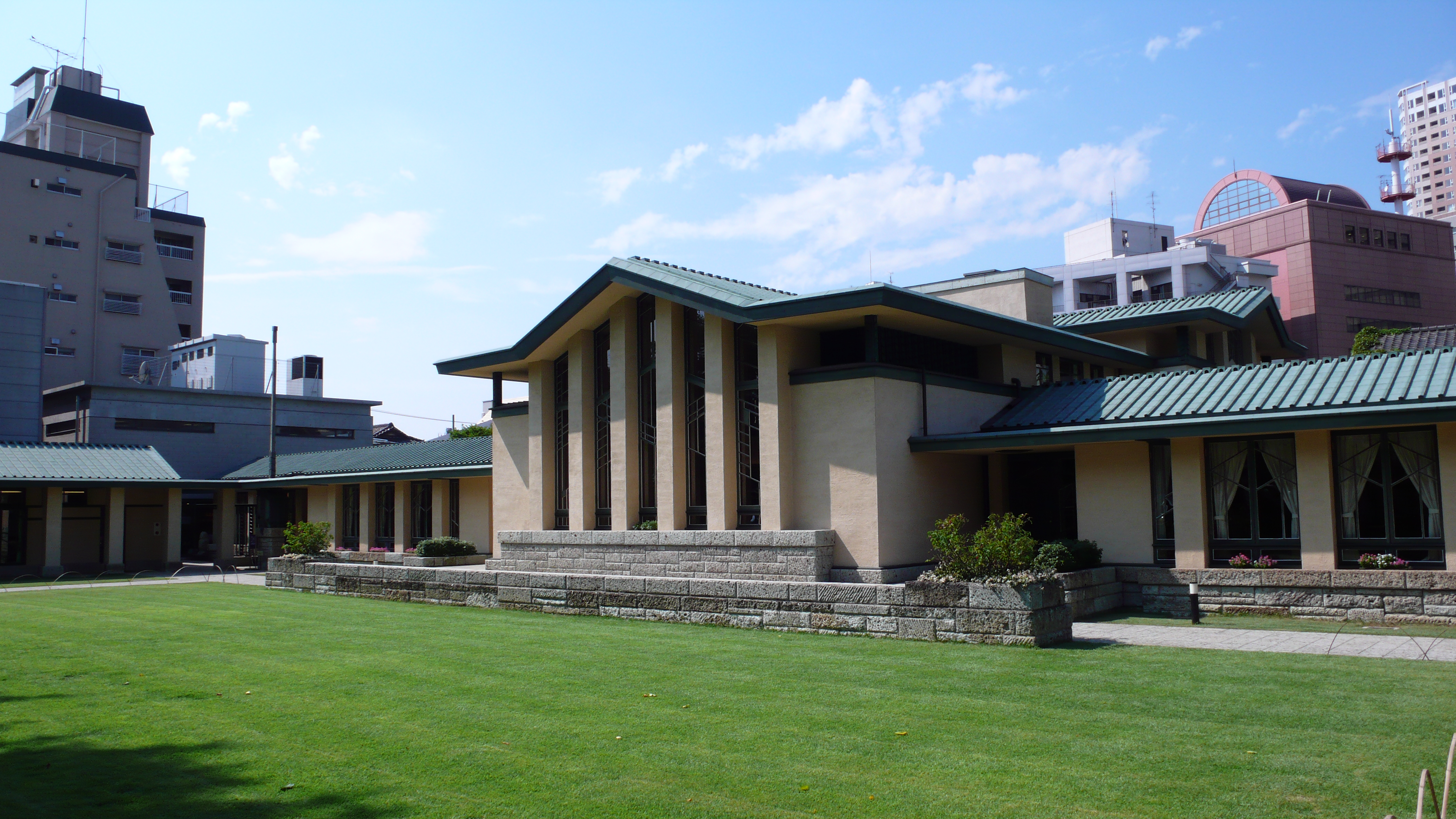
Jiyu Gakuen Girls' School
Most of Frank Lloyd Wright's buildings in Japan are gone. The Imperial Hotel, his most famous Tokyo commission, was demolished in 1968. But tucked into the residential streets of Toshima, a few minutes' walk from the neon chaos of Ikebukuro, a small complex of gray-green stone and geometric windows still stands exactly as Wright designed it in 1921. Jiyu Gakuen Myonichikan is not just one of the last Wright structures in Japan -- it may be the purest surviving expression of his belief that architecture could shape the human spirit.
A School Born from a Handshake
The building exists because of a chance introduction. Arata Endo, Wright's chief assistant on the Imperial Hotel project, introduced the architect to Yoshikazu and Motoko Hani, a husband-and-wife team who had founded Jiyu Gakuen -- literally "Freedom School" -- as a progressive girls' academy rooted in self-reliance and Christian values. Wright was so taken with the Hanis' educational philosophy that he agreed to design their school despite its modest budget. Motoko Hani herself was a remarkable figure: widely considered Japan's first female journalist. The couple wanted a building that would teach as much as any classroom, and Wright delivered something extraordinary from the simplest materials.
Prairie Lines in a Tokyo Neighborhood
Built from economical two-by-four lumber and plaster, the school belies its humble materials at every turn. A central hall rises to double height, its soaring south-facing windows flooding the courtyard with light. Symmetrical classroom wings extend east and west, forming a U-shape that embraces the open space. Wright designed everything to child scale -- doorways, desks, corridors -- creating an environment where young students would feel the building belonged to them. The horizontal lines stretching outward, blending structure into landscape, are pure Prairie School design from Wright's first golden age. Yet Wright also wove in Japanese sensibility: gray-green Oya stone from Tochigi Prefecture lines the pavements, columns, and corridor lanterns, giving the complex a texture that feels rooted in its surroundings rather than imported.
Survival Against the Odds
In 1934, the school outgrew the original campus and relocated to Higashikurume in western Tokyo. The Myonichikan buildings passed to the alumni association, who used them for gatherings and events. Decades of use without major investment took their toll, and by the 1990s, the aging structures faced an uncertain future. A protracted battle within the Japanese government over how to preserve a wooden building while keeping it in active use led to something unusual: the government actually rewrote its regulations. In May 1997, Jiyu Gakuen was designated a National Important Cultural Asset, and a comprehensive restoration ran from January 1999 through September 2001. The painstaking work brought every detail back to Wright's original vision.
A Living Masterpiece
Since November 2001, the Myonichikan has been open to the public, though it still serves as a venue for weddings and cultural events -- exactly the kind of living use the government's revised rules were designed to allow. Along with the Yodoko Guest House in Ashiya, Hyogo Prefecture, it is one of only two Wright buildings in Japan to retain its original appearance completely. Visitors enter a space that feels simultaneously a century old and startlingly modern: the geometric window patterns, the interplay of stone and wood, the way light moves through the central hall as the day progresses. Wright once said he designed buildings to grow out of the ground and into the light. In Toshima, a school built for young women seeking freedom does exactly that.
From the Air
Located at 35.726N, 139.707E in the Toshima ward of Tokyo, near Ikebukuro. The low-rise complex is difficult to spot from altitude amid dense urban fabric. Look for the residential area southwest of Ikebukuro Station. Nearest major airport is Tokyo Haneda (RJTT), approximately 20 km south. Narita International (RJAA) is 65 km east. Best viewed at low altitude on approach corridors.