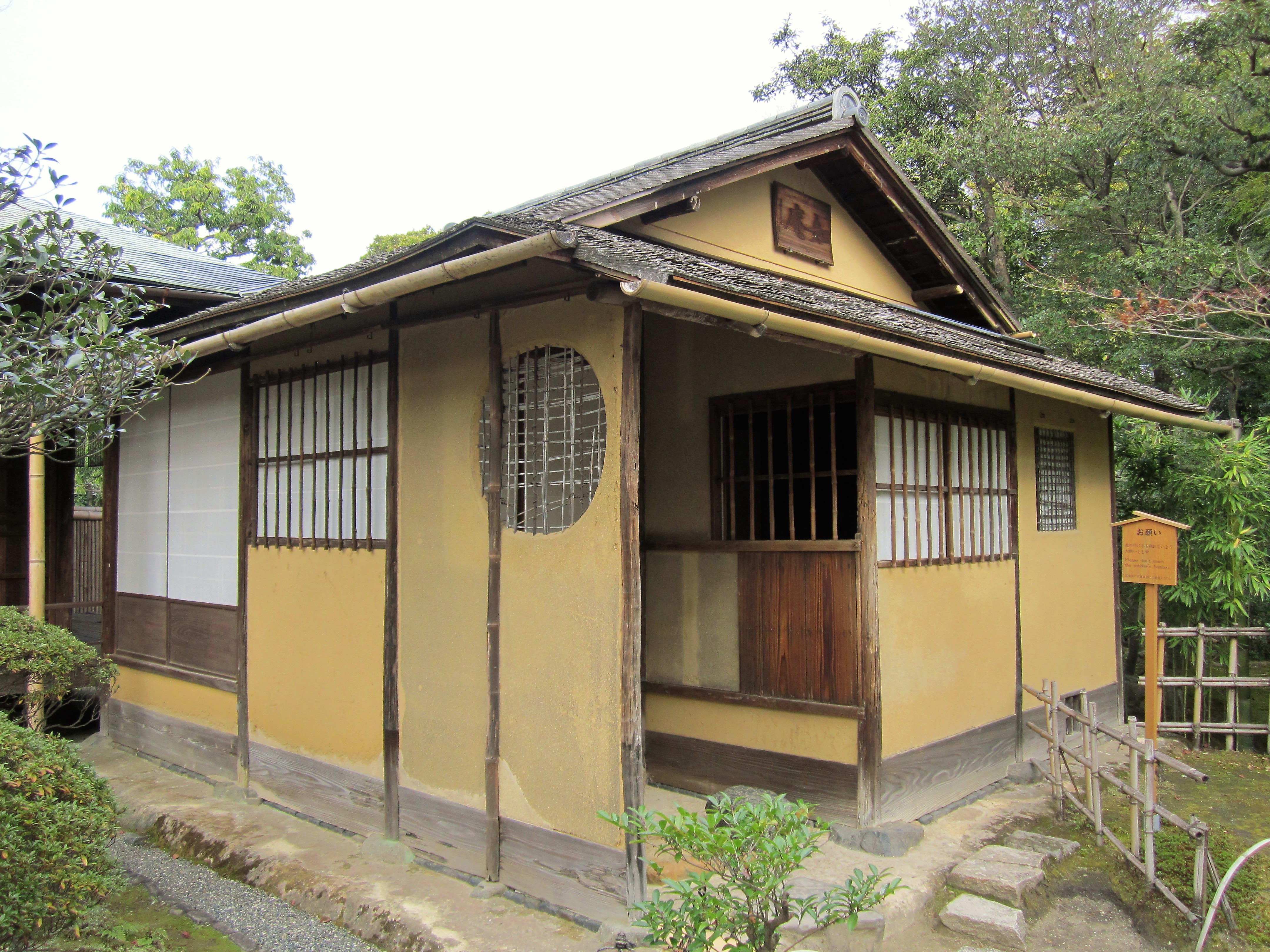
Jo-an: A Warlord's Brother and the Art of Tea
To enter the Jo-an teahouse, you get on your knees. The nijiriguchi -- the "crawling-in entrance" -- stands barely two feet high, forcing every visitor, regardless of rank or station, to bow low and shuffle through. This was the point. In the world of the Japanese tea ceremony, the teahouse is an equalizer, a space where swords are left outside and warlords sit on the same tatami as merchants. Oda Urakusai understood this better than most. Born Oda Nagamasu, the eleventh son of Oda Nobuhide and younger half-brother of the great unifier Oda Nobunaga, he spent his early life in the shadow of one of history's most ambitious military campaigns. But Urakusai chose a different path. He became a disciple of the legendary tea master Sen no Rikyu and devoted his later years to the way of tea. Around 1618, he built Jo-an at the Zen temple Kennin-ji in Kyoto. Four centuries later, it is designated one of Japan's three finest teahouses and a National Treasure.
A Samurai's Second Life
Oda Urakusai lived through the most violent era in Japanese history and emerged as one of its great aesthetes. He served under all three of Japan's great unifiers -- his brother Nobunaga, then Toyotomi Hideyoshi, and finally Tokugawa Ieyasu. He fought at the Battle of Sekigahara in 1600 on the Tokugawa side. But alongside his military career, Urakusai had been studying the tea ceremony under Sen no Rikyu since the mid-1570s, and his skill earned him a place among Hideyoshi's elite circle of Rikyu-trained cultural advisors. After retiring from political life, Urakusai restored the subtemple Shoden-in at Kennin-ji in Kyoto and built Jo-an there as his personal tea space. He founded the Uraku school of tea ceremony, a distinct tradition that blended Rikyu's wabi-sabi minimalism with the formality and discipline of the samurai class. He died in 1622 at the age of 75.
Geometry of Humility
Jo-an is remarkably small. The main tea room measures just two and a half tatami mats plus a daime -- a three-quarter-size mat -- and a tokonoma alcove. A three-mat preparation room and a tiny corridor room of one and a half mats complete the structure. The building wears a shake-shingle roof and sits behind a roji, the "dewy ground" garden that serves as a transitional space between the outside world and the tea room's austere interior. The walls incorporate old calendar pages as wainscoting along the lower sections, a deliberate use of humble materials. Latticed bamboo windows filter light onto the host's position while leaving the rest of the room in soft shadow. Every element -- the asymmetrical layout, the exposed lathing left unplastered in certain window openings, the low entrance -- serves a philosophy: strip away pretension, create intimacy, and force awareness of the present moment.
A Teahouse That Traveled
Jo-an did not stay at Kennin-ji. Over the centuries, the teahouse was relocated multiple times, a not-uncommon fate for significant Japanese wooden structures, which can be carefully disassembled and rebuilt elsewhere. Its journey ended in 1972, when it was reassembled in the Urakuen gardens in Inuyama, Aichi Prefecture -- the heart of the old Owari Province that the Oda clan once ruled. The location carries a poetic resonance: Urakusai's teahouse now sits in the territory his brother Nobunaga fought to unify, just a short walk from Inuyama Castle, which Nobunaga himself besieged and captured in 1564. The Urakuen garden was designed specifically to house Jo-an and provide the proper roji approach. In 1951, the Japanese government designated Jo-an a National Treasure, placing it alongside the Tai-an and Mitsu-an as one of the country's three most important surviving teahouses.
What the Bamboo Lattice Holds
The tea ceremony practiced inside Jo-an is not a museum recreation. It is a living tradition, the Uraku school that traces directly to Urakusai's synthesis of warrior discipline and Rikyu's contemplative minimalism. Visitors to the Urakuen garden can view the exterior and peer into the shadowed interior through the latticed windows, though the teahouse itself is protected from casual entry. The scale of the building resists photography and defies expectations -- people expect a National Treasure to be grand, but Jo-an's power is in its compression. Every surface is within arm's reach. The light through the bamboo lattice shifts with the sun. The sound of water in the garden carries through the thin walls. Four hundred years after a retired samurai built himself a quiet room, the quiet remains the entire point.
From the Air
Located at 35.39N, 136.94E within the Urakuen gardens in Inuyama, Aichi Prefecture, adjacent to the Kiso River and very near Inuyama Castle. The teahouse itself is far too small to spot from the air, but the Urakuen garden complex is identifiable as a wooded enclosure near the castle hill. Best experienced on the ground after spotting the castle from altitude. Nearest airport is Nagoya Airfield / Komaki (RJNA), approximately 10 nautical miles south-southeast. Chubu Centrair International Airport (RJGG) lies roughly 40 nautical miles south.