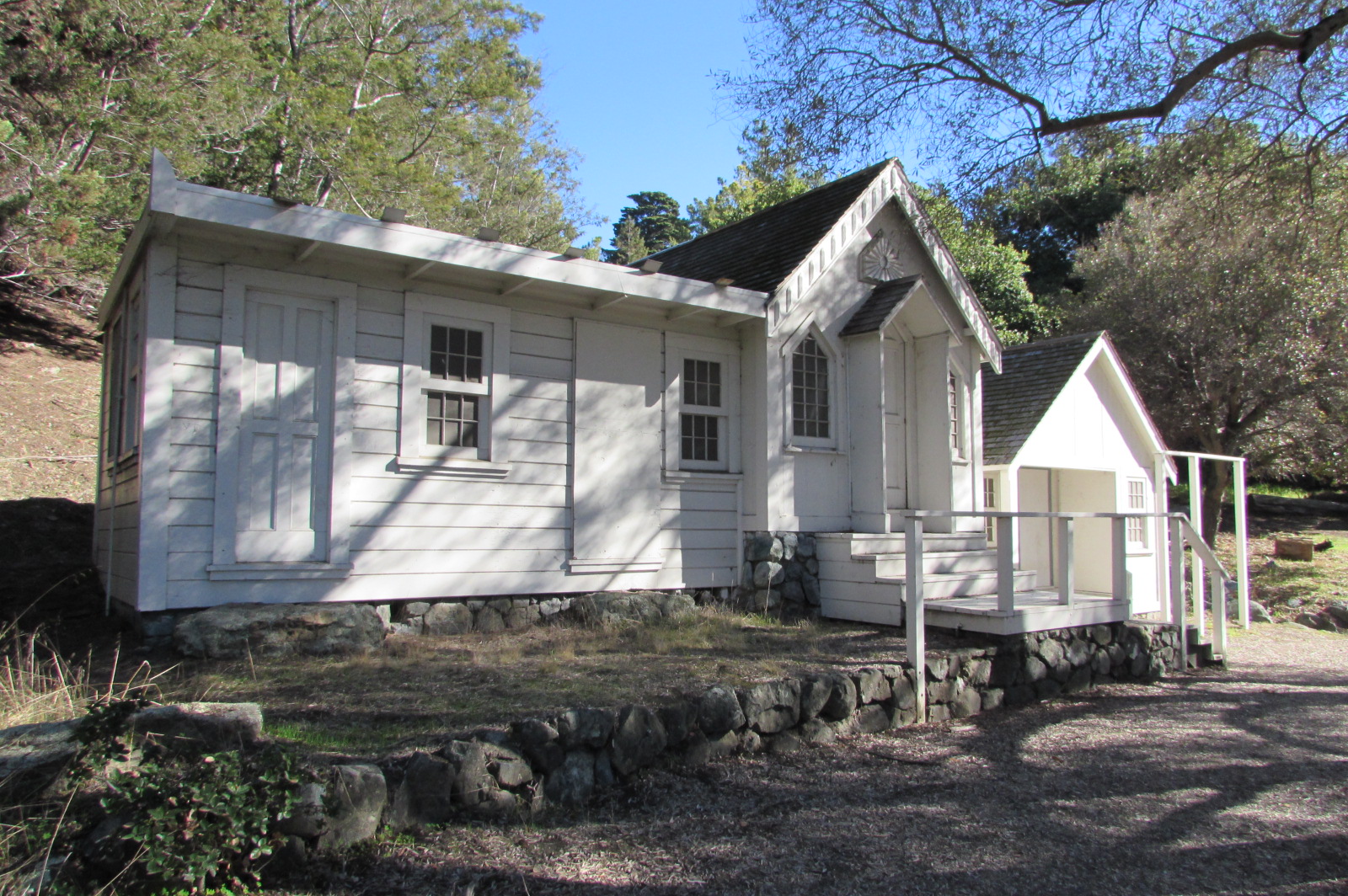
Joaquin Miller House
Joaquin Miller built his own funeral pyre. Not as a metaphor, not as an art piece, but as a genuine structure on a hilltop in the Oakland Hills where he intended his body to be burned when the time came. He also erected stone monuments to Moses, to the explorer John C. Fremont, and to the poets Robert and Elizabeth Barrett Browning -- scattering them across the hundred acres he purchased in 1886 and named, with characteristic disregard for convention, "The Hights." The misspelling was deliberate. Miller was a man who did everything on his own terms, including dying, though even that did not go quite as he planned.
The Poet of the Sierras
Joaquin Miller was born Cincinnatus Hiner Miller in Indiana in 1837, but he left that name behind along with most of the conventional life it implied. He headed west as a young man, living among the Modoc people in Northern California, mining for gold, riding with horse thieves -- or so he claimed. His poetry about the American West, particularly his 1871 collection Songs of the Sierras, made him famous first in London, where his frontier persona delighted Victorian audiences, and then back home. By the time he bought his Oakland hilltop, he was one of the first widely recognized poets of the far western United States. He was also a tireless self-mythologizer whose biography has always been difficult to separate from his fiction.
A Hilltop Built by Hand
Miller did not simply move to The Hights -- he made it. His first structure was a one-room cabin of redwood logs, built for himself and his mother, who came down from Oregon to join him. The house that still stands, known as The Abbey, is a crude, vaguely Gothic structure that looks like someone tried to build a church out of lumber scraps and raw enthusiasm. He planted the surrounding trees himself, hundreds of them, transforming bare hillside into what would eventually become a dense woodland. Then came the monuments: rough stone pillars and cairns placed on the eminence to the north, each dedicated to a figure Miller admired. The whole property was part home, part shrine, part outdoor gallery -- a physical manifestation of one man's unedited imagination.
The Homeless Snail
In 1894, a young Japanese poet named Yone Noguchi arrived at The Hights. He worked as a laborer in exchange for room and board, living in the cabin next to Miller's. Noguchi found Miller generous but overwhelming -- he later called him "the most natural man" while also describing the years at The Hights as difficult. Living in that cabin, Noguchi wrote and published his first book, Seen or Unseen; or, Monologues of a Homeless Snail. He referred to The Abbey as "Miller's sanctum or Holy Grotto." Noguchi would go on to become one of the first Japanese poets to write extensively in English, and he later fictionalized his Oakland experience in The American Diary of a Japanese Girl. The intersection of these two literary lives -- the frontiersman-showman and the immigrant poet finding his voice -- is one of the most unexpected stories in California's literary history.
A Funeral He Could Not Control
Miller died on February 17, 1913. His instructions were clear: cremate him on the pyre he had built, with no religious ceremony and no embalming. The city of Oakland had other ideas. His funeral on February 19 drew thousands of mourners, and conventional rites prevailed over the poet's wishes. His ashes were eventually scattered from the pyre he had constructed, a partial concession to a man who had tried to choreograph even his own ending. He left no will, and his estate -- valued at roughly $100,000, a substantial sum in 1913 -- was divided between his wife Abigail and his daughter Juanita.
Landmark in the Redwoods
Oakland purchased The Hights in 1919, six years after Miller's death. The 14-acre core of the property, including the house and Miller's monuments, was declared a National Historic Landmark in 1962 and listed on the National Register of Historic Places in 1966. The trees Miller planted now tower overhead, mature coast redwoods and oaks that have transformed his once-bare hilltop into dense forest. The Abbey still stands, its simple Victorian lines unchanged, a house that looks exactly like what it is: a shelter built by a poet who cared more about the view than the architecture. The monuments remain too, weathered but intact, still honoring the heroes of a man whose greatest monument turned out to be the landscape itself.
From the Air
Located at 37.81N, 122.19W in the Oakland Hills, within the larger Joaquin Miller Park. Best viewed at 1,500-3,000 feet AGL; look for the dense woodland on the hillside east of downtown Oakland. Nearest airports: KOAK (Oakland International, 7 nm south-southwest), KHWD (Hayward Executive, 9 nm southeast). The house sits within the tree canopy and is not easily spotted from altitude, but the park's clearing and amphitheater area provide a visual reference.