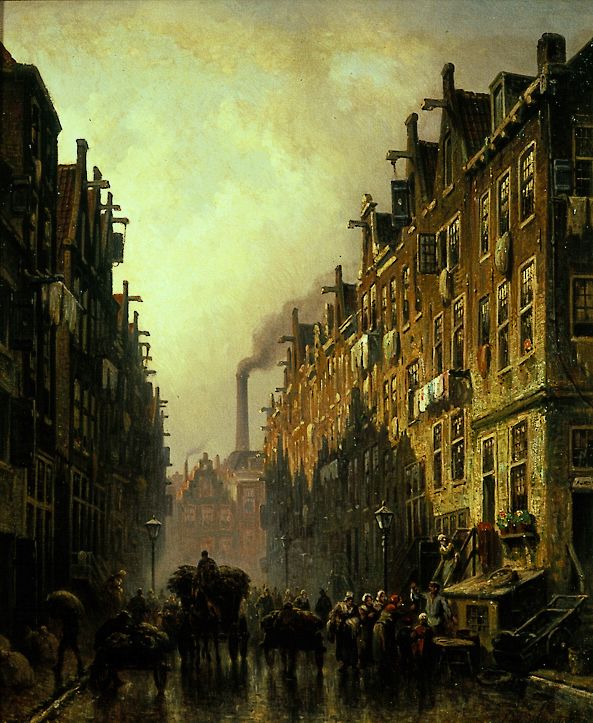
Jodenbuurt
Before the war, the Jews of Amsterdam called their city Mokum - Hebrew for 'place', simply 'the place', the way you would say it of somewhere you had finally come home. The word carried four hundred years of refuge. It carried the Sephardim who arrived after Spain and Portugal expelled them in 1492 and 1493, and the Ashkenazim who came from Germany and Poland in the 1600s. It carried Spinoza, born here on Vlooienburg island in 1632. It carried the diamond cutters, the booksellers, the rabbis. And then, in less than four years between 1940 and 1945, that word came to carry something almost too heavy to say out loud: of the roughly 80,000 Jews who lived in Amsterdam before the German occupation, only about 5,000 returned from the camps.
Why They Came Here
The first Sephardic Jews arrived in Amsterdam at the end of the 1500s, refugees from the Iberian Inquisitions who had been forced to live as nominal Christians - the so-called Marranos - and who often did not know their own religion well enough to practice it. They came to a young Dutch Republic that, with the Union of Utrecht in 1579, had become the first European state to write freedom of religion into its founding law. The Jews settled where land was cheap and available, on the marshy island of Vlooienburg east of the medieval city, along a street that quickly took the name Jodenbreestraat - Jewish Broad Street. They built synagogues, at first hidden from view, and brought in rabbis from Italy, North Africa, and the Ottoman Empire to teach a community that had lost its own teachers under persecution. By 1672, around 2,500 Jews lived in the quarter. By 1693 the synagogues had unified under the name Talmud Torah.
Spinoza, Rembrandt, and the Diamond Workers
The neighborhood produced one of the most consequential philosophers in European history. Baruch Spinoza was born on Vlooienburg in 1632 to a Sephardic family that had fled Portugal; in 1656 the Portuguese Synagogue placed him under the herem, the ban, for his radical views on God and scripture. He spent the rest of his life elsewhere, grinding lenses and writing the books that would help launch the Enlightenment. The painter Rembrandt lived a few doors down on Jodenbreestraat - he was fascinated, his biographer Steven Nadler argues, by what he called the 'Biblical' faces of his neighbors, and many of his most arresting portraits are of Jewish Amsterdammers. In the 19th century, after the emancipation of 1796, the Jews of Amsterdam became the backbone of the city's diamond industry, which in turn gave the Netherlands its first major trade union, the Algemene Nederlandse Diamantbewerkersbond, chaired by Henri Polak. Their union hall, De Burcht on Henri Polaklaan in the Plantage, still stands.
1940 to 1945
The Germans crossed the Dutch border in May 1940. In 1941 they declared the Jodenbuurt a ghetto, fenced it, posted guards on the bridges, and began layering on the restrictions that have become familiar from every account of the Holocaust: registration, then no telephones, then no driving, then no streetcars. Tram Line 8, which had run through the quarter since 1906, simply went out of service in the summer of 1942 because most of its passengers were no longer allowed to ride it. Three major raids - razzias - swept through Amsterdam in May, June, and September of 1943. The deportations were funneled through the Hollandsche Schouwburg, a theater on the Plantage Middenlaan that the Nazis converted into a holding center. Most of those taken there went to Westerbork and then to Auschwitz or Sobibor. Some Amsterdammers, at terrible risk to themselves, hid Jewish neighbors in attics, cloisters, and orphanages. They saved many lives. They could not save most.
The Hunger Winter and What Was Lost
By the end of 1944 the quarter was empty. The Hunger Winter of 1944-1945 then did its own kind of damage - residents of Amsterdam, freezing and starving, stripped the abandoned wooden houses of the Jodenbuurt for fuel, tearing down galleries and three of the four Torah arks at the Ashkenazi synagogues on Jonas Daniel Meijer Square. Only the Great Synagogue's ark survived, because it was made of marble. After the war the survivors came back to a neighborhood that no longer really existed. The 1953 reconstruction plan called for a major road and a metro line straight through the heart of the quarter. By the 1970s, what the deportations and the Hunger Winter had not destroyed, the bulldozers and the metro tunnels finished. The Maupoleum office block went up. Whole streets disappeared.
What You See Today
Walk through this part of Amsterdam now and you see a neighborhood that has been gentrified, redeveloped, and rebuilt - and the absence is what defines it. The Portuguese Synagogue still stands on Mr. Visserplein, austere and shuttered and intact. Across the square the Jewish Historical Museum occupies the four reunited Ashkenazi synagogues. The Mozes en Aaronkerk anchors the corner of Waterlooplein, where the old market still sets up every weekday. The Huis de Pinto, saved from demolition by activists in the 1970s, holds a small library. The Hollandsche Schouwburg is now a memorial - its empty courtyard lists 6,700 family names of victims, each surname appearing once to represent all those who bore it. The Jodenbuurt is not really a Jewish neighborhood anymore. It is the place where a Jewish neighborhood used to be.
From the Air
The historic Jodenbuurt centers around 52.368 N, 4.903 E, immediately east of central Amsterdam and the Amstel river. Key landmarks visible from the air: the twin white towers of the Mozes en Aaronkerk at Waterlooplein, the Portuguese Synagogue complex on Mr. Visserplein, and the green roof of the Stopera (city hall and opera) directly on the river. Nearest airport: Schiphol (EHAM), 9 nm southwest. Amsterdam city center lies under controlled airspace; the quarter is best viewed on departure or arrival routings that pass east of the IJ.