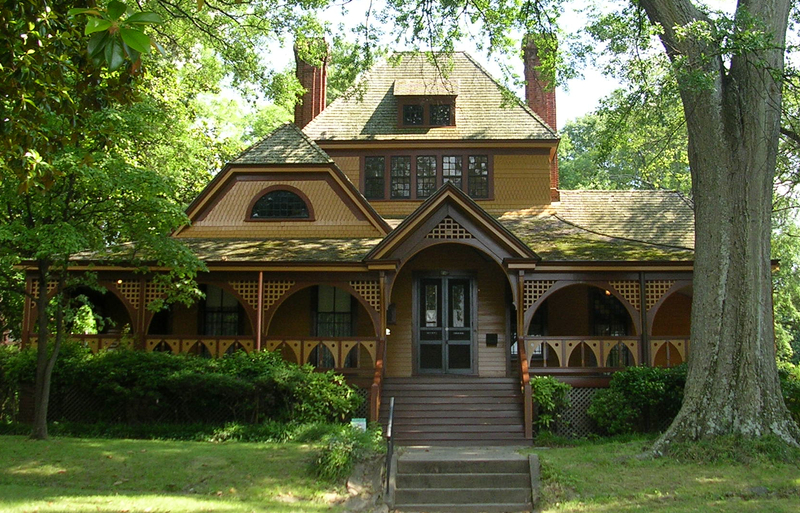
The Wren's Nest
A family of wrens moved into the mailbox in the spring of 1895, and Joel Chandler Harris refused to disturb them. He rerouted his mail rather than evict the tiny tenants, and the name stuck. The Wren's Nest, as it has been known ever since, sits at 1050 Ralph D. Abernathy Boulevard in Atlanta's West End neighborhood, a Queen Anne Victorian that became the creative headquarters for one of the most widely read American authors of the nineteenth century. Harris lived here from 1881 until his death in 1908, and within these walls he shaped the Uncle Remus tales that introduced Brer Rabbit, Brer Fox, and a rich tradition of African American folklore to the world.
From Snap Bean Farm to a Literary Landmark
Harris first rented the house in 1881, in a neighborhood then known for its upper-class residents. Two years later, earnings from his debut book Uncle Remus: His Songs and His Sayings allowed him to purchase the property outright. He originally called it Snap Bean Farm, a playful nod to fellow author Eugene Field's home, Sabine Farm. In 1884, Harris expanded the house with six additional rooms and a new Queen Anne-style facade, transforming it into the rambling Victorian that still stands today. A furnace, indoor plumbing, and electricity followed around 1900. The house became a gathering place for literary visitors and, in a detail that connects it to Hollywood history, Harris's goddaughter Daisy Baker lived here in the late 1880s and early 1890s. She would later become Margaret Dumont, the grande dame foil to the Marx Brothers in seven of their films.
The Storyteller's Craft
Harris worked as a journalist at the Atlanta Constitution, but it was his literary work that made the house famous. Drawing on African American folktales he had heard during his youth on a Georgia plantation, Harris created the character of Uncle Remus, an elderly formerly enslaved man who tells animal fables to a young boy. The stories, featuring the trickster Brer Rabbit outwitting stronger opponents, preserved an oral tradition rooted in West African and African American culture. Harris published multiple collections from his study in this house, and the tales became some of the most widely translated American literature of their era. The legacy is complicated. Harris was a white journalist transcribing Black oral traditions, and modern scholarship continues to grapple with questions of ownership and representation. The museum today works to honor the African American roots of the folklore.
Carnegie's Investment
Andrew Carnegie visited the house in 1900 for just twenty minutes, but the encounter left an impression. After Harris died in 1908, Carnegie donated five thousand dollars toward establishing the home as a museum. With additional support from President Theodore Roosevelt and a fundraising campaign led by Atlanta public school students, the Wren's Nest opened as a house museum in 1913, making it Atlanta's oldest. The Uncle Remus Memorial Association, a volunteer group, managed the property for four decades. In 1962, the house was designated a National Historic Landmark for its association with Harris. The original mailbox that housed the famous wrens was recreated during a 1991 renovation, a small tribute to the whimsical moment that gave the house its enduring name.
A Living Tradition
Today the Wren's Nest operates as a cultural center dedicated to preserving oral storytelling traditions. Visitors walk through rooms still furnished with the Harris family's original belongings, from the study where the Uncle Remus tales were written to the parlor where Carnegie sat for those brief twenty minutes. The museum hosts storytelling events that celebrate African American folklore in all its contemporary forms, connecting the nineteenth-century tales that made the house famous to a living artistic tradition. In a city defined by constant reinvention, the Wren's Nest remains a quiet pocket of the old West End, a place where the stories outlasted the storyteller and a mailbox became a monument.
From the Air
Located at 33.738N, 84.422W in Atlanta's West End neighborhood, southwest of downtown. From the air, look for the residential neighborhood along Ralph D. Abernathy Boulevard, south of I-20 and west of the Atlanta University Center campus. Nearest major airport is Hartsfield-Jackson Atlanta International (KATL), approximately 8 nm to the south. The West End neighborhood sits within Atlanta's Class B airspace. Best viewed at 2,000-3,000 ft AGL for neighborhood context.