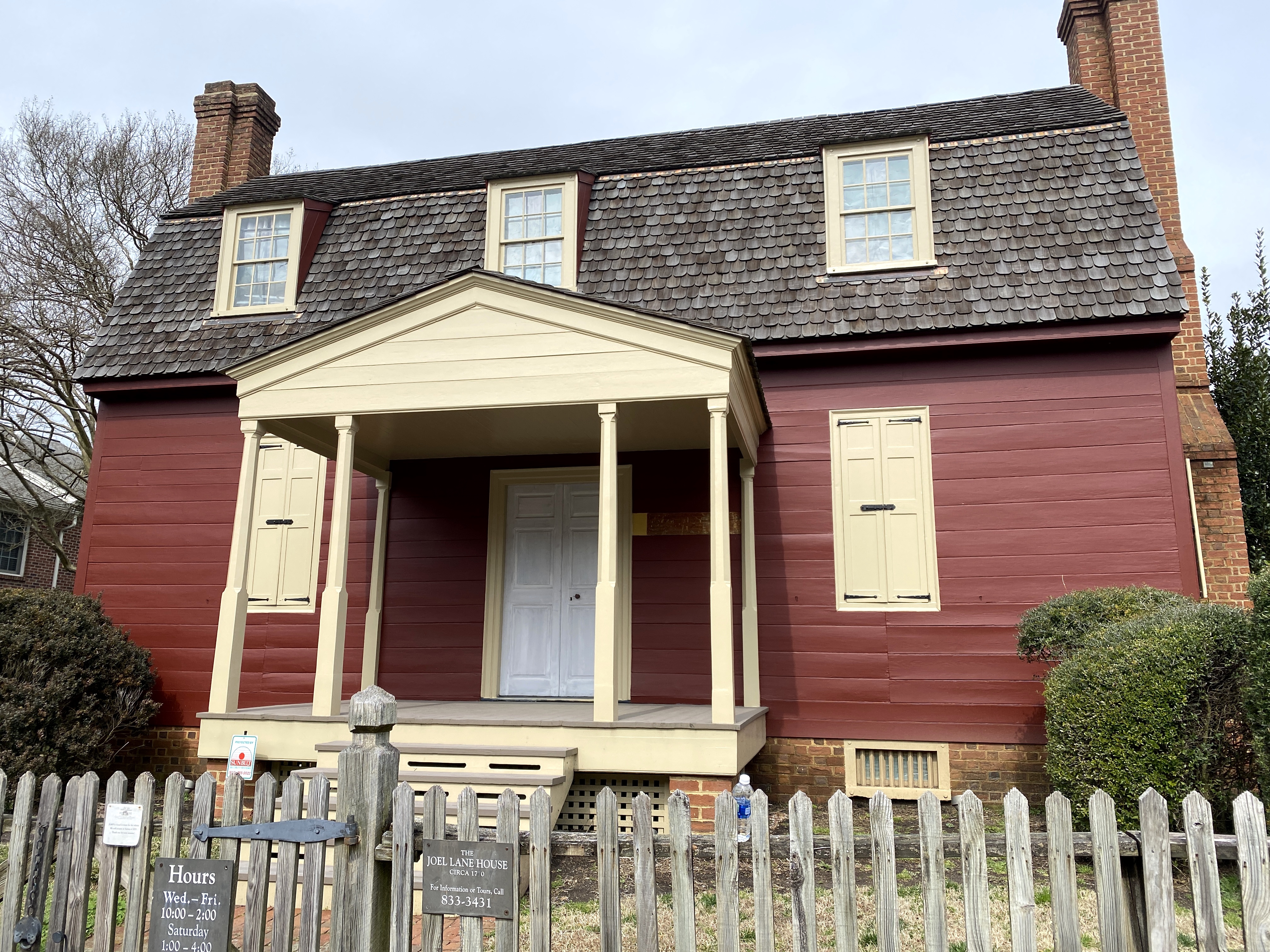
Joel Lane House
Beneath 26 layers of paint, the Joel Lane House was hiding a secret. When restorers began peeling back centuries of accumulated color in 2019 to celebrate the house's 250th anniversary, they discovered the original finish: a deep garnet red, bold and unexpected for a colonial plantation home. That revelation captured something essential about Joel Lane himself, a man whose ambitions ran bolder than his surroundings would suggest. From this modest hill at Wake Cross Roads in what was then sparsely settled wilderness, Lane shaped the creation of Wake County, hosted sessions of the state General Assembly, and ultimately sold the land on which North Carolina built its permanent capital.
The Father of Raleigh
Joel Lane arrived at Wake Cross Roads in the late 1760s, settling in colonial Johnston County in what is now central Wake County. His plantation manor stood on a small hill overlooking a landscape of unbroken forest and scattered farms. But Lane was no mere planter. He owned thousands of acres, and he wielded that wealth to reshape the political geography of North Carolina. As a member of the colonial General Assembly, Lane lobbied successfully to carve Wake County out of the wilderness in 1770, naming it for Margaret Wake, wife of colonial Governor William Tryon. The following year, Wake County's first court is believed to have convened in Lane's own home. He was appointed to the court and held the position until his death in 1795.
Revolution at the Crossroads
When the American Revolution swept through the colonies, Wake Cross Roads became a gathering point for patriot governance. In 1776, Lane hosted the colony's Council of Safety at his home, a body charged with coordinating resistance to British rule. The following year, he obtained a license to operate a small inn, making his property both a political nerve center and a waypoint for travelers. From May to June of 1781, the state General Assembly held a full session on Lane's property. He served in the state Senate during 11 of the 14 legislative sessions between 1782 and 1794, and in 1789 he traveled to Halifax as a delegate to the convention that ratified the United States Constitution. Lane was not just witnessing North Carolina's transformation from colony to state; he was engineering it from his parlor.
Selling the Ground for a Capital
Lane's most consequential act came in 1792, when the North Carolina legislature authorized the purchase of a tract of his land to establish a permanent state capital. The new city would be called Raleigh, and its western boundary was drawn just east of Lane's house. A street was named in his honor. In a single transaction, Lane transformed himself from a frontier planter into the literal founder of a capital city. After his death in 1795, the house passed through several owners before businessman William Boylan purchased it in 1818. The Boylan family held the property, along with nearby Montfort Hall, until 1909. As Raleigh grew, the city absorbed Lane's former plantation, replacing fields and forest with streets, houses, and businesses. The house was moved a short distance in 1911, relocated but not forgotten.
A House Preserved in Garnet
In 1927, the National Society of Colonial Dames of America in North Carolina purchased the Joel Lane House to ensure its survival. The organization has operated it as a museum ever since, making it one of the longest-running house museum operations in the state. Today, visitors find the oldest dwelling in Wake County restored to its 18th-century character, filled with period artifacts and furnishings. The grounds include a detached middle-class home from around 1790, a formal city garden, and a period herb garden. The 2019 restoration that uncovered those 26 layers of paint revealed not just the original garnet color but also the damaged wood beneath, which the team carefully repaired before repainting the house to match its 1769 appearance. Standing garnet red once more amid the glass towers and broad avenues of modern Raleigh, the Joel Lane House is a vivid reminder that this capital city began as one man's plantation at a crossroads in the Carolina wilderness.
From the Air
Located at 35.78°N, 78.65°W in downtown Raleigh, North Carolina. The house sits at 728 Hargett Street, near the center of the city. At low altitude (1,000-2,000 feet AGL), look for the small colonial structure amid the surrounding modern downtown development. Raleigh-Durham International Airport (KRDU) is approximately 10 nm to the northwest. The North Carolina State Capitol building nearby provides a useful visual reference for locating the house.