Joggins
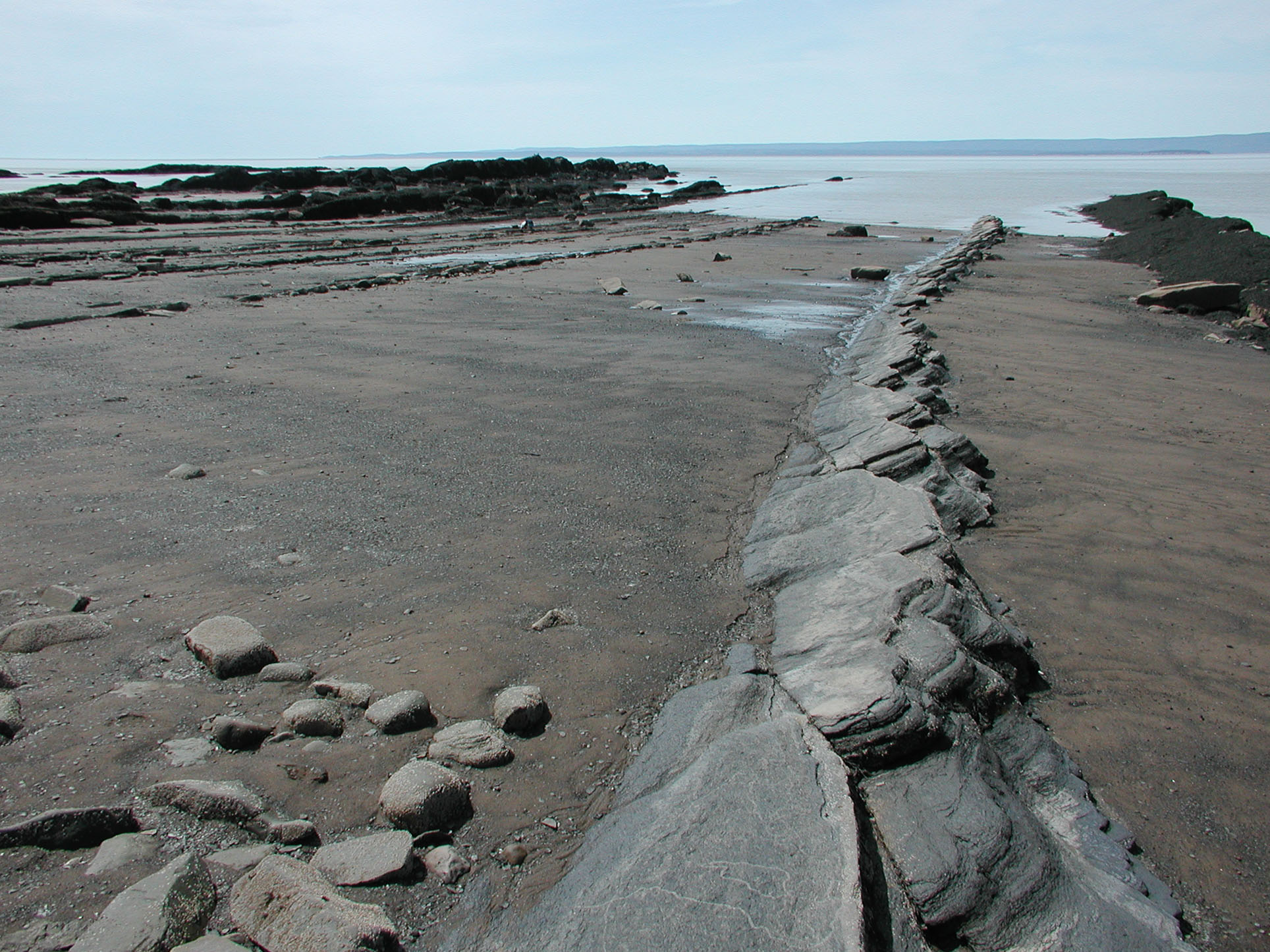
Every day the Bay of Fundy tides carve a little more from the cliffs at Joggins, and every day something 310 million years old falls onto the beach. Fossils here do not require excavation. The ocean does the digging, prying ancient tree trunks, amphibian bones, and arthropod trackways from Carboniferous coal seams and depositing them on the shore like offerings. Charles Lyell, the founder of modern geology, visited twice and declared Joggins 'the finest example in the world' of Coal Age rocks. Darwin cited it in On the Origin of Species. UNESCO inscribed it as a World Heritage Site in 2008. The tides, indifferent to honors, keep working.
Chegoggins
The Mi'kmaq called this place Chegoggins -- the place of the large fish weir -- a name that French and English settlers gradually shortened to Joggins. The community sits on the Cumberland Basin, a sub-basin of the Bay of Fundy, where coal seams stripe the sea cliffs like dark lines in a ledger. Acadian settlers were mining those seams as early as 1686, and the British garrison at Annapolis Royal tapped them by 1715. Major Henry Cope established the first commercial mine in 1731; the Mi'kmaq destroyed it the following year. Coal drew waves of workers through the 19th century -- Acadians returning from New Brunswick, Irish and Scottish immigrants, some laborers as young as twelve. Joggins Mines grew to include three churches, a hotel, a roller rink, and a movie theater. The community incorporated as a town in 1919, but the coal industry's decline hollowed it out, and Joggins lost its town status by 1949. The 1958 Springhill Mining Disaster, which killed 75 miners at a colliery just 30 kilometres away, dealt a further blow to the region's mining economy.
When Nova Scotia Was Tropical
Three hundred and ten million years ago, Nova Scotia straddled the equator. Dense tropical rainforest blanketed the region, and the trees that grew here -- giant lycopsids like Sigillaria and Lepidodendron, towering horsetails called Calamites -- were nothing like modern forests. They grew in swampy lowlands where organic matter accumulated into the coal seams that would later draw miners to these shores. The fossils preserved in the Joggins cliffs capture this alien world in extraordinary detail: bark impressions, seed ferns, fish, amphibians, arthropod trackways, even raindrop imprints and wave ripples frozen in stone. The Joggins Fossil Cliffs stretch for nearly 15 kilometers along the coast, continually refreshed by tidal erosion. It is one of the easiest places in the world to find Pennsylvanian-era coal fossils, because you simply walk the beach after high tide and look down.
The Reptile in the Tree
In 1852, Charles Lyell and Nova Scotian geologist William Dawson made a discovery that would ripple through the history of science. At Coal Mine Point, they found tetrapod fossils entombed inside an upright fossilized tree. Dawson's subsequent investigations revealed Hylonomus lyelli -- the earliest known sauropsid, or reptile, in the fossil record. This small creature, trapped inside a hollow tree stump 310 million years ago, became a keystone in understanding how vertebrates made the transition from water to land. In 2002, Nova Scotia named Hylonomus lyelli its provincial fossil. Joggins also yielded Protoclepsydrops, the earliest known synapsid, the lineage that would eventually produce mammals. Abraham Gesner, the inventor of kerosene, and William Logan, who painstakingly measured the cliffs bed by bed for the Geological Survey of Canada, both did foundational work here. The fossil record at Joggins even played a role in the famous 1860 Oxford debate between Bishop Wilberforce and Thomas Huxley over Darwin's theory of evolution.
Coal Age Galapagos
The Joggins Fossil Cliffs earned their UNESCO inscription in 2008 not just for individual specimens but for what they collectively represent: a complete snapshot of a Carboniferous rainforest ecosystem, sometimes called the Coal Age Galapagos. The cliffs record the moment when tropical rainforests collapsed across Euramerica, triggering mass extinction and accelerating the diversification of tetrapods. The Joggins Fossil Centre, built on the cliff above the beach, houses exhibits on the geological history of the cliffs, the story of scientific discovery here, and the community's coal mining heritage. Interpretive tours take visitors down to the shore where, depending on the tide, you might find a 310-million-year-old tree stump freshly exposed or a scorpion trackway that was sealed in stone when this coast was a swamp at the equator. Amateur collectors have contributed significantly -- Don Reid, a longtime Joggins resident, donated his entire personal collection to the Fossil Institute. Along the Glooscap Trail, the twisting coastal drive of soaring cliffs and deep valleys, eagles and osprey circle overhead while hundreds of thousands of migrating birds gather in the marshes that the Acadians first diked four centuries ago.
From the Air
Located at 45.69N, 64.44W on the Cumberland Basin shore of the Bay of Fundy. The fossil cliffs extend roughly 15 km along the coast and are visible from altitude as a dramatic band of dark stratified rock. Nearest airports include Greater Moncton Roméo LeBlanc International (CYQM) to the northeast and Halifax Stanfield International (CYHZ) to the southeast. Best viewed at 1,500-3,000 feet to see the cliff stratification and the tidal flats. The Chignecto Isthmus connecting Nova Scotia to New Brunswick is visible to the north.