Jogyesa
A 500-year-old white pine grows in the courtyard of Jogyesa, its bark peeling in puzzle-piece patterns, its roots gripping soil that has been sacred ground since 1395. The tree is classified as Natural Monument No. 9 by the South Korean government, but to the monks who tend it, such designations miss the point. The pine was already old when the Joseon dynasty was young. It has outlasted kings, invasions, and occupations. Jogyesa, the chief temple of the Jogye Order of Korean Buddhism, occupies a modest footprint in Seoul's Jongno District, wedged between the commercial bustle of Insa-dong and the grandeur of Gyeongbokgung Palace. There is no mountain retreat here, no secluded forest. This is urban Buddhism, practiced where the city's heartbeat is loudest.
Names Shed Like Old Skin
The temple has worn three names across its life, each marking a shift in Korea's identity. It began as Gakhwangsa in 1395, at the dawn of the Joseon period, when the new dynasty's embrace of Confucianism pushed Buddhism from the center of Korean power to its margins. The modern temple was founded in 1910 and took the Gakhwangsa name. During the Japanese colonial period, when authorities attempted to absorb Korean Buddhism into Japanese institutional structures, it was renamed Taegosa. That name stuck until 1954, when Korean Buddhists reclaimed their independence and rechristened it Jogyesa, after the Jogye Order that traces its lineage to the Seon tradition of meditation practice. Each renaming was a quiet act of resistance, a refusal to let the temple's meaning be defined by outside powers.
A Fortress of Faith
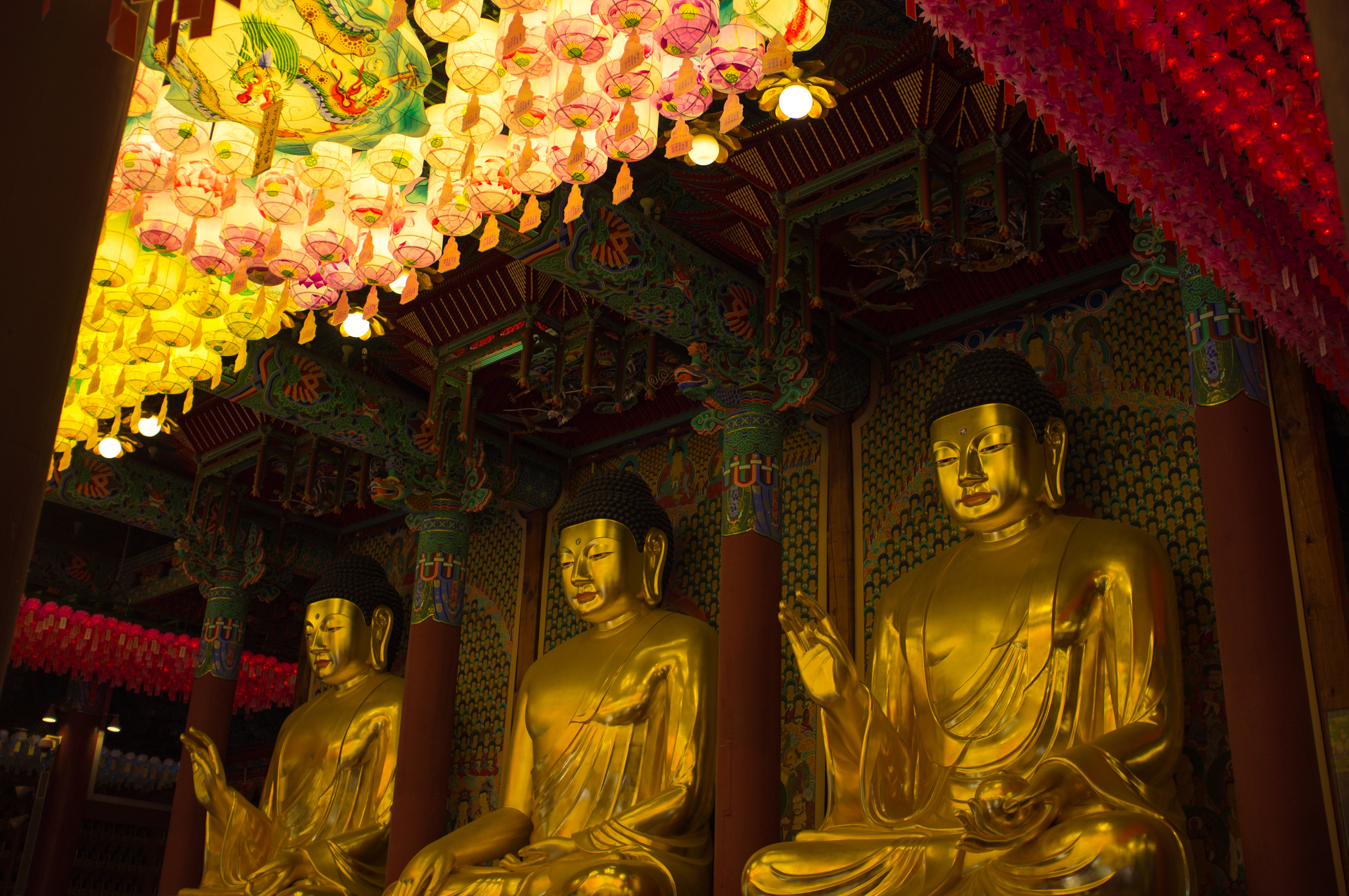
During the Japanese colonial period from 1910 to 1945, Jogyesa became something more than a place of worship. While Japanese authorities worked to consolidate Korean Buddhist sects under Japanese administrative control, Gakhwangsa emerged as a center of resistance. Monks here pushed back against the imposition of Japanese Buddhist practices, particularly the allowance of married clergy, which contradicted Korean monastic tradition. In 1937, a movement to establish a Central Headquarters for Korean Buddhism began at the temple. By 1938, the Main Buddha Hall had been completed, giving the resistance a physical and spiritual anchor. The hall still stands, housing a gilded Shakyamuni Buddha, its serene expression a counterpoint to the turbulence that birthed the building.
Lanterns and Living Tradition
Each spring, thousands of lotus lanterns transform Jogyesa and the surrounding streets of Jongno into a river of colored light. The Yeondeunghoe lantern festival, designated Korea's Important Intangible Cultural Property No. 122, marks Buddha's Birthday with a tradition stretching back over 1,300 years to the Unified Silla era. What began as a celebration of the first full moon of the lunar calendar evolved during the Goryeo Dynasty into a festival honoring the Buddha's birth. Today the lanterns take the shapes of lotus flowers, dragons, and traditional figures, each one carrying someone's wish. From early May through late in the month, the temple grounds glow from 6 p.m. to midnight, drawing Buddhist devotees and curious visitors alike into the warm illumination.
Contested Ground
Jogyesa has not always been serene. In December 1998, a factional dispute within the Jogye Order escalated into a full-scale occupation of the temple. Rival groups of monks barricaded themselves inside, and for more than 40 days the standoff played out on international news. Riot police were eventually called to clear the temple and restore order. Nearly two decades earlier, during the Kyeongsin Persecution of October 1980, government forces raided Jogyesa and other major Buddhist temples across the country under the pretext of anti-government investigations and an effort to purify Buddhism. These episodes reveal a temple that has never been merely contemplative. Jogyesa sits at the intersection of faith and power, and the tension between the two has shaped it as much as any prayer.
Crossing the Threshold
Visitors enter Jogyesa through the Iljumun, the one-pillar gate that symbolizes the boundary between the everyday world and the realm of the Buddha. Beyond it, the courtyard holds the ancient white pine and a Chinese scholar tree, both roughly 500 years old. The Geuknakjeon, or Hall of Supreme Bliss, enshrines the Amitabha Buddha. The Beomjongnu houses a great bell whose resonant tones are meant to awaken all beings from suffering. Through the Templestay program, visitors can stay overnight, following the monks' schedule of predawn chanting, vegetarian meals, and meditation. It is an experience designed not for spectacle but for stillness, a chance to step out of Seoul's relentless pace and into a rhythm that has persisted here, under various names and through considerable upheaval, for more than six centuries.
From the Air
Located at 37.574N, 126.982E in central Seoul's Jongno District. The temple compound sits near Gyeongbokgung Palace and the Insa-dong cultural quarter. Best viewed from lower altitudes. Nearest major airport is Gimpo International (RKSS), approximately 17 km west. Incheon International (RKSI) is about 52 km to the west. Seoul's dense urban grid and the green slopes of Namsan to the south provide visual orientation landmarks.