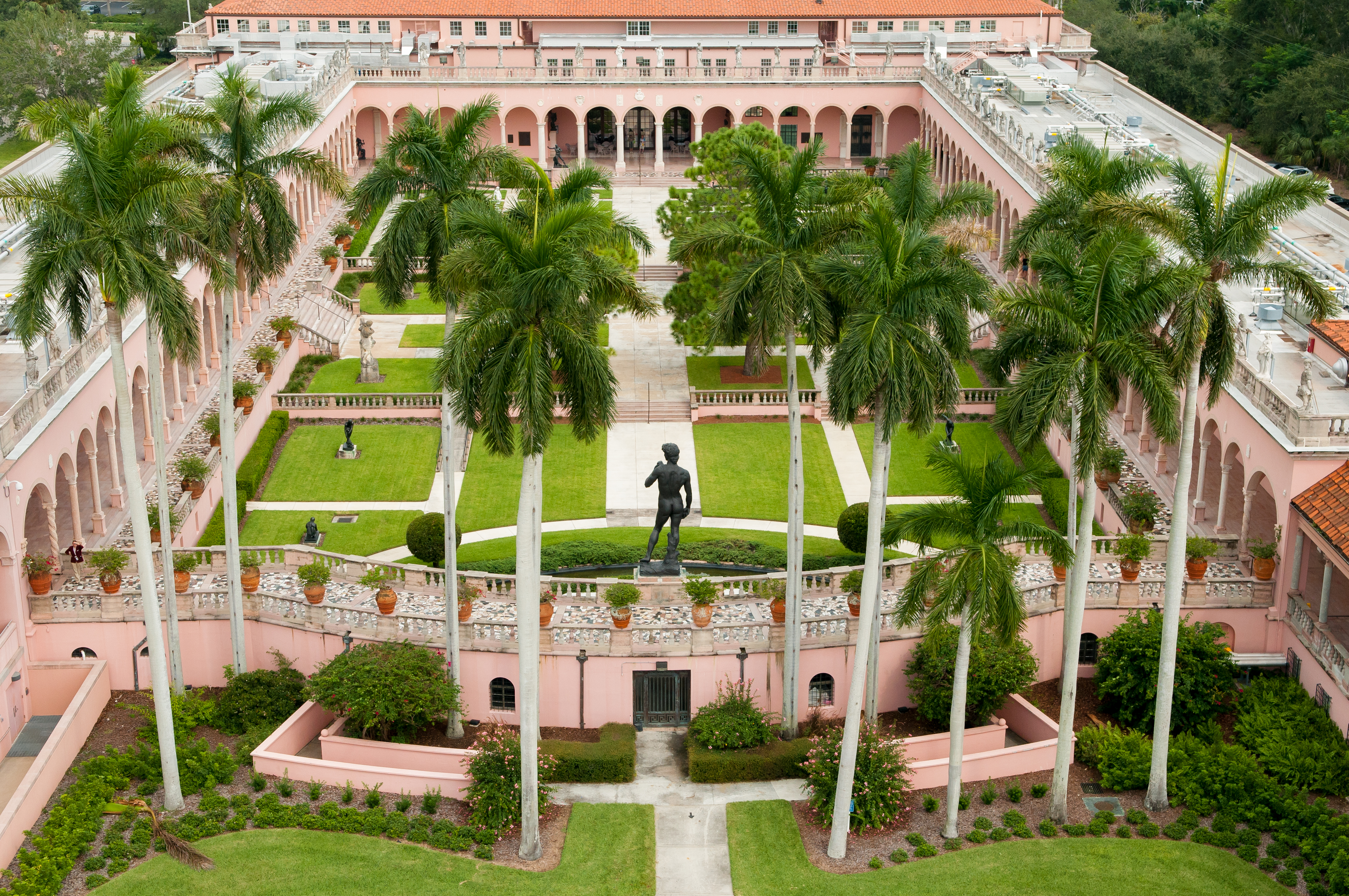
John and Mable Ringling Museum of Art
On the anniversary of John Ringling's birthday, students from neighboring New College sneak onto the grounds and place a cigar on his grave. It is exactly the kind of irreverent tribute the circus king would have appreciated. Ringling made his fortune under the big top, traveling America in a private Pullman car named Wisconsin, but he spent that fortune building something permanent: an Italian Renaissance villa on Sarasota Bay filled with one of the finest collections of Baroque art in the Western Hemisphere. He willed the entire property -- the museum, the mansion, the gardens, the art -- to the people of Florida. Then he died nearly bankrupt in 1936, leaving the state to fight his creditors for a decade before it could accept the gift. The Ringling has survived neglect, near-ruin, and two hurricanes. It endures because the collection inside is genuinely extraordinary.
A Showman's Eye for the Masters
John Ringling was not an obvious art collector. He was a circus impresario from Baraboo, Wisconsin, one of seven brothers who built the Ringling Bros. and Barnum & Bailey empire. But his years of traveling Europe -- scouting acts, negotiating deals -- gave him access to private collections and auction houses. He developed a genuine passion for Baroque painting, particularly the work of Peter Paul Rubens. Today the museum holds more than 10,000 objects across 21 galleries: paintings, sculpture, drawings, prints, photographs, and decorative arts spanning ancient through contemporary periods. The Rubens collection alone would justify a visit. But the walls also hold works by Velazquez, Veronese, Bernini, Cranach the Elder, Gainsborough, Poussin, and Marcel Duchamp. In 1925, Ringling hired architect John H. Phillips to design the museum in an Italian-inspired style. Construction began on the marshy Shell Beach site on June 27, 1927. Ringling envisioned adding a university, but his wife Mable's death in June 1929 and his own financial collapse made that impossible.
Ca' d'Zan: The House of John
The name means 'House of John' in Venetian dialect, and the mansion earns it. Designed by architect Dwight James Baum and completed in 1926, Ca' d'Zan is a Venetian Gothic fantasy overlooking Sarasota Bay -- part Doge's Palace, part Gilded Age extravagance. The Ringlings themselves provided design input, drawing on their extensive European travels. Owen Burns oversaw the construction. For years the mansion was the social center of Sarasota, hosting parties that mixed circus performers with Florida society. After Ringling's death, Ca' d'Zan fell into shocking disrepair. The state, which inherited the property, did virtually nothing to manage the endowment or maintain the building. By the late 1990s, the mansion was falling apart, the museum had a serious roof leak, security systems were inadequate, and the historic Asolo Theater had been condemned. The original $1.2 million endowment had grown to a mere $2 million in six decades. A 2002 state appropriation of $42.9 million, contingent on $50 million in private fundraising, finally saved the property. The museum raised $55 million by the deadline.
Under the Big Top, In Miniature
The Circus Museum, established in 1948, was the first museum in the United States dedicated to documenting circus history. Its collections include handbills, posters, business records, wardrobe, performance props, circus equipment, and parade wagons -- the material culture of an entertainment form that defined American popular life for a century. The adjacent Tibbals Learning Center houses the Howard Bros. Circus model, built by Howard Tibbals: a scale replica of the Ringling Bros. and Barnum & Bailey Circus as it appeared between 1919 and 1938. Billed as the world's largest miniature circus, the model captures in obsessive detail an entire traveling circus at its peak -- every tent, every wagon, every performer and animal rendered at exacting scale. Nearby sits the Wisconsin, Ringling's private railroad car built by the Pullman Company. Its interior of mahogany, gold-leaf stencils, and stained glass, with ceilings painted viva gold, baize green, and fiery brown, reveals a man who brought showmanship into every aspect of his life.
Storms and Resilience
In September and October 2024, Hurricanes Helene and Milton struck Florida's west coast in quick succession. Ca' d'Zan suffered the worst: eight feet of water flooded the basement, displaced roof tiles caused damage upstairs, and unmoored boats struck the terrace columns. The estate's grounds lost ancient banyan trees and strangler figs. Yet the art collection emerged unscathed. Within days of power being restored, the Ringling reopened with free admission -- offering Sarasota residents a place of beauty while they recovered from the storms. It was exactly what John Ringling had intended when he willed everything to the people of Florida.
The Secret Garden
John Ringling, his wife Mable, and his sister Ida Ringling North are buried on the property in a small enclosure called the Secret Garden, just in front of Ca' d'Zan. Mable's rose garden, completed in 1913, stands nearby, surrounded by stone statues depicting Italian peasant figures in scenes of courtship. The Dwarf Garden features Commedia dell'arte characters arranged along a path among banyan hammocks and bamboo. Florida State University assumed governance in 2000. The Chao Center for Asian Art opened in 2016, the Monda Gallery for Contemporary Art that same year, and the Kotler-Coville Glass Pavilion in 2018. The collection continues to grow, as Ringling insisted it would.
From the Air
Located at 27.38N, 82.56W on the Sarasota Bay waterfront. The campus is visible from the air as a large cultural compound with distinctive Italian-style architecture and the red-tile-roofed Ca' d'Zan mansion on the waterfront. Nearest airports: Sarasota-Bradenton International (KSRQ) approximately 5 miles north, and Venice Municipal (KVNC) approximately 18 miles south. Recommended viewing altitude: 1,500-2,500 feet AGL for the best perspective of the museum courtyard, Ca' d'Zan's waterfront facade, and the surrounding gardens. Sarasota Bay and the barrier islands provide unmistakable visual context.