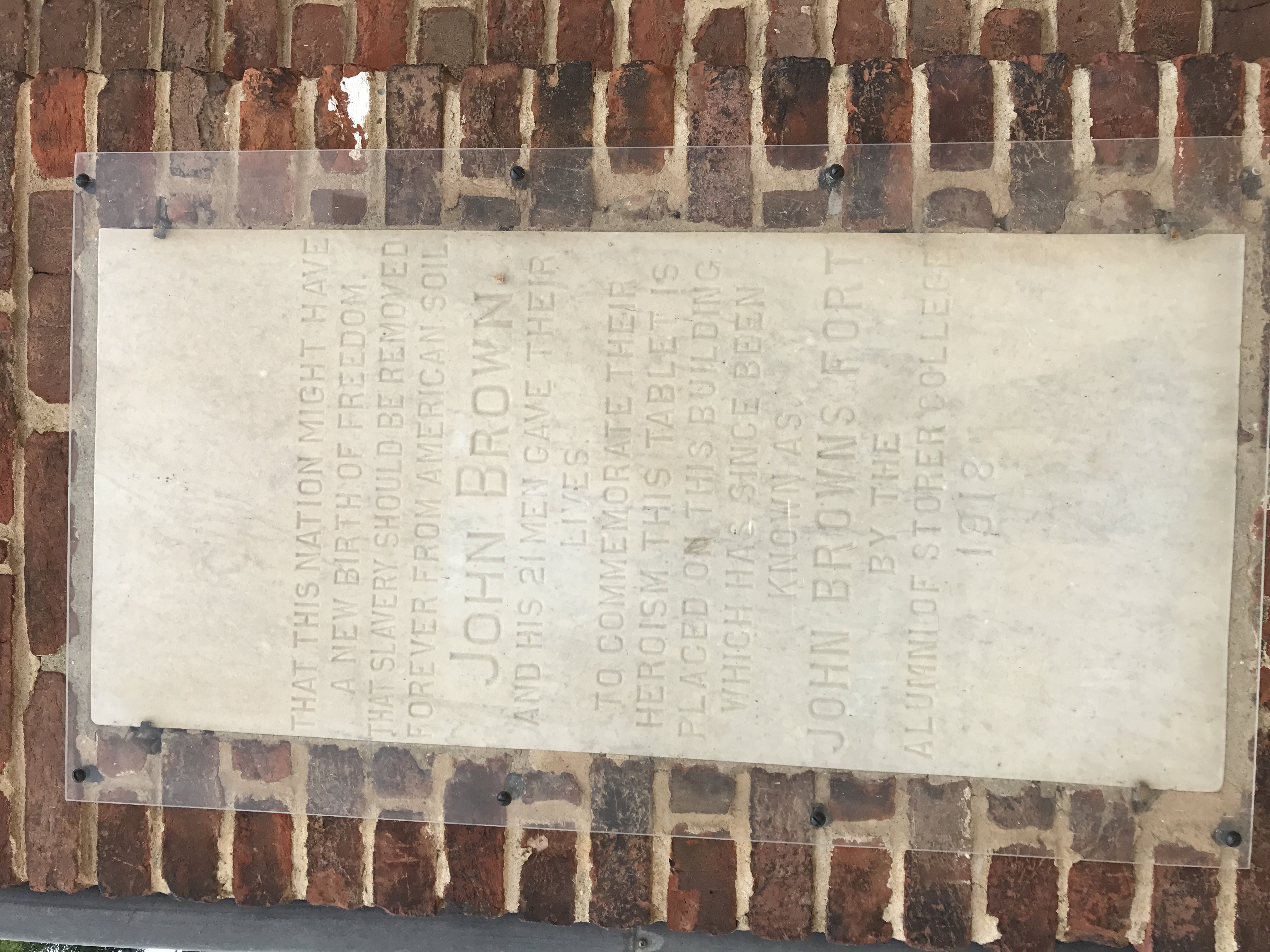
John Brown's Fort
No building in America has traveled farther for its size. What began in 1848 as a plain one-story brick guard and fire engine house at the Harpers Ferry Armory -- 35 and a half feet by 24, covered with slate -- became the last redoubt of John Brown's doomed antislavery raid in 1859, the most visited tourist destination in West Virginia, a symbol that helped launch the civil rights movement, and the only structure from the entire armory complex to survive the Civil War. It has been dismantled and moved four times, had its bricks stolen for souvenirs, been abandoned on a Chicago vacant lot, and today sits near its original location in the lower town of Harpers Ferry, still slightly smaller than it once was.
Eighteen Hours That Changed a Nation
On the night of October 16, 1859, John Brown and his army of 21 men -- 16 white and 5 Black -- seized the federal armory and arsenal at Harpers Ferry, intending to arm an insurrection against slavery. They captured 60 hostages, but by the next day local militia and armed citizens had pinned them down. Brown retreated into the sturdy engine house with several hostages and prepared for a siege. On the morning of October 18, 86 Marines under Lieutenant Colonel Robert E. Lee, with Lieutenant J.E.B. Stuart as his aide, stormed the building. Using a heavy ladder as a battering ram, they smashed through the doors. One Marine was killed. Brown was stabbed by the Marine commander, Lieutenant Israel Greene, and captured along with most of his surviving men. The raid was a military disaster, but Brown's trial and execution electrified the nation. Within eighteen months, the Civil War had begun.
Shrine and Scapegoat
After the war, the engine house stood as the lone survivor of the armory complex. Someone painted "John Brown's Fort" above its three doors, and Black Americans began arriving by train to see the place where the fight against slavery had turned violent. By the 1880s it was crumbling -- roof gone, windows shattered, bricks chipped away and sold as souvenirs with silver engravings attached. The building polarized the town. For Black visitors, it was a shrine to freedom. For some white residents, Brown was a madman and traitor, and the Black tourists his memory attracted were unwelcome. In 1891, the building was dismantled and shipped to Chicago for the World's Columbian Exposition, where it failed to draw crowds. Disconnected from its landscape, the fort meant nothing. It was abandoned on a vacant lot.
The Building That Kept Coming Back
Washington journalist Kate Field spearheaded a campaign to rescue the fort, and the Baltimore and Ohio Railroad offered to ship the disassembled structure back to Harpers Ferry for free -- they had lost tourist ridership when the building left town. Alexander and Mary Murphy donated land on their farm two miles above Harpers Ferry, and by November 1895 the fort was rebuilt there, though 8,000 replacement bricks were needed for those lost to souvenir hunters. The B&O marked the original site with a white stone obelisk. The fort's return drew African-American visitors just as the railroad had hoped. The first national convention of the National League of Colored Women took an excursion from Washington to see it. In 1909, the building was moved again to the campus of Storer College, a historically Black institution in upper Harpers Ferry, where students gave tours to practice their public speaking.
Where Freedom's Memory Lives
In 1906, Storer College hosted the Niagara Movement's second annual conference -- its first meeting on American soil -- the predecessor of the NAACP. Attendees walked from the campus to visit the fort on the Murphy farm. W.E.B. DuBois called the gathering "one of the greatest meetings that American Negroes ever held." In 1918, Storer alumni placed a bronze plaque on the fort's west wall: "That this nation might have a new birth of freedom, that slavery should be removed forever from American soil, John Brown and his 21 men gave their lives." The college closed in 1955, and in 1968 the National Park Service moved the building to its fourth and current location in lower Harpers Ferry, near its original site. The fort now anchors Harpers Ferry National Historical Park and appears on West Virginia's America the Beautiful quarter. Its original bell, however, ended up in Marlborough, Massachusetts, where a 2011 lawsuit to reclaim it was dismissed. The bell remains in New England. The fort remains in Harpers Ferry, still drawing pilgrims to the place where one man's desperate act cracked open the conscience of a nation.
From the Air
John Brown's Fort is located at 39.323N, 77.730W in the lower town of Harpers Ferry, at the point where the Shenandoah and Potomac rivers converge. The small brick building is not individually visible from typical flight altitudes but sits within the clearly identifiable Harpers Ferry National Historical Park complex at the river confluence. The dramatic gap where the rivers cut through the Blue Ridge is the primary visual landmark. Maryland Heights rises to the northeast, Loudoun Heights to the south. The B&O Railroad bridge crossing the Potomac is prominent. Nearest airports: Eastern WV Regional Airport (KMRB) 12nm west, Frederick Municipal Airport (KFDK) 18nm east. Best viewed at low altitude (1,500-2,500 feet AGL) in clear conditions.