John Day Fossil Beds National Monument
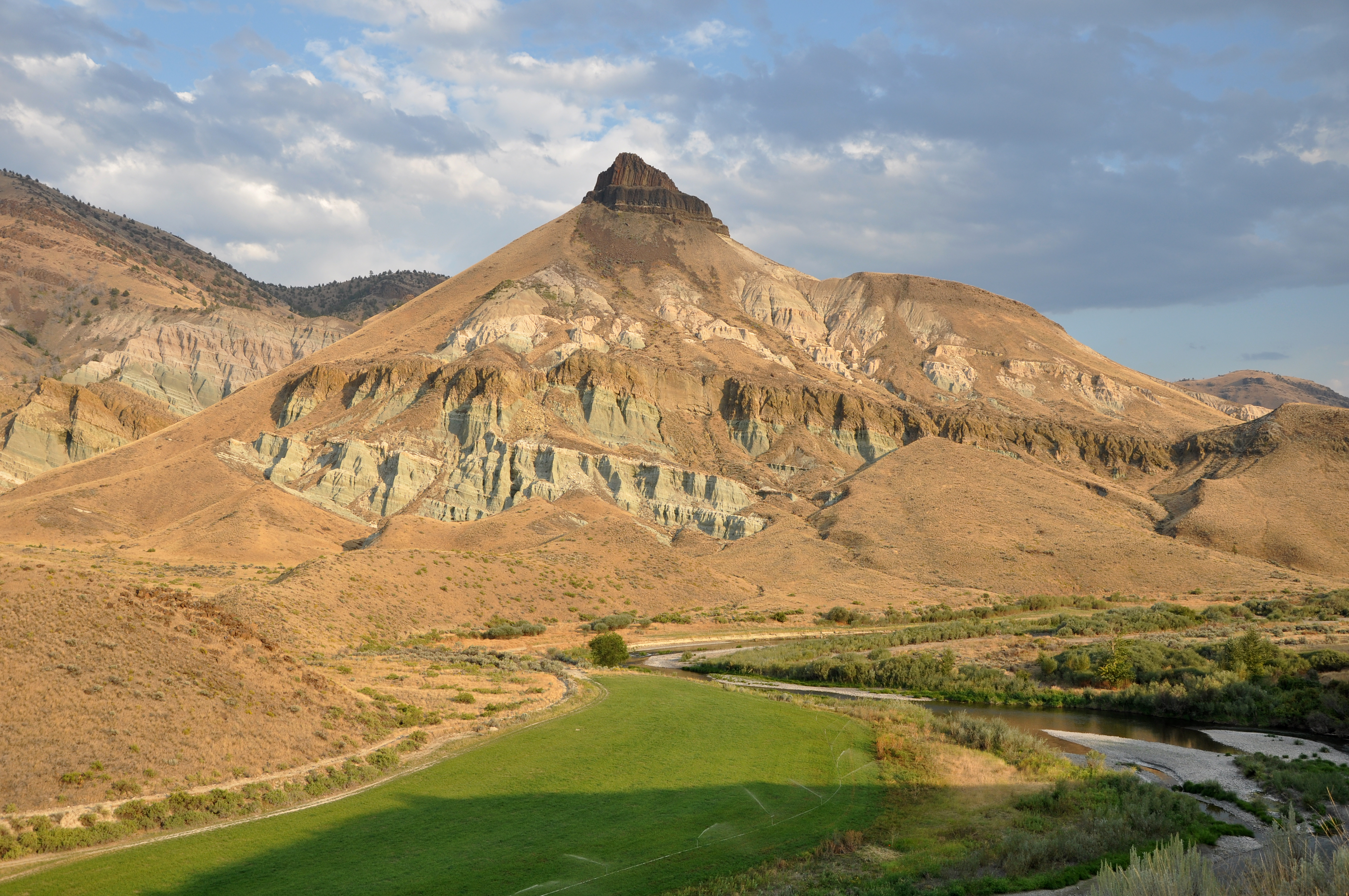
The colors are wrong for Oregon. Red and gold and cream stripe the hillsides like a fever dream, layers of volcanic ash that trapped entire ecosystems as they fell. The Painted Hills of John Day preserve 40 million years of life in bands of claystone, each color a different age, a different climate, a different world. Here paleontologists have uncovered evidence of subtropical forests where Oregon's high desert now stands, of three-toed horses and saber-toothed cats, of a land transformed beyond recognition by volcanoes and time. The Thomas Condon Paleontology Center houses one of the most complete fossil records of the Cenozoic Era anywhere on Earth.
Written in Stone
The monument sprawls across three separate units, each preserving a different chapter of deep time. At the Clarno Unit, 44-million-year-old lakebeds contain remnants of a near-tropical climate, petrified wood from trees related to those now found in Southeast Asia. The Painted Hills Unit displays the transition from forest to grassland in bands of red, tan, and black, iron-rich soils oxidized to rust, manganese darkening to shadow. The Sheep Rock Unit preserves the most recent layers, a mere 7 million years old, where fossils of horses, camels, and early dogs tell the story of mammals adapting to a cooling, drying world. Three units, three ages, one continuous record of planetary change.
Life Between Eruptions
Volcanoes built this archive. When ancient calderas exploded, they buried entire forests in ash that would harden to tuff and claystone. A 2003 study identified petrified woods from at least 173 species at the Clarno Unit alone, including relatives of walnut, laurel, and even banana. The Nut Beds formation preserves fruits and seeds in such detail that botanists can trace the ancestry of modern plants. Between eruptions, life flourished. Eocene forests supported early primates and ancestors of modern rhinoceroses. As the climate dried over millions of years, these jungles gave way to savannas, then to the sagebrush steppe that dominates today. Each layer is a snapshot, a world frozen in volcanic glass.
The Living Desert
More than 80 soil types now support a surprising diversity in these painted badlands. A black cryptobiotic crust, composed of algae, lichens, mosses, fungi, and bacteria, holds the soil together, stores water, and fixes nitrogen for the plants that follow. Bighorn sheep, reintroduced to the Foree Area in 2010 after vanishing in the early 20th century, pick their way across rocky outcrops. Chinook salmon and steelhead pass through the Sheep Rock Unit via the John Day River, the longest undammed tributary of the Columbia. More than 50 bird species nest or migrate through, from red-tailed hawks circling thermals to mountain bluebirds flashing across the sagebrush. The fossil beds are not merely a museum of the dead.
Thieves and Time
Fossil theft is an ongoing problem. The paleontology center exists partly to protect what remains, its laboratory visible through windows where visitors can watch scientists extract specimens from stone. The monument holds over 40,000 catalogued fossils, with thousands more awaiting preparation. Some of the most significant finds, evidence of the earliest true beaver, early oreodont herds, and ancient bear-dogs, came from these hills. Yet for every specimen collected, erosion exposes more, weathering out of the soft claystones at a rate that both reveals and destroys. Entrance is free, trails are open year-round, but digging is forbidden. The rocks give up their secrets slowly, to those with patience and proper training.
From the Air
Located at 44.55N, 119.63W in Wheeler and Grant Counties, Oregon. The monument consists of three separate units spread across 60 miles of the John Day River basin. The Painted Hills Unit is most visually distinctive from the air, with red and gold striped badlands visible from 10,000 feet. Best viewing in early morning or late afternoon light when shadows accentuate the color bands. Nearest airports include Grant County Regional (KGCD) in John Day, 30nm southeast, and Redmond Municipal (KRDM) 90nm west. The John Day River is the prominent linear feature connecting the units.