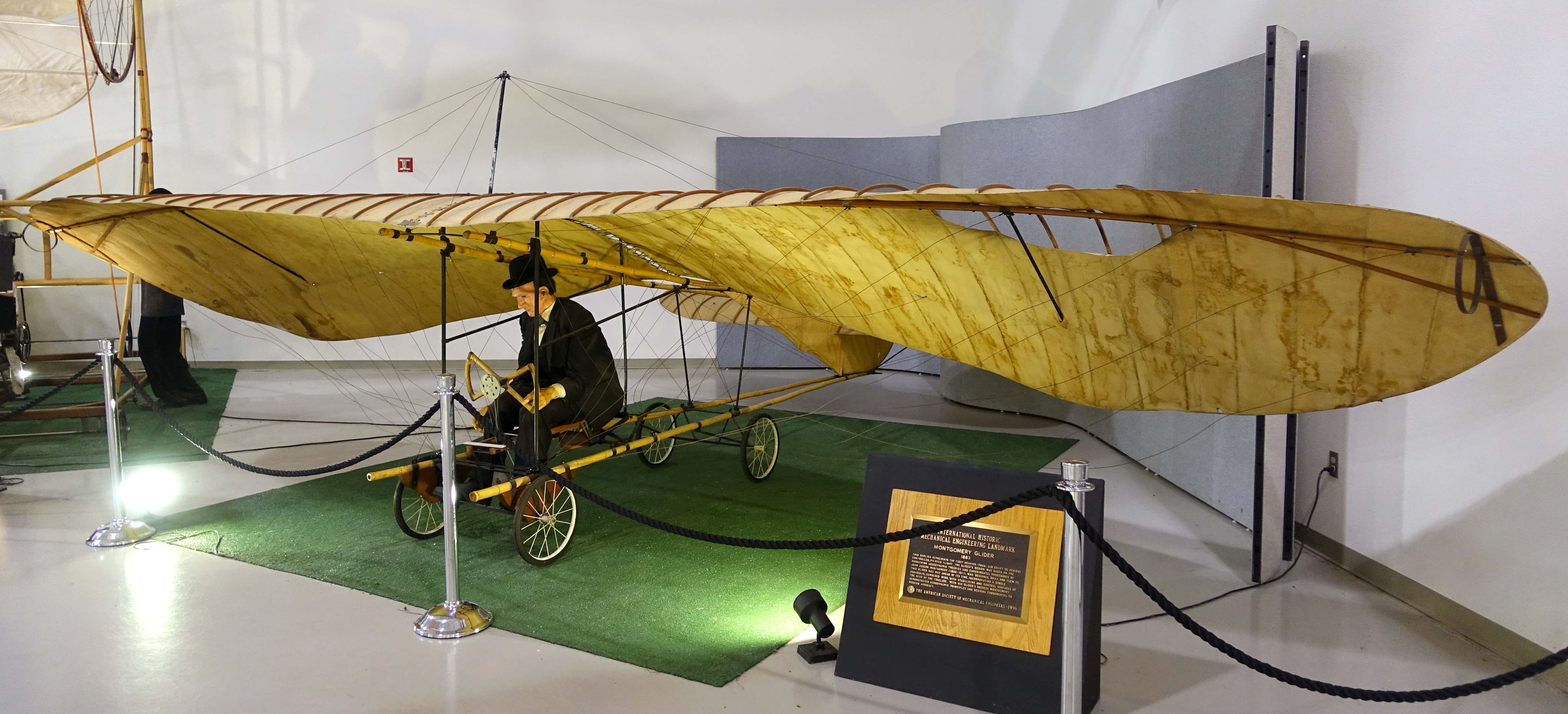
John Joseph Montgomery
Twenty years before Kitty Hawk, a young rancher soared off a hilltop near San Diego in a glider of his own design. John Joseph Montgomery made what many consider the first controlled heavier-than-air flights in the Western Hemisphere in 1883, yet his name is largely forgotten outside aviation history circles. He spent his life chasing the science of flight with a professor's rigor and a daredevil's appetite for risk, and in the end, the sky he loved killed him.
The Otay Mesa Flights
Montgomery was born on February 15, 1858, in Yuba City, California, to a family that valued education and invention. He studied physics at St. Ignatius College in San Francisco (now the University of San Francisco) and later at Santa Clara College, where he would eventually teach. His fascination with bird flight led him to build a series of gliders beginning in the early 1880s. In 1883, at Otay Mesa near San Diego, Montgomery launched himself from a hillside in a monoplane glider, achieving controlled flight, including turns, at a time when most scientists considered heavier-than-air flight impossible. These flights predated the Wright Brothers' first powered flight by a full twenty years. The distance was modest, but the principle was proven: a curved wing could generate lift, and a pilot could control direction.
The Santa Clara Aeronaut
Montgomery spent the next two decades refining his understanding of aerodynamics through careful experimentation. He became a professor of physics at Santa Clara College, where he continued building and testing gliders. By 1905, he had developed a tandem-wing glider sophisticated enough for public demonstration. On March 16, 1905, professional aeronaut Daniel Maloney ascended to 4,000 feet beneath a hot air balloon at Santa Clara, then released the glider and flew it back to earth in a controlled descent that lasted nearly twenty minutes. The demonstration amazed witnesses and drew national press coverage. Alexander Graham Bell reportedly called it "the most daring feat ever attempted." Montgomery continued pushing the boundaries, conducting increasingly ambitious flights that demonstrated banking turns, figure-eight patterns, and precise landings.
A Fatal Descent
On October 31, 1911, Montgomery took off in his own glider from a ranch near San Jose. Something went wrong at low altitude, possibly a structural failure or a sudden gust, and the glider crashed. Montgomery died from his injuries, just two years before the start of World War I would transform aviation from curiosity to military necessity. He was 53. His contributions to understanding wing curvature and aerodynamic control surfaces were real and significant, even if history's spotlight settled on the Wright Brothers' powered flight rather than his earlier gliding achievements. The city of San Diego later named Montgomery Field airport in his honor, and a monument marks the approximate site of his 1883 flights at Otay Mesa.
Legacy in the Margins
Montgomery's story raises an uncomfortable question about how we assign credit for invention. The Wright Brothers achieved powered, sustained, and controlled flight in 1903, a different and arguably more significant milestone than Montgomery's unpowered glides. But Montgomery's work on wing curvature and aerodynamic control predated theirs and contributed to the broader understanding that made powered flight possible. Santa Clara University maintains his papers and considers him one of its most distinguished alumni. His life arc, from rancher's son to physics professor to aviation pioneer to fatal crash, captures both the romance and the cost of pushing into the unknown.
From the Air
Montgomery's connection to San Francisco centers on his education at St. Ignatius College (now USF) at approximately 37.78°N, 122.45°W, and his teaching career at Santa Clara College to the south. Montgomery Field (KMYF) in San Diego is named for him. Nearest SF airports: SFO (KSFO), Oakland (KOAK). The Santa Clara area where he conducted his 1905 demonstrations is visible from altitude in the South Bay.