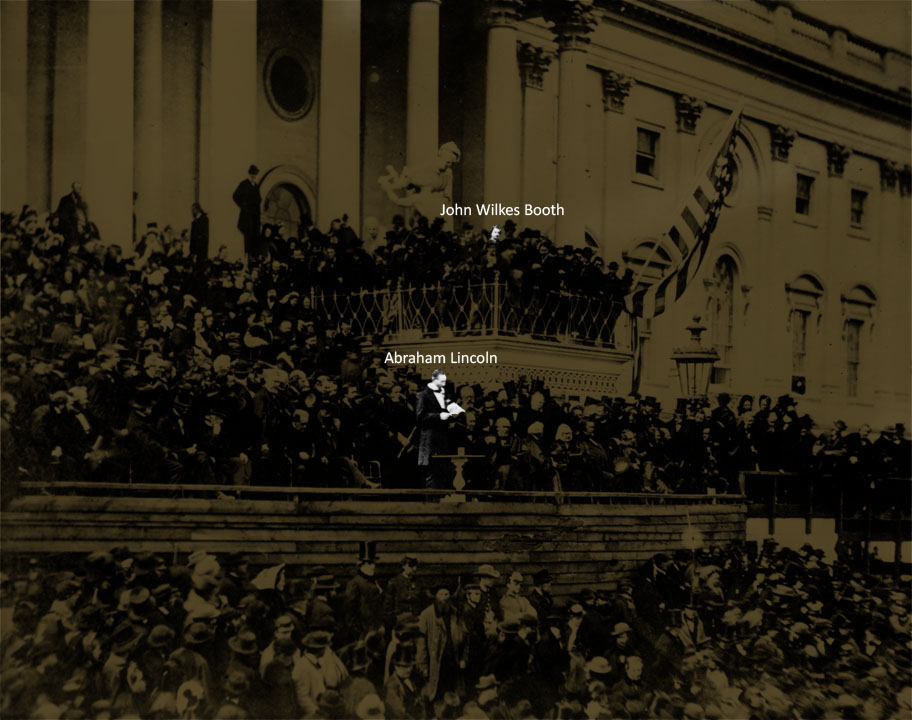
John Wilkes Booth
A Romani fortune-teller once read the palm of a boy at a Maryland boarding school and told him he would have a grand but short life, doomed to die young and meet a bad end. The boy wrote the prediction down, showed it to his family, and returned to it often in dark moods. His name was John Wilkes Booth, and the prophecy would prove devastatingly accurate. Here, at a farm near Port Royal, Virginia, the 26-year-old actor-turned-assassin breathed his last on April 26, 1865, twelve days after firing the shot that killed Abraham Lincoln and plunged a nation already shattered by civil war into unfathomable grief.
The Handsomest Man in America
Before he became the most wanted man in the country, John Wilkes Booth was one of its brightest theatrical stars. Born in 1838 in a four-room log house near Bel Air, Maryland, the ninth of ten children, he inherited his craft from his father Junius Brutus Booth, a renowned British Shakespearean actor who had eloped to America with his mistress in 1821. Young Booth was athletic, popular, and skilled at horsemanship and fencing, though indifferent in the classroom. He made his stage debut at 17 in Baltimore, fumbling his lines as the Earl of Richmond in Richard III. But he improved fast. Critics called him a natural genius with an astonishing memory. Walt Whitman observed flashes of real genius in his performances. By the late 1850s, Booth was earning $20,000 a year and filling theaters from New York to New Orleans with his acrobatic, intensely physical style of acting.
A House Divided Against Itself
The Booth family mirrored the fractured nation. Brother Edwin became the North's most celebrated actor and a staunch Unionist. John Wilkes burned with devotion to the Confederate cause, publicly calling Southern secession heroic and clashing bitterly with Edwin over politics. He attended the hanging of abolitionist John Brown in 1859, donning a borrowed militia uniform to get close to the scaffold. He smuggled quinine to the South through Union blockade lines. He drafted speeches supporting slavery that he apparently never delivered. And as Lincoln won reelection in November 1864 on a platform of abolishing slavery by constitutional amendment, Booth's rage curdled into something far more dangerous. He assembled a band of Confederate sympathizers and began plotting to kidnap the president.
Good Friday, 1865
When Robert E. Lee surrendered at Appomattox on April 9, 1865, Booth abandoned kidnapping for assassination. On the morning of April 14, Good Friday, he stopped at Ford's Theatre to collect his mail and learned that Lincoln would attend that evening's performance of Our American Cousin. Booth knew every corridor and doorway of the theater. At 10:14 that night, he slipped into the presidential box and fired a .44 caliber Philadelphia Deringer pistol into the back of Lincoln's head. He stabbed Major Henry Rathbone when the officer lunged at him, then leaped to the stage, injuring his leg when his spur snagged a flag. Lincoln died the next morning. Booth fled on horseback into the darkness of southern Maryland, where Confederate sympathizers and dense swamps offered cover.
Twelve Days on the Run
Booth and his companion David Herold rode south through a landscape without telegraphs or railroads, relying on a Confederate underground network that had operated in Charles and St. Mary's Counties throughout the war. They stopped at Dr. Samuel Mudd's home for treatment of Booth's injured leg, then hid in woods and swamps as federal troops combed the countryside. The War Department posted a $100,000 reward. Meanwhile, Lincoln's nine-car funeral train departed Washington on a thirteen-day journey to Springfield, Illinois, as seven million mourners lined the railroad tracks. Booth wrote in his diary of his dismay that even Southern newspapers condemned his act. Confederate General Joseph E. Johnston called it a disgrace to the age. The hero's welcome Booth had imagined never materialized.
The Garrett Farm
On April 26, 1865, federal soldiers tracked Booth and Herold to a tobacco barn on the Garrett farm near Port Royal, Virginia. Herold surrendered, but Booth refused. The soldiers set the barn ablaze. Through the firelight, Union Sergeant Boston Corbett fired a single shot that struck Booth in the neck, severing his spinal cord. Paralyzed and dying, Booth was dragged onto the farmhouse porch. He asked that his hands be lifted to his face so he could see them. Looking at his useless fingers, the actor who had lived for the stage whispered his last words: "Useless, useless." He was twenty-six years old. Of the eight conspirators later convicted, four were hanged. The patch of Virginia countryside where Booth's grand and terrible story ended remains a quiet place, its fields and tree lines little changed from that spring morning when a nation's fury finally caught up with its most notorious fugitive.
From the Air
Located at 38.14°N, 77.23°W near Port Royal, Virginia, along the Rappahannock River in rural Caroline County. The Garrett farm site where Booth died is in flat agricultural country south of Fredericksburg. The Rappahannock River is the prominent waterway to the north. Nearest airports: Shannon Airport (KEZF) in Fredericksburg approximately 20nm north, Stafford Regional Airport (KRMN) approximately 25nm north-northwest. The area is characterized by open farmland, scattered woodlots, and small rural roads with few distinguishing landmarks from altitude.