Johnson Space Center
It started with 45 people -- 37 engineers, eight secretaries and human 'computers' who ran calculations on mechanical adding machines. The Space Task Group, tucked inside the Langley Research Center in Hampton, Virginia, was supposed to put Americans in orbit. Nobody imagined it would need an entire city. But when President Kennedy declared in 1961 that the nation would reach the Moon before the decade was out, NASA's first administrator realized this scrappy team would need its own home. What followed was one of the most consequential real estate decisions in American history: a hundred buildings on land where cattle had grazed just months before, rising from the Texas coastal plain to become the command center for humanity's greatest explorations. Houston earned its official nickname -- Space City -- in 1967, and it has never let go.
A Pasture Becomes a Launchpad
The search for a new home began with a list of 22 cities and a set of demanding requirements: water access for barge transport, moderate climate, commercial jet service, an established industrial base, proximity to a university, and strong utilities. A site-selection team led by John F. Parsons narrowed the field to nine cities with nearby federal facilities, then expanded to 23 candidates. Tampa's MacDill Air Force Base was the first choice -- until the Air Force decided not to close its operations there. That moved the Houston site, adjacent to Clear Lake near Galveston Bay, to first place. The land had been donated to Rice University by the Humble Oil company, and it was still being used to graze cattle when NASA came calling. As Texas A&M historian Henry C. Dethloff noted, Texas political muscle sealed the deal: Vice President Lyndon Johnson headed the Space Council, Albert Thomas chaired House Appropriations, and Sam Rayburn was Speaker of the House. Construction began in April 1962, designed by architect Charles Luckman.
Where Kennedy Chose the Moon
In September 1962, with construction underway and staff already relocating to 11 scattered temporary sites across Houston, President Kennedy visited Rice University to deliver what became one of the most famous speeches in American history. 'We choose to go to the Moon in this decade and do the other things,' he told the crowd, 'not because they are easy, but because they are hard.' Kennedy also referenced the new center rising from the Texas flatlands. The facility officially opened for business in September 1963, and by then it was already the operational heart of American spaceflight. Building 30 housed the Mission Control Center that would guide every crewed mission from Gemini 4 forward. The Lunar Receiving Laboratory quarantined the first astronauts returning from the Moon and stored the majority of lunar samples. A complete Saturn V rocket -- assembled from actual surplus flight-ready hardware, including command and service modules intended for the canceled Apollo 19 mission -- still stands on display.
Triumph and Tragedy on NASA Parkway
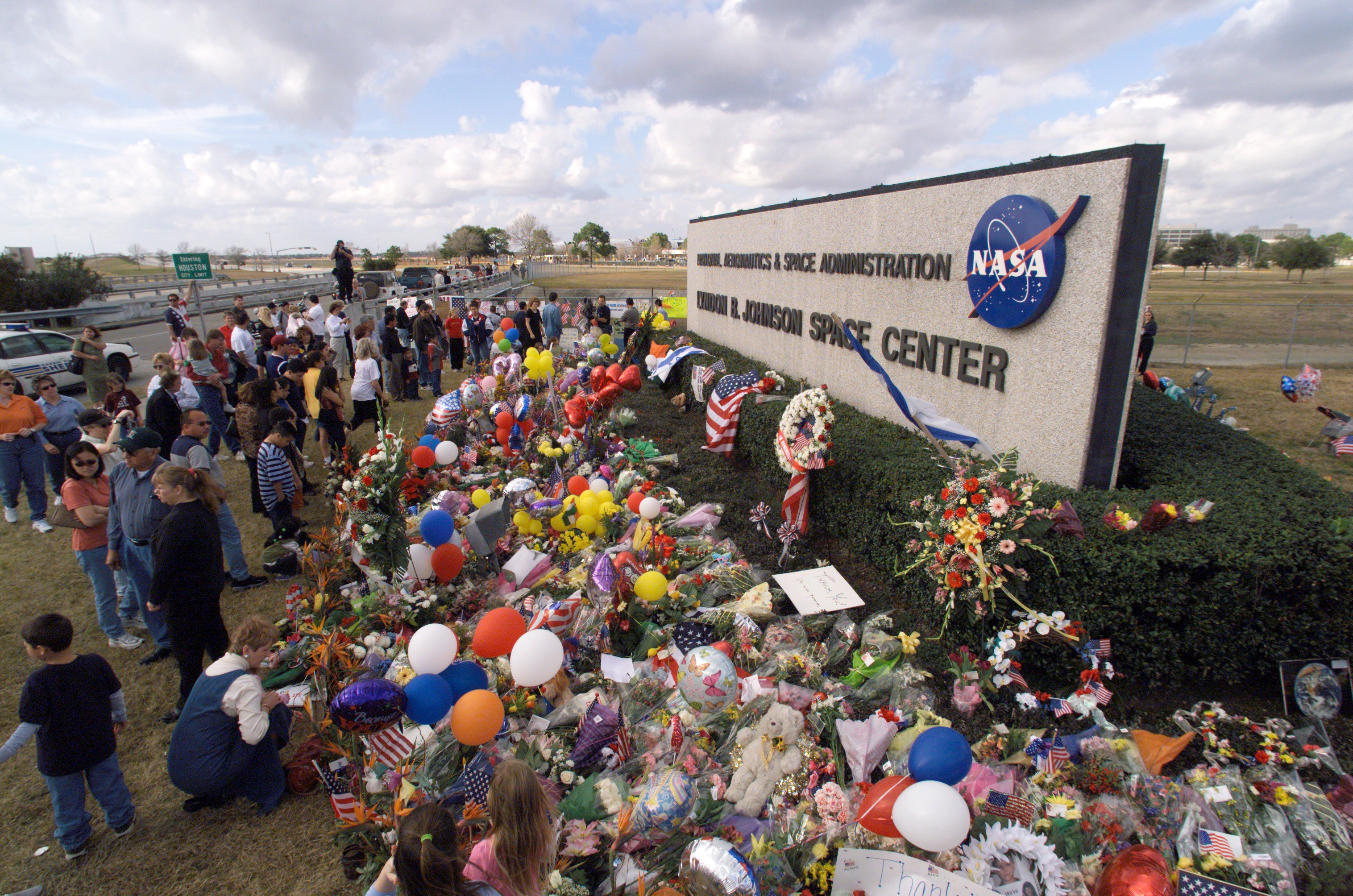
Johnson Space Center has witnessed both the highest triumphs and deepest sorrows of the space program. On January 31, 1986, three days after the Challenger disaster, President Ronald Reagan traveled to JSC for a memorial attended by 6,000 NASA employees and 4,000 guests. An Air Force band led 'God Bless America' as T-38 Talon jets flew the missing-man formation overhead. Seventeen years later, on February 4, 2003, President George W. Bush spoke at a similar service for the Columbia astronauts, held just three days after the shuttle broke apart during reentry. In September 2008, Hurricane Ike struck as a Category 2 storm and damaged roofs on several hangars at nearby Ellington Field, though the Mission Control Center itself sustained only minor damage. Four weeks after President Lyndon Johnson's death in January 1973, President Nixon signed a Senate resolution renaming the Manned Spacecraft Center in his honor -- fitting, since Johnson had sponsored the 1958 legislation that created NASA.
Training Astronauts for the Unknown
Today, approximately 3,200 civil servants and over 11,000 contractors work at JSC, including about 110 active astronauts. Every American astronaut trains here, mastering spacecraft systems and basic sciences from orbital dynamics to oceanography. Candidates must complete military water survival training and become scuba-qualified for extravehicular activity practice at the Sonny Carter Training Facility and its Neutral Buoyancy Laboratory, a massive underwater facility that simulates weightlessness. The center's Astromaterials Research and Exploration Science office conducts research in earth, planetary, and space sciences, while a $120-million partnership with the National Space Biomedical Research Institute at Baylor College of Medicine studies the health risks of long-duration spaceflight. The Memorial Grove near the main entrance honors astronauts, center directors, and employees with dedicated trees -- a quiet forest of remembrance on the campus that gave humanity its wings beyond Earth.
From the Air
Johnson Space Center sits at 29.558N, 95.089W on the western shore of Clear Lake, southeast of Houston proper. The campus of roughly 100 white buildings is clearly visible from the air, bordered by NASA Parkway to the north. Look for the Saturn V rocket display at the Space Center Houston visitor complex on the campus's east side. Ellington Field (KEFD) is approximately 5nm northwest. William P. Hobby Airport (KHOU) lies 15nm to the northwest, and George Bush Intercontinental (KIAH) is 30nm north. Clear Lake and Galveston Bay to the east provide excellent visual orientation. Best viewed at 2,000-4,000 feet AGL.
Sources
- Wikipedia - Space Task Group
- JFK Library - Address at Rice University, 12 September 1962
- NASA - 50 Years Ago: Manned Spacecraft Center Renamed Johnson Space Center
- Wikipedia - Nicknames of Houston
- Reagan Library - Remarks at Memorial Service for Challenger Crew at JSC
- White House Archives - President Bush Attends Columbia Memorial at JSC
- Wikipedia - Effects of Hurricane Ike in Texas