Johnson Wax Headquarters
Frank Lloyd Wright called the previous architect's design a crematorium. It was 1936, and Hibbert Johnson, the chief executive of S.C. Johnson & Son, had just shown Wright the plans for a new office building in Racine, Wisconsin. Wright promised something radically different, offered to do it for $200,000, and was hired less than a month before construction was supposed to begin. The building that emerged three turbulent years later - through labor strikes, budget overruns, fistfights over Pyrex skylights, and a near-resignation by Wright himself - would redefine what a workplace could look like. Today, the Johnson Wax Headquarters stands as one of the most celebrated pieces of commercial architecture in American history, a National Historic Landmark that still functions as a working office.
A Forest of Concrete Lily Pads
Step inside the Administration Building's great workroom and the ceiling disappears. In its place float dozens of concrete dendriform columns - slender stems nine inches wide at their base that swell into broad circular 'calyxes' eighteen feet above the floor. Wright called them lily pads. Wisconsin building inspectors called them structurally impossible. When the state refused to approve the thin columns, Wright staged a public load test, piling twelve tons of sand and pig iron onto a single column - five times the required load. The column held. He ordered workers to keep piling. At sixty tons it still stood. Wright had to order it pulled down because no one could safely remove the weight. The inspectors relented. Between these columns, bands of Pyrex glass tubing replace traditional windows, filling the space with diffused natural light while eliminating any view of the outside world. Wright wanted workers focused on each other, not on the street.
The Architect and the Executive
The relationship between Wright and Hibbert Johnson was a collision of egos held together by mutual ambition. Hibbert's son Samuel later explained the impulse: his father 'was tired of us being seen as a little old family enterprise in a little town in the Midwest.' Wright, who had designed just two buildings in the previous five years, was equally hungry. He tried to convince the company to relocate to the suburbs. When his wife Olgivanna warned him that Johnson might fire him for pushing too hard, Wright finally dropped the idea. Construction became a theater of confrontation. Wright spent an entire year adjusting the details of the glass tubes for the facade. He revised plans for the squash court and cafeteria with little warning, halting all work. When Hibbert secretly ordered standard glass skylights to replace the Pyrex ones Wright insisted upon, Wright threatened to resign. Hibbert fired the site supervisor who leaked the substitution, then rehired him and accepted the Pyrex after Wright held firm. The building's original $200,000 budget ballooned considerably before completion.
The Tower That Couldn't Stay Open
Hibbert liked what Wright built so much that he hired him again in 1945 to design a Research Tower. Completed in 1950, the fifteen-story structure is an engineering marvel: alternating square floors and circular mezzanines cantilever outward from a single central core, like branches from a tree trunk. Pyrex glass tubes wrap the exterior, matching the Administration Building. Inside, S.C. Johnson's scientists developed new products for decades. But the tower's innovative design became its undoing. By 1982, safety concerns forced its closure - the cantilevered floors and single-core structure made modern fire codes impossible to satisfy. The tower stood empty for over thirty years before partially reopening for guided tours in 2014. Visitors can now walk through the space where chemists once formulated household products, looking out through the same glass tubes that Wright fought so hard to install.
A Campus That Keeps Growing
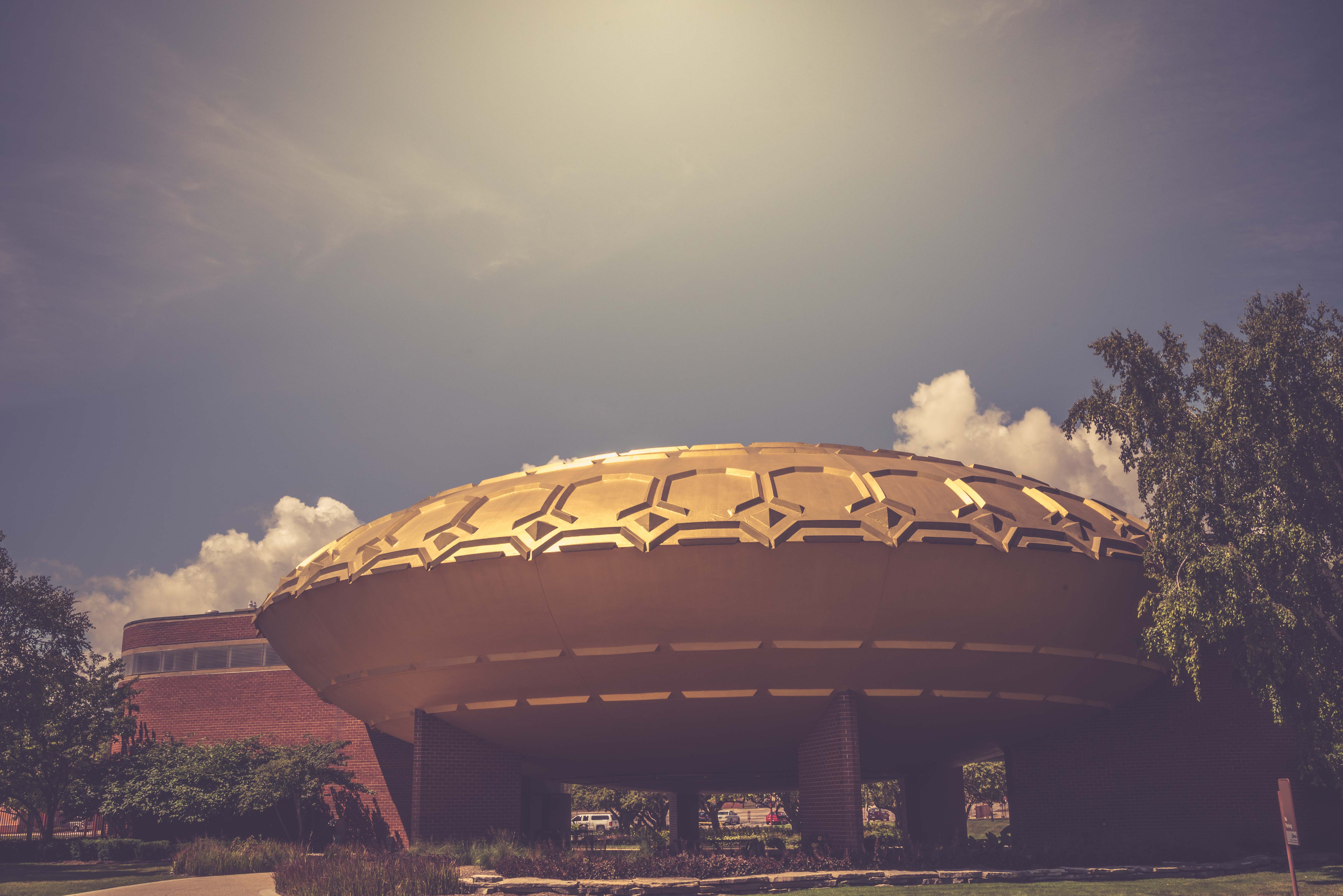
The Johnson Wax campus has continued evolving long after Wright's death in 1959. The Golden Rondelle Theater arrived in 1967, relocated from the 1964 New York World's Fair. Its saucer-shaped, gold-colored roof supported by six concrete columns sits just north of the original campus, flanked by brick structures with glass-tube windows designed by Taliesin Associated Architects. In 2010, Foster + Partners completed Fortaleza Hall, a memorial to Samuel Curtis Johnson Jr. Named for the Brazilian city where Hibbert Johnson had flown his Sikorsky S-38 biplane in 1935, the building houses a replica of that aircraft inside a spherical atrium. In 2021, Waxbird Commons opened next door - named after another company airplane - featuring solar roofing and geothermal heating. A large plastic globe, first built in 1954 and once reported as the largest of its kind in the world, still marks the campus. Architecture here isn't a backdrop; it's the company's identity.
Racine from Above
From the air, the Johnson Wax campus occupies a compact city block at 1525 Howe Street in Racine, bounded by 15th and 16th streets. The Research Tower's narrow vertical profile rises unmistakably above the surrounding residential neighborhood - a fifteen-story exclamation point amid low-rise houses. The curved brick walls of the Administration Building contrast sharply with the rectangular grid of Racine's streets. To the north, the Golden Rondelle's disc-shaped roof catches sunlight. Fortaleza Hall's spherical atrium glints beside it. Racine itself sits on the western shore of Lake Michigan, about thirty miles south of Milwaukee. The city's lakefront and the Root River channel are visible landmarks for orienting toward the campus.
From the Air
Coordinates: 42.7136N, 87.7908W. The Johnson Wax campus sits at 1525 Howe Street in Racine, Wisconsin, roughly 30 miles south of Milwaukee along the Lake Michigan shoreline. The Research Tower's 15-story vertical profile is the most visible feature from altitude, rising distinctly above the low-rise residential neighborhood. Best viewed at 2,000-3,000 feet AGL. Nearest major airport: Milwaukee Mitchell International (KMKE), 22nm north. Racine's John H. Batten Airport (KRAC) is approximately 5nm southwest of the campus. Lake Michigan's western shoreline provides clear orientation. The Root River channel runs through Racine to the lake.