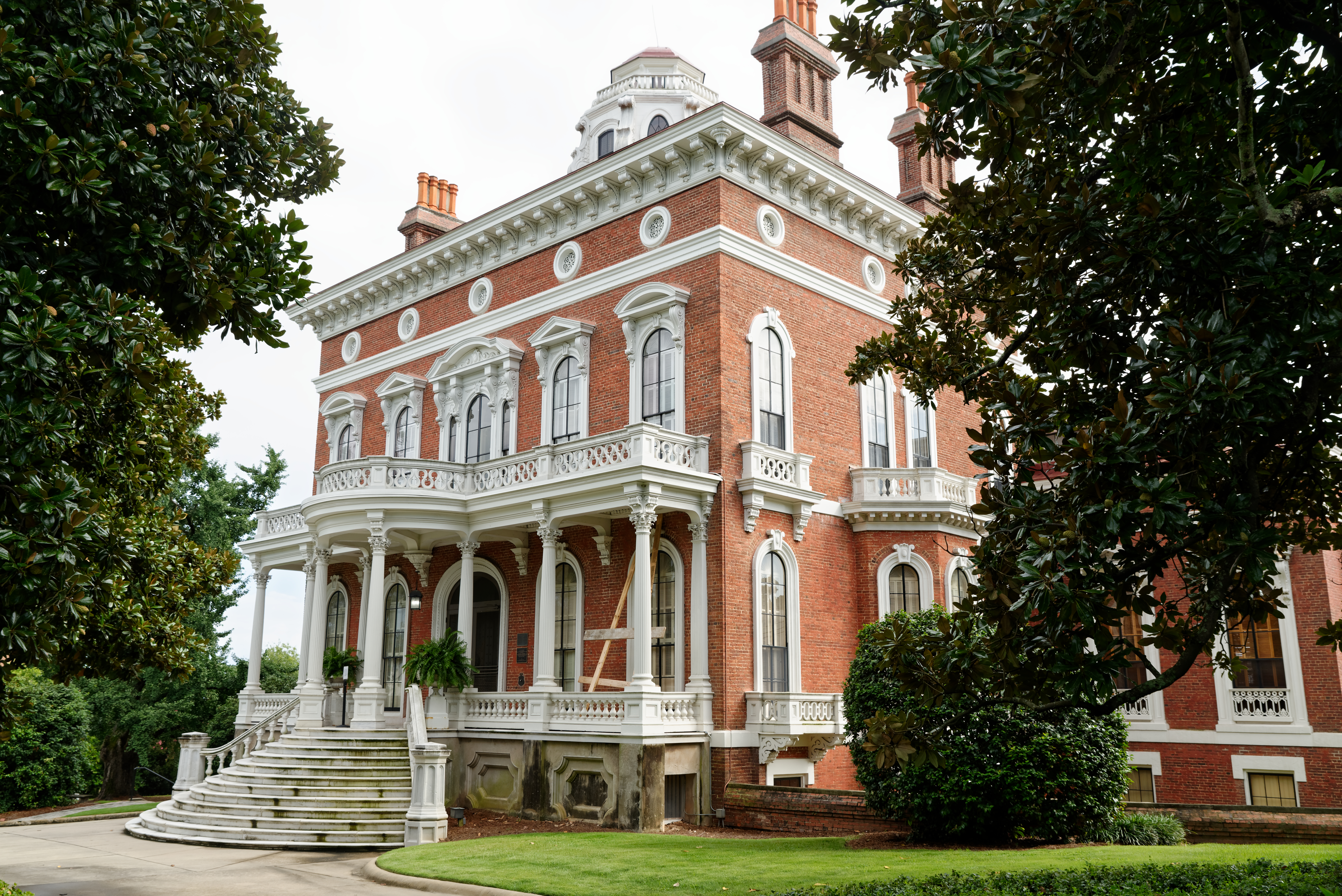
Johnston–Felton–Hay House
They called it the "Palace of the South," and the name was not hyperbole. Perched atop Coleman Hill in downtown Macon, Georgia, the Johnston–Felton–Hay House commands attention the way only a building of supreme confidence can. William Butler Johnston and his wife Anne Tracy Johnston spent four years—from 1855 to 1859—constructing this 24-room Italian Renaissance Revival mansion, importing craftsmen and artisans from Italy to execute their vision. The New York architecture firm T. Thomas and Son drew the plans. Local master builder James B. Ayers oversaw the construction. The result was something Georgia had never seen: a residence so grand, so technologically advanced, and so unapologetically ambitious that it earned a National Historic Landmark designation in 1974 and continues to draw 20,000 visitors a year.
Ambition in Antebellum Georgia
The Johnstons did not build a house. They built a statement. In the late 1850s, while most Southern mansions relied on Greek Revival columns and plantation symmetry, the Johnstons looked to the Italian Renaissance for inspiration. The 24-room residence at 934 Georgia Avenue rose on Coleman Hill with views stretching across Macon, just steps from what would become Mercer University's Walter F. George School of Law. Inside, the home featured innovations that were extraordinary for its era, including an elaborate 8,000-gallon water tank system that represented cutting-edge domestic technology. Italian craftsmen shaped the ornamental details—the stained glass windows, the spiraling staircase visible from the cupola, the porcelain collections that filled its rooms. Every surface carried intention. Every room told a story of a family that believed beauty and engineering could coexist under one roof.
Three Families, One Legacy
The house's triple-barreled name reflects the three families who called it home. The Johnstons built it. The Feltons lived in it next. And the Hay family gave it the name that stuck—Hay House. When Mrs. P.L. Hay died, her heirs established the P.L. Hay Foundation and opened the mansion as a private house museum, ensuring that this singular creation would survive the decades. In 1977, ownership transferred to the Georgia Trust for Historic Preservation, an act that secured the building's future against the forces of neglect and time. Each family left its mark on the rooms, the furnishings, and the landscape. Some of the plantings surrounding the house date back to the 19th century, living witnesses to the generations that passed through these halls.
Preservation as an Ongoing Act
Keeping a 160-year-old mansion alive is not a single event but an endless commitment. The Georgia Trust launched a $7 million capital campaign, allocating half to the restoration of the exterior, cupola, and most public rooms. Workers have repaired the porch, stairs, and masonry. Conservators have tended the stained glass. UV protection now shields the windows. The ground floor, attic, and cupola have all been restored. One particularly striking project illuminated the interior of the 8,000-gallon water tank, turning a piece of 19th-century infrastructure into a display of technological ingenuity. In 2000, the White House Millennium Council designated Hay House an Official Project of Save America's Treasures, placing it alongside the nation's most important preservation efforts. Researchers continue to study original furnishings and decorations, working to restore wall coverings, paint finishes, and furniture upholstery to match the Hay family's era of residence.
The Palace Finds the Spotlight
Hay House has always attracted attention, but it found an unexpected moment in popular culture when the mansion served as the filming location for the debutante ball scene in the 2020 film Borat Subsequent Moviefilm. The ornate interiors—the kind of rooms that make you stand a little straighter when you enter—provided the perfect backdrop for the film's satirical take on Southern high society. It was a reminder that this house, built in earnest by people who believed in the transformative power of architecture, still has the ability to surprise. Today, daily tours guide visitors through a building that is simultaneously a museum, a monument to craftsmanship, and one of Macon's most popular tourist attractions. The stained glass catches the Georgia sunlight. The spiral staircase draws the eye upward. And Coleman Hill holds its ground, as it has since 1859, overlooking a city that grew up around a palace.
From the Air
Located at 32.840°N, 83.634°W in downtown Macon, Georgia. The mansion sits prominently atop Coleman Hill and is visible at lower altitudes. Nearby airports include Middle Georgia Regional Airport (KMCN) approximately 9 nm south. The Ocmulgee River runs nearby to the east, providing a useful visual reference. Best viewed below 3,000 feet AGL in clear conditions for detail of the roofline and cupola.