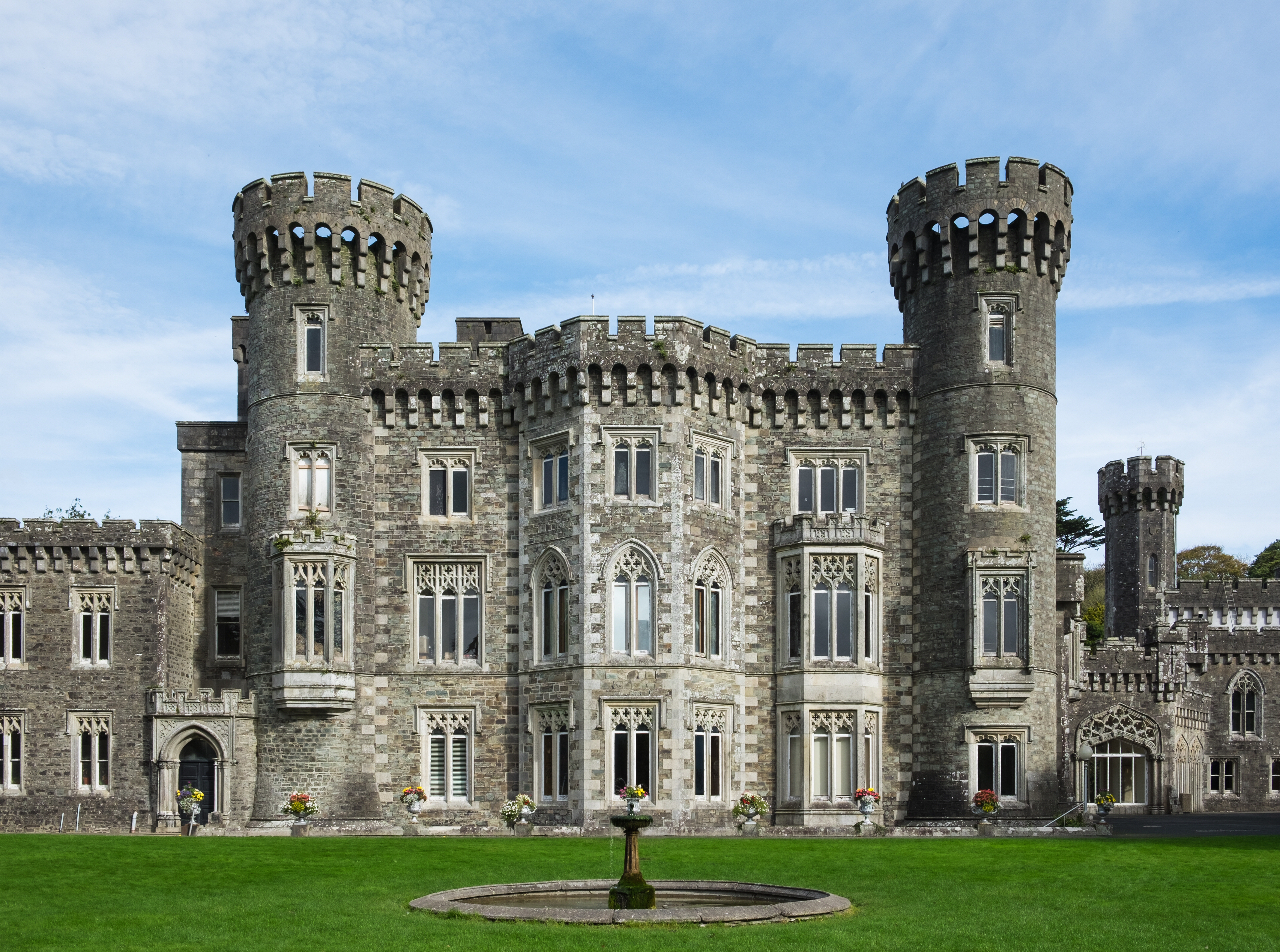
Johnstown Castle
Cornelius Grogan was hanged in 1798 for his role in the Irish Rebellion. He had served as commissary-general for the United Irishmen, and the British authorities made an example of him. His family's castle in County Wexford was seized. Eleven years later, the estate was restored to his brother, who set about transforming it into one of Ireland's most extravagant Gothic Revival showpieces. Johnstown Castle is that rare building whose beauty was born directly from political catastrophe -- a rebel's home remade as an aristocratic fantasy.
Eight Centuries of Owners
The Esmonde family, Normans from Lincolnshire, built the first tower house on this site in the late 12th century, shortly after the Norman invasion of Ireland in 1169. They held it for five centuries until Cromwell's forces arrived. Oliver Cromwell himself spent a night at the estate in 1649, using the surrounding land to prepare his army for the Sack of Wexford that October. The Catholic Esmondes were expelled during the Cromwellian years, and the castle passed through various hands before the Grogan family purchased it in 1692. The Grogans later married into the ancient FitzGerald dynasty, one of the most powerful Norman-Irish families, connecting Johnstown to a lineage that stretched back to the Dukes of Leinster.
The Castle Reimagined
After the 1798 Rebellion and Cornelius Grogan's execution, the estate was returned to his brother John Knox Grogan in 1810. Father and son -- John Knox and Hamilton Knox Grogan-Morgan -- embarked on a decades-long transformation. Architect Daniel Robertson designed a Gothic Revival castle that rose from the bones of the original Norman tower house, which still stands within the fabric of the building. By the 1860s, the 150-acre demesne was divided into a deer park in the north and pleasure grounds, farm, and two artificial lakes to the south. Inside, the castle featured the Apostles' Hall, with wood carvings of saints, oil paintings, carved oak benches, and mahogany billiard tables. An 86-meter servants' tunnel connected the meat house to the kitchens, keeping the domestic machinery invisible to the family above.
Airships and Endings
During the First World War, Johnstown Castle took on an unlikely military role. Royal Naval Air Service airships were based on the estate, tasked with hunting German U-boats in the waters off Ireland's southeast coast. Their success was limited, but the image is arresting: lighter-than-air warships floating above a Gothic Revival fantasy, scanning the Celtic Sea for submarines. The last private owner to live in the house was Lady Maurice FitzGerald, born Adelaide Jane Frances Forbes in 1860. After her death in 1942, the estate passed to her grandson, who sought to sell. Wexford's county manager recommended the State acquire it for an agricultural college. On May 1, 1944, the castle's contents were sold at a five-day public auction. The Johnstown Castle Agricultural College Act was ratified on October 17, 1945, and the estate was formally handed to the State in lieu of death duties.
From Soil Labs to Open Doors
For decades, Johnstown Castle served science rather than society. The Department of Agriculture, later Teagasc, used the Gothic halls as laboratories for soil research -- an almost comically prosaic use for a building designed to awe. The former stable yard was converted into the Irish Agricultural Museum. It was not until 2019 that the castle opened its doors to the public for the first time, following extensive renovation managed by the Irish Heritage Trust. Visitors can now walk through the rooms where the Grogans entertained, where Lady Maurice FitzGerald lived out her final years, and where scientists spent decades studying the composition of Irish earth. The artificial lakes reflect the castle's turrets and towers in water that is perfectly still on calm days, creating the postcard image that draws visitors from Wexford town, just five and a half kilometers away. Conservation work continues. The Norman tower house that started it all, eight centuries old and counting, still stands inside the Gothic shell, hidden but unbroken.
From the Air
Johnstown Castle is located at 52.293N, 6.505W in County Wexford, 5.5 km southwest of Wexford town. From the air, the Gothic Revival castle is dramatically visible beside two artificial lakes, set within a 150-acre wooded estate. The original Norman tower house is embedded within the later structure. Nearest airports: Waterford Airport (EIWF) approximately 40 km west; Wexford is 5.5 km northeast. Recommended viewing altitude: 1,500-2,500 ft for best views of the castle, lakes, and surrounding parkland.