Johnstown Flood
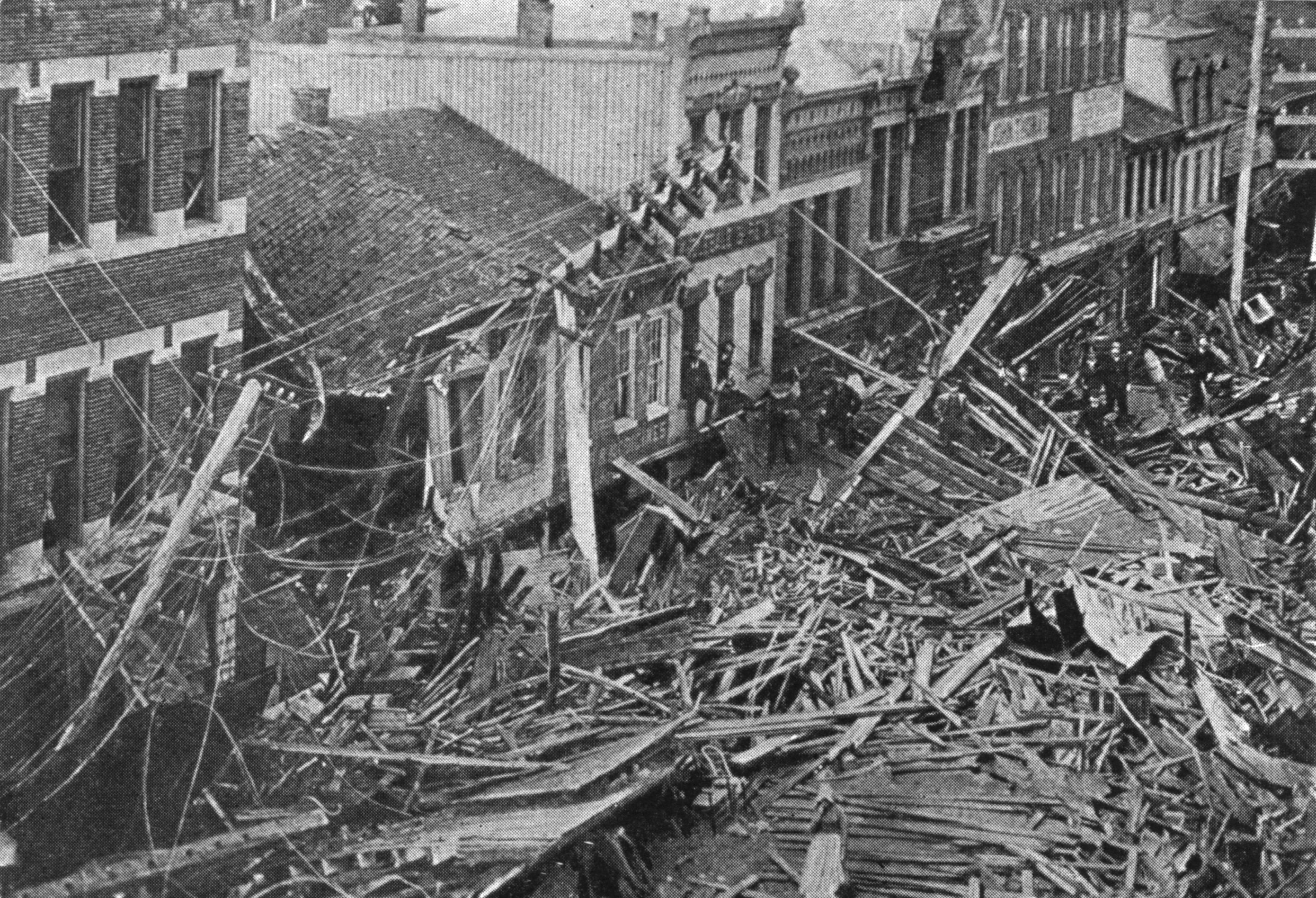
The locomotive engineer John Hess heard the rumbling before he saw it. From his idle engine in Johnstown's railyard, he threw the throttle into reverse and raced backward toward East Conemaugh, whistle screaming. His warning saved dozens. But for most of the 30,000 residents of this steel town wedged into the narrow Conemaugh Valley, the first sign of the flood was the flood itself -- a wall of water, debris, and twisted steel traveling at highway speed, reaching 60 feet high in places. Fifty-seven minutes after the South Fork Dam burst on May 31, 1889, Johnstown was gone. The death toll reached 2,208. The dam had failed because a group of Pittsburgh millionaires -- members of the exclusive South Fork Fishing and Hunting Club, whose ranks included Henry Clay Frick and associates of Andrew Carnegie -- had wanted a private lake and could not be bothered to maintain the dam that held it.
A Rich Man's Fishing Hole
Johnstown was founded in 1800 by Swiss immigrant Joseph Johns at the confluence of the Stonycreek and Little Conemaugh rivers. By 1889, the Cambria Iron Works and the Pennsylvania Railroad had turned it into a thriving steel community of 30,000, mostly Welsh and German immigrants. Fourteen miles upstream, the South Fork Dam held back Lake Conemaugh -- originally built in 1853 to supply a canal system that was already obsolete. Henry Clay Frick and a consortium of Pittsburgh speculators purchased the abandoned reservoir and converted it into a private resort for their South Fork Fishing and Hunting Club, whose more than fifty members included the wealthiest industrialists in steel, coal, and railroads. They lowered the dam to widen the road across it for their carriages. They installed fish screens in the spillway that trapped debris. They never replaced the relief pipes that had been sold for scrap. The club had no mechanism to lower the lake in an emergency.
Fourteen Miles in Fifty-Seven Minutes
On May 28, 1889, a low-pressure system that had formed over Kansas arrived in western Pennsylvania carrying what the U.S. Army Signal Corps called the heaviest rainfall ever recorded in the region. Lake Conemaugh rose eight feet in a day. Between 2:50 and 2:55 PM on May 31, the dam gave way, releasing 14.55 million cubic meters of water -- a volume whose flow rate briefly matched the Mississippi River. The flood picked up everything in the narrow valley: bridges, houses, railroad cars, and miles of barbed wire from the Gautier Wire Works. In the town of Woodvale, 314 of its 1,100 residents were killed. When the torrent reached Johnstown at approximately 4 PM, residents were caught in their homes and workplaces. Many were crushed by debris or entangled in barbed wire. Those who reached roofs clung to wreckage and waited.
Fire on the Water
The Stone Bridge, a massive arched railroad structure spanning the Conemaugh River in the center of Johnstown, became the focal point of a second catastrophe. Debris carried by the flood -- twisted steel rails, boxcars, entire buildings, and victims' bodies -- piled against the bridge and formed a temporary dam. The surge reversed upstream along the Stoney Creek before gravity sent it back, hitting the city from a different direction. Then the mountain of wreckage caught fire. At least eighty people who had survived the water died in the inferno at the Stone Bridge. The fire burned for three days. When it was over, the debris pile covered thirty acres. It took workers three months to clear, hampered by the vast tangle of barbed wire from the upstream ironworks. Dynamite was eventually required.
The Unpunished
The disaster killed 2,208 people, destroyed 1,600 homes, and caused $17 million in property damage -- roughly $550 million in today's dollars. Ninety-nine entire families were wiped out. Clara Barton and the American Red Cross mounted a major relief effort with support from eighteen foreign countries. But the South Fork Fishing and Hunting Club never paid a penny in damages. The club's wealthy members had structured their finances to shield personal assets, and courts could not prove individual negligence. Individual members donated to recovery -- Frick gave thousands, Carnegie built a library -- but the organization bore no legal responsibility. The perceived injustice sparked a national reckoning: state courts across the country began adopting the British precedent of Rylands v. Fletcher, holding that landowners could be strictly liable for damage caused by unnatural land use. The Johnstown Flood thus helped establish the doctrine of strict liability in American law.
The Valley That Would Not Quit
Johnstown rebuilt. The town flooded again in 1936 and again in 1977, earning it the grim nickname 'Flood City.' But the community endured. The Johnstown Flood National Memorial, established in 1964, preserves the site of the South Fork Dam and tells the story of the disaster. The ruins of the dam are visible, and walking trails follow the old lakebed. The South Fork Fishing and Hunting Club site was designated a National Historic Landmark District in 1986, administered by the National Park Service. Downtown, the Johnstown Flood Museum houses exhibits and an Academy Award-winning 1989 documentary short. David McCullough's first book, The Johnstown Flood, published in 1968, brought renewed national attention to the disaster and became a cornerstone of popular American history writing. Walt Whitman himself was moved to write a poem, 'A Voice from Death,' for the New York World within days of the catastrophe.
From the Air
Located at 40.349N, 78.775W in the Allegheny Mountains of western Pennsylvania. From the air, the geography tells the whole story: Johnstown sits in a tight valley at the confluence of the Stonycreek and Little Conemaugh rivers, hemmed in by steep hills with nowhere for floodwater to go. The South Fork Dam site is visible 14 miles upstream as a gap in the valley where the dam once stood. John Murtha Johnstown-Cambria County Airport (KJST) is approximately 5 miles to the northeast. Best viewed at 3,000-5,000 feet AGL. The narrow valley and converging rivers are clearly visible and explain why this location has flooded repeatedly throughout its history.