Johnstown Inclined Plane
The city of Johnstown, Pennsylvania had just buried 2,209 of its residents when the Cambria Iron Company started building a way out. Completed in 1891, two years after the catastrophic Johnstown Flood, the Johnstown Inclined Plane was engineered with a singular purpose: get people up and out of the valley floor before the water could take them again. Designed by Hungarian-American engineer Samuel Diescher, the funicular climbs Yoder Hill at a grade of approximately 72 percent -- the steepest vehicular incline in the world, according to Guinness World Records. It carries both passengers and automobiles, makes the ascent in 90 seconds, and has done exactly what it was built for: during the Johnstown floods of 1936 and 1977, the incline evacuated thousands to safety on the hilltop above.
Born from Disaster
On May 31, 1889, the South Fork Dam collapsed and sent a wall of water into the narrow valley where the Stonycreek and Little Conemaugh rivers meet to form the Conemaugh. Johnstown, a steel town of 30,000, was devastated. As the city rebuilt, the Cambria Iron Company saw an opportunity: develop the high ground atop Yoder Hill into a residential community and connect it to the valley floor with a funicular. Samuel Diescher, already famous for designing Pittsburgh's Duquesne, Castle Shannon, and Fort Pitt inclines, drew up the plans. The incline opened with double-decker cars -- horses and wagons rode on the upper deck, passengers in a compartment below. The convenience it offered made Westmont, the borough at the top of the hill, one of the country's first true suburbs. In its first 80 years, over 40 million trips were taken on the incline.
Escape Route, Twice Proven
The incline's designers understood Johnstown's geography was a trap. The valley is narrow, the rivers converge at the city's center, and when floodwaters rise, there is nowhere to go but up. The incline was that way up. On March 17, 1936, when Johnstown flooded again, nearly 4,000 people were evacuated from the valley floor to the safety of Yoder Hill via the funicular. In 1977, the city flooded a third time, and again the incline carried rescue equipment and emergency personnel into the valley while evacuating residents to higher ground. Both times, the machine built as insurance against a repeat of 1889 paid off exactly as intended. Tourists also gathered at the upper station during the 1977 flood to survey the damage below, inadvertently hampering cleanup efforts.
The Steepest Ride in the World
The engineering is striking in its simplicity. Two open-air cars run on parallel broad-gauge tracks, connected by steel wire rope wound around a drum powered by an electric motor. As one car descends, the other ascends, each acting as the other's counterweight. The 90-second journey covers a vertical rise measured in hundreds of feet at a grade of roughly 72 percent. The rails rest on 720 railroad ties made from Southern Yellow Pine, and 114 high-pressure sodium-vapor lamps illuminate the tracks at night. An emergency brake engages automatically if air pressure drops or if the operator's dead man's switch is tripped. The cars can carry automobiles as well as passengers -- at peak ridership in 1919, the incline transported 1,356,393 pedestrians and 124,825 vehicles in a single year.
Surviving Its Own Obsolescence
The automobile nearly killed the incline before any flood could. Ridership peaked in 1919 and declined steadily as highways improved. The Cambria Inclined Plane Company twice applied to shut it down -- in 1930 and 1934 -- but the Pennsylvania Public Service Commission denied the closure. Bethlehem Steel, Cambria Iron's successor, sold the incline to the borough of Westmont in 1935 for modest revenue. When Bethlehem Steel cut off the power supply in 1962, the incline went dark. Public outcry forced a deal: the Cambria County Tourist Council leased and reopened it on July 4, 1962. The funicular transitioned from daily transportation to tourist attraction, and the Cambria County Transit Authority took over in 1983, overseeing an 18-month renovation. The Pittsburgh Press wrote at the rededication: 'For Johnstown, the incline has, in more ways than one, provided a lift.'
Still Climbing
Listed on the National Register of Historic Places since 1973 and designated a Historic Mechanical Engineering Landmark by the American Society of Mechanical Engineers in 1994, the Johnstown Inclined Plane has spent its recent decades as the city's signature tourist attraction. The upper station in Westmont features a visitor center, gift shop, and observation deck with views across the valley. A major renovation beginning in 2021 -- funded in part by a $24 million federal infrastructure grant -- replaced all 720 track ties, overhauled the mechanical and electrical systems, and restored the cars. The project faced delays from faulty sheave wheels and cable damage, but by mid-2025 test runs were successful and the incline was preparing to reopen. A ride costs $5 round-trip. The same journey by car takes ten minutes. The incline does it in 90 seconds, straight up the side of the hill, just as it has since the people of Johnstown decided they would never again be trapped in their own valley.
From the Air
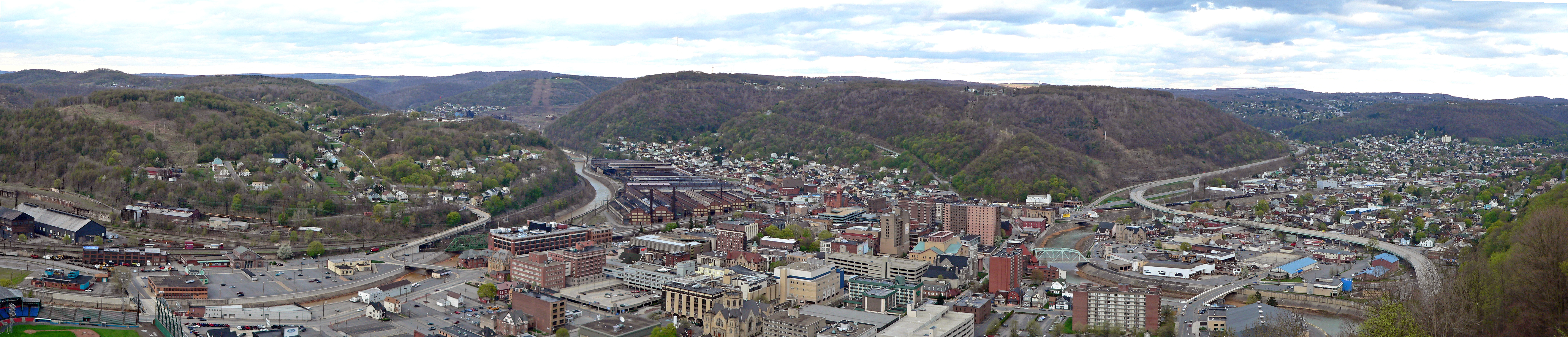
Located at 40.326N, 78.929W in Johnstown, Cambria County, Pennsylvania. The incline is visible from the air as a straight diagonal line climbing the steep hillside from the valley floor to the borough of Westmont on Yoder Hill. The Stonycreek River and the Inclined Plane Bridge are visible at the base. Johnstown's flood-prone geography is obvious from altitude: the city sits in a tight V-shaped valley at the confluence of two rivers. John Murtha Johnstown-Cambria County Airport (KJST) is approximately 4 miles to the east-northeast. Best viewed at 2,000-4,000 feet AGL. The incline's track bed, illuminated at night by sodium-vapor lamps, is a distinctive visual landmark.