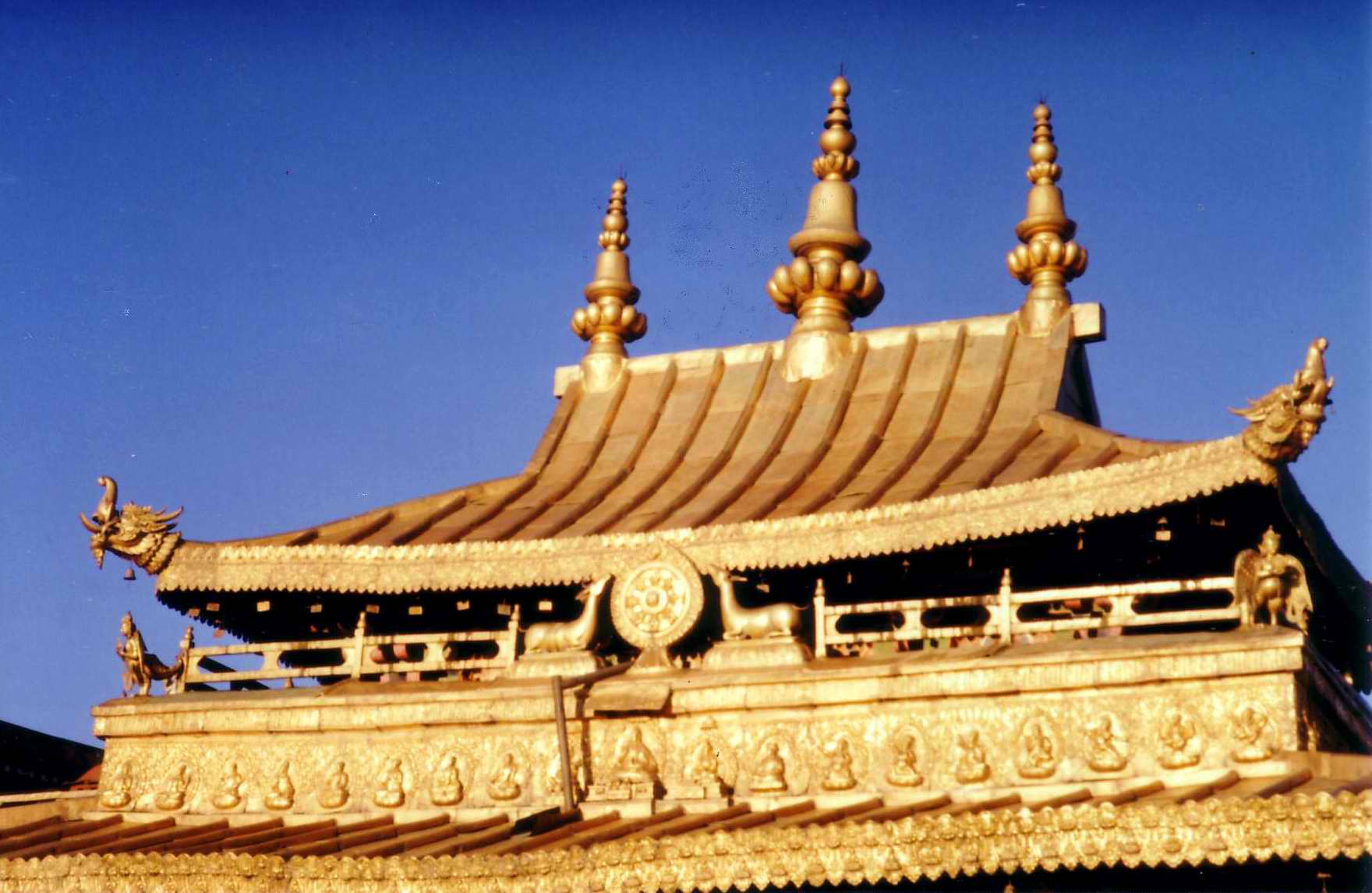
Jokhang
Every day, pilgrims prostrate themselves on the stone flagging outside the Jokhang, their bodies wearing grooves into rock that has absorbed devotion for nearly fourteen centuries. This is the building Tibetans call the heart of their city, and they mean it literally. Streets radiate outward from the Jokhang like arteries. The Barkhor, the market and pilgrim circuit that encircles it, pulses with commerce and prayer in equal measure. When King Songtsen Gampo built the temple around 640 CE to house a sacred statue brought by his Nepalese queen Bhrikuti, the city was called Rasa, meaning "Place of Goats," because goats hauled the earth for its construction. After the king's death, the city was renamed Lhasa - "Place of the Gods." The temple made the name true.
A Statue That Moved Nations
The Jokhang was constructed to house the Jowo Mikyo Dorje, a statue of Akshobhya Buddha that Princess Bhrikuti brought from Nepal as part of her marriage to Songtsen Gampo. The temple faces west toward Nepal in her honor. By the 14th century, the Jokhang had become associated with the Vajrasana, Buddhism's holiest site in India, elevating its status across the Buddhist world. When Nepalese Gorkha forces invaded Tibet in 1792, the Qianlong Emperor of the Qing dynasty barred Nepalese visitors from the temple, making it an exclusively Tibetan place of worship. That decision sealed the Jokhang's identity as the spiritual center of Tibetan Buddhism, a role it has never relinquished. The temple complex covers 2.51 hectares, and its original 7th-century structure had eight rooms on two floors to house scriptures and sculptures. Additions over the centuries expanded it into the sprawling complex visible today.
Stone, Wood, and the Weight of Centuries
Walking through the Jokhang is an exercise in reading architectural history. The original structure used brick-lined floors with columns and door frames carved from wood, a style characteristic of the Tubo period. The second and third floors of the Buddha Hall were added in the 11th century, and major improvements came after 1409 during the Ming dynasty. The four-story Buddha Hall dominates the complex. The temple follows an east-west axis that begins with an arch gate and proceeds through the hall, an enclosed passage, a cloister, atriums, and a hostel for monks. Four stone incense burners mark Barkhor Square, two at the front and two at the rear. The pilgrimage circuit around the temple takes roughly twenty minutes to walk, though many pilgrims measure the distance in full-body prostrations rather than steps, a practice that can stretch the circuit into hours.
Desecration and Renovation
The Cultural Revolution reached the Jokhang in 1966. Red Guards attacked the temple, and for a decade no worship took place within its walls. The damage was extensive, though the Jowo statue survived. Renovation began in 1972 and continued through 1980, restoring much of what had been destroyed. But the Jokhang's trials were not over. In February 2018, a fire struck the temple, damaging portions of the roof, though Chinese authorities stated the blaze was quickly contained. The interplay between destruction and restoration has defined the Jokhang for much of its modern history. In 2000, UNESCO designated it a World Heritage Site as an extension of the Potala Palace, which had received that status in 1994. Yet even UNESCO recognition brought complications. Subsequent redevelopment of the area altered parts of the World Heritage Site, and portions of Barkhor Square in front of the temple were partially demolished and encroached upon.
Where Commerce Meets Devotion
The Jokhang sits at the center of Lhasa's commercial life as much as its spiritual life. Barkhor Square is both a sacred circuit and a market, and the maze of streets radiating from the temple teems with vendors, tea houses, and pilgrims who see no contradiction between shopping and worship. The temple is 1,000 meters east of the Potala Palace, close enough that the two buildings define the axis of Lhasa's old city. For Tibetans, the Jokhang is not a museum or a tourist destination. It is the place where their Buddhism lives, the building that turned a settlement named for goats into a place named for gods. The pilgrims outside will continue their prostrations tomorrow, and the day after, wearing the stone a little smoother each time.
From the Air
The Jokhang is located at 29.653N, 91.132E in central Lhasa at approximately 3,650m elevation. It sits 1,000m east of the Potala Palace, and the Barkhor market area surrounding it is identifiable as a dense cluster of buildings in the old city center. Lhasa Gonggar Airport (ZULS) is about 60km to the southwest. The gilded roof of the temple is a visual landmark in clear conditions. Expect high-altitude turbulence and variable mountain weather.