Jolo Group of Volcanoes
From the air, the island of Jolo looks like a pair of green fists pressed together at the knuckles, its figure-eight silhouette stretching 60 kilometers across the Sulu Sea. What the shape conceals is the violence underneath. This is one of the most volcanically active spots in the southern Philippines, a cluster of cinder cones, tuff cones, maars, and crater lakes scattered across an island that sits directly on the Sulu Volcanic Arc, where the Sunda Plate grinds against the Philippine Mobile Belt. The Global Volcanism Program classifies the Jolo Group as active. The Philippine Institute of Volcanology and Seismology lists the entire group under the name of one prominent cone: Bud Dajo, rising 620 meters above sea level.
Fire Beneath the Coral
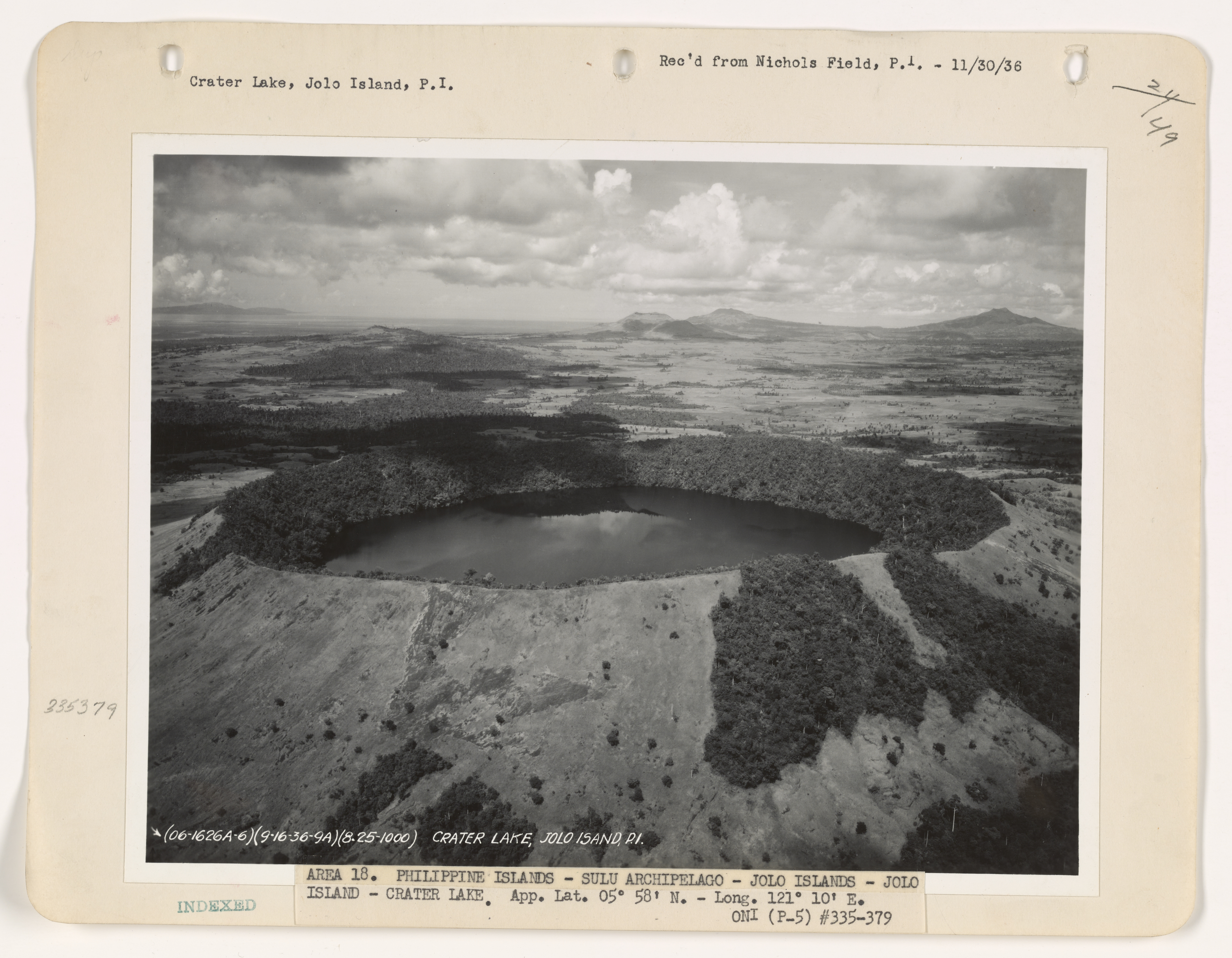
The island's volcanic anatomy is remarkably diverse for its modest size. Mount Tumatangas, the highest point at 811 meters, presides over a landscape pocked with at least four crater lakes: Lake Seit, Lake Panamao, Lake Timpuak, and Sani Crater Lake. At Lake Seit, a volcanic maar, solfataric activity persists to this day, sulfurous gases seeping through the water's surface in a quiet reminder that the earth here is far from finished. Nearby cones named Guimba, Matanding, and Sungal cluster around Bud Dajo like satellites. The bedrock is predominantly basalt and andesite, dark volcanic rock that gives the island's interior a brooding quality even under tropical sun.
The Eruptions That Were and Weren't
On January 4, 1641, a volcanic eruption plunged much of Mindanao into darkness, raining ash as far as Cebu and Panay. Historical accounts attributed the event to a small island "opposite the main river of Jolo," pointing to Mount Dakula near Lake Panamao as the likely source. Modern volcanologists, however, have reassigned the blame to Mount Parker in South Cotabato, hundreds of kilometers to the east. The Jolo Group keeps its own eruptive history more ambiguous. In 1897, a tsunami struck the island, and evidence points to a submarine eruption on September 21 of that year, possibly centered at Lake Seit. The volcanoes here are geologically young, and their classification as active rests largely on these tantalizing but uncertain events.
Where Tectonic Worlds Collide
All Philippine volcanoes belong to the Pacific Ring of Fire, but the Jolo Group occupies a particularly dramatic position. It sits on the Sulu Volcanic Arc, one of two northeastern arms of the Sunda Plate, locked in slow-motion collision with the Philippine Mobile Belt. This tectonic squeeze zone generates frequent earthquakes and fuels the volcanic activity that built the island in the first place. Despite this geological significance, the Jolo Group remains one of the least studied volcanic systems in the Philippines. The volcanoes lie within what was historically the Sultanate of Sulu, a region where centuries of conflict have made sustained scientific fieldwork difficult. What researchers do know suggests that the story beneath Jolo's surface is far from over.
An Island Shaped by Fire and Water
At its widest, Jolo stretches 15 kilometers; at its narrowest pinch point, the waist of the figure-eight, barely five. The volcanic terrain creates a landscape that oscillates between fertile lowlands and steep, jungled slopes. Crater lakes fill ancient calderas with still, dark water, their surfaces occasionally disturbed by gas bubbles rising from below. The island sits 150 kilometers southwest of the Zamboanga Peninsula, part of the Sulu Archipelago in what is now the Bangsamoro Autonomous Region. For the Tausug people who have inhabited these shores for centuries, the volcanoes are simply part of the landscape, features named and navigated but never fully tamed.
From the Air
Coordinates: 6.013°N, 121.057°E. The figure-eight island shape is unmistakable from above 10,000 feet. Look for the multiple crater lakes and cinder cones dotting the island's interior. Mount Tumatangas (811m) is the highest peak. Nearest significant airport is Jolo Airport (RPMJ). Be aware of restricted airspace due to military operations in the region. The volcanic terrain creates localized turbulence and cloud formation over the peaks.