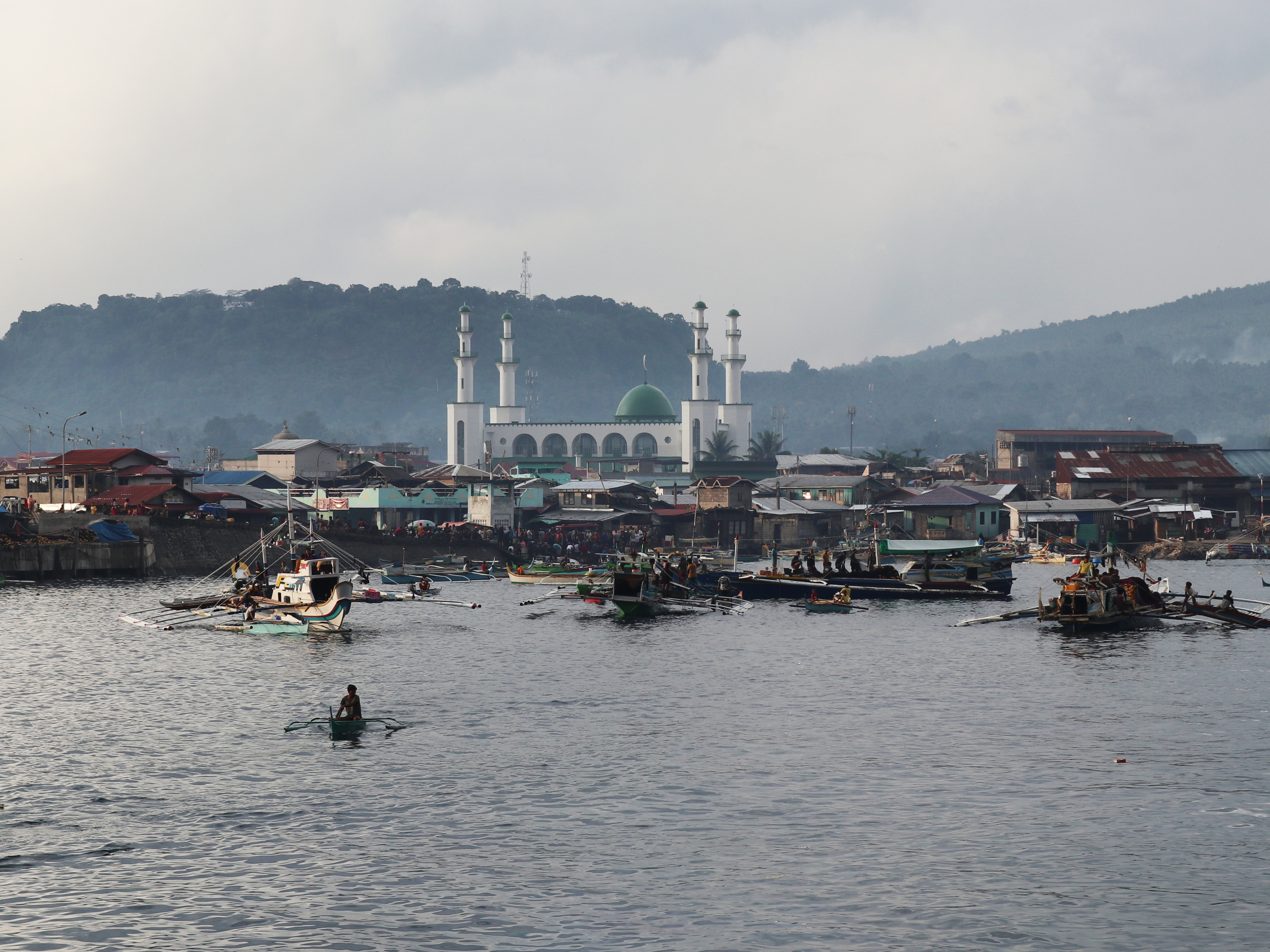
Jolo, Sulu
An estimated 100,000 rifles circulate through the Sulu Archipelago. In Jolo, the provincial capital of Sulu, nearly every household owns at least one gun, and clan disputes over land are sometimes settled not in courts but in gunfire. This is a town where the Filipino Army is routinely called in to mediate feuds between families, where a rejected marriage proposal can fracture an entire community along clan lines. Yet Jolo is also a place where coconut, coffee, durian, and mangosteen grow in abundance, where boat builders shape hulls by hand, and where mat weavers produce work of intricate beauty. It is the only municipality in Sulu that does not farm seaweed, as if the town insists on its own distinct identity even in agriculture.
Four Centuries of Defiance
Jolo has been the epicenter of Moro resistance for over 400 years. The Moro people, geographically concentrated in the southwestern Philippines, have long identified more closely with the Muslim-majority nations of Indonesia and Malaysia than with the Catholic-dominated Philippine government in Manila. Between 1972 and 1976, Jolo became the center of the Muslim Separatist Rebellion against the Marcos regime, a conflict that killed an estimated 120,000 people. In 1974, fighting erupted when government troops blocked the Moro National Liberation Front from taking the town. The scars of that era have not fully healed, though by 1996, the MNLF was granted leadership of the Autonomous Region in Muslim Mindanao in response to calls for Muslim autonomy.
The Shadow of Bud Dajo
Much of the deep anger toward Americans in Jolo traces to a single event. In 1906, during the Philippine-American War, American forces killed roughly 1,000 men, women, and children who had retreated to the crater of Mount Dajo after refusing to pay taxes. The First Battle of Bud Dajo remains one of the most controversial episodes of American colonial history in the Philippines. For decades afterward, the island was considered dangerous for foreigners, particularly Americans, as militant groups threatened abduction or worse. The Abu Sayyaf group, which claimed to be fighting for an independent Islamic state, made Jolo one of its principal strongholds. In April 2000, Abu Sayyaf fighters raided the Malaysian resort island of Sipadan, kidnapping 21 tourists from Germany, France, Finland, and South Africa and bringing them to Jolo, demanding $25 million in ransom.
Roads Toward a Fragile Peace
The tide has shifted, if gradually. In April 2008, the Jolo Zone of Peace was established with support from the Geneva-based Centre for Humanitarian Dialogue, restricting firearms and creating mediation channels between feuding clans. The Philippine and American governments have poured resources into development: USAID funded a farm-to-market road between Maimbung and Jolo, announced $3 million to improve Jolo Airport, and has spent $4 million annually in the region since 1997. The World Bank, Japan's JICA, and Australia's AusAID have all contributed. In 2008, a 54-million-peso water supply project began upgrading Jolo's infrastructure. Operation Enduring Freedom in the Philippines brought U.S. Special Forces alongside Governor Benjamin Loong's "Operation Smiles" program, providing medical care and building schools. The strategy has been to undercut militant recruitment by addressing its root cause: poverty.
Commerce Between Conflicts
Jolo's economy revolves around agriculture and fishing. Coconut, cassava, abaca, coffee, lanzones, jackfruit, and durian fill its markets. Fishing remains the most important industry, supplemented by boat building, mat weaving, coffee processing, and fruit preservation. Banks including the Philippine National Bank, Al-Amanah Islamic Bank, and Land Bank operate branches in town, though economic development has been persistently hampered by instability. Jolo was once among the poorest regions in the nation, its poverty an ideal recruiting ground for extremist groups. The situation has improved markedly since the mid-2010s, with increased military operations weakening Abu Sayyaf and foreign investment slowly entering the region. The town that was once synonymous with danger is cautiously reimagining itself.
From the Air
Coordinates: 6.05°N, 121.00°E. Jolo is the main town on the volcanic island of Jolo in the Sulu Archipelago. The town is visible along the northern coast of the island. Jolo Airport (RPMJ) serves the area with limited domestic flights. Be aware of potential military activity and restricted airspace. The volcanic peaks of the Jolo Group are visible to the south and east of the town. Zamboanga City, with its larger airport, lies approximately 150 km to the northeast across the Sulu Sea.