Jonas Bronck
Somewhere around 1600, a boy was born in the Swedish province of Smaland. His name was Jonas Bronck, or possibly Jonas Jonsson Brunk, or Jonas Jonasson Bronk -- the spelling depends on which century you ask. He would live in the New World for approximately four years before dying under circumstances that remain unclear. In that brief time, he left behind a single enduring legacy: his surname, which attached itself to a river, then a county, then a borough of 1.4 million people. The Bronx is the only New York City borough named after a person, and that person barely had time to unpack.
The Man Nobody Can Place
Scholars have spent centuries trying to determine where Bronck came from, and the debate remains unresolved. A 1981 pamphlet by G. V. C. Young traced his origins to Komstad in Jonkoping County, Sweden, interpreting archival words from Dutch-language documents -- 'Coonstay' and 'Smolach' -- as references to Komstad and Smaland. His betrothal certificate, signed June 18, 1638 as Jonas Jonasson Bronck, indicates his father's name was also Jonas, supporting the Swedish theory. Other researchers have claimed him as Danish, Faroese, or even a Dutch Mennonite fleeing religious persecution. The Faroe Islands theory places his father as a Lutheran minister in Torshavn. But the patronym Jonsson undermines this -- a Faroese minister named Morten would have produced a son called Mortensen, not Jonsson. The Pulitzer Prize-winning Gotham: A History of New York City to 1898 parenthetically calls him a Dane. What is certain: he married a Dutch woman named Teuntje Joriaens at the New Church in Amsterdam on July 6, 1638, and almost immediately began planning his departure for the colonies.
Fire of Troy
In the spring of 1639, Bronck sailed from the Dutch port of Hoorn aboard a ship called De Brandt van Troyen -- the Fire of Troy -- loaded with cattle and fellow emigrants, including his friend, the Danish settler Jochem Pietersen Kuyter. They arrived in the harbor of New Amsterdam on June 16. The colony they found was struggling. Its population had stagnated at roughly four hundred people, company properties were neglected, and law enforcement was tenuous. But the Dutch West India Company, facing possible government seizure of the territory, had appointed Willem Kieft as director with orders to expand settlement. Kieft was purchasing Lenape lands around Manhattan and encouraging colonists of diverse backgrounds to take up farming. Bronck was among the first to seize the opportunity. He and Kuyter sailed up the East River and took land on the mainland, across the Harlem River from Manhattan -- territory inhabited by the Siwanoy and Wecquaesgeek people.
A Fort by the River
Bronck's farmstead encompassed roughly 274 hectares at the junction of the Harlem River and the Bronx Kill, across from Randalls Island. He reportedly described his new home as 'a veritable paradise' covered in virgin forest. The house he and Teuntje built resembled a miniature fort, with stone walls and a tile roof -- practical precautions on a contested frontier. On April 22, 1642, a peace treaty was signed at Bronck's homestead between Dutch authorities and the Wecquaesgeek sachems Ranaqua and Tackamuck. The moment of diplomacy did not last. Less than a year later, Director Kieft launched attacks on refugee camps of the Wecquaesgeek and Tappan at Communipaw and Corlaers Hook -- the Pavonia Massacre of February 23, 1643. The slaughter triggered retaliatory attacks on outlying settlements, including some in what is now the Bronx. Bronck died in 1643, though whether his death was connected to the violence remains unknown.
Four Years, Four Hundred Years
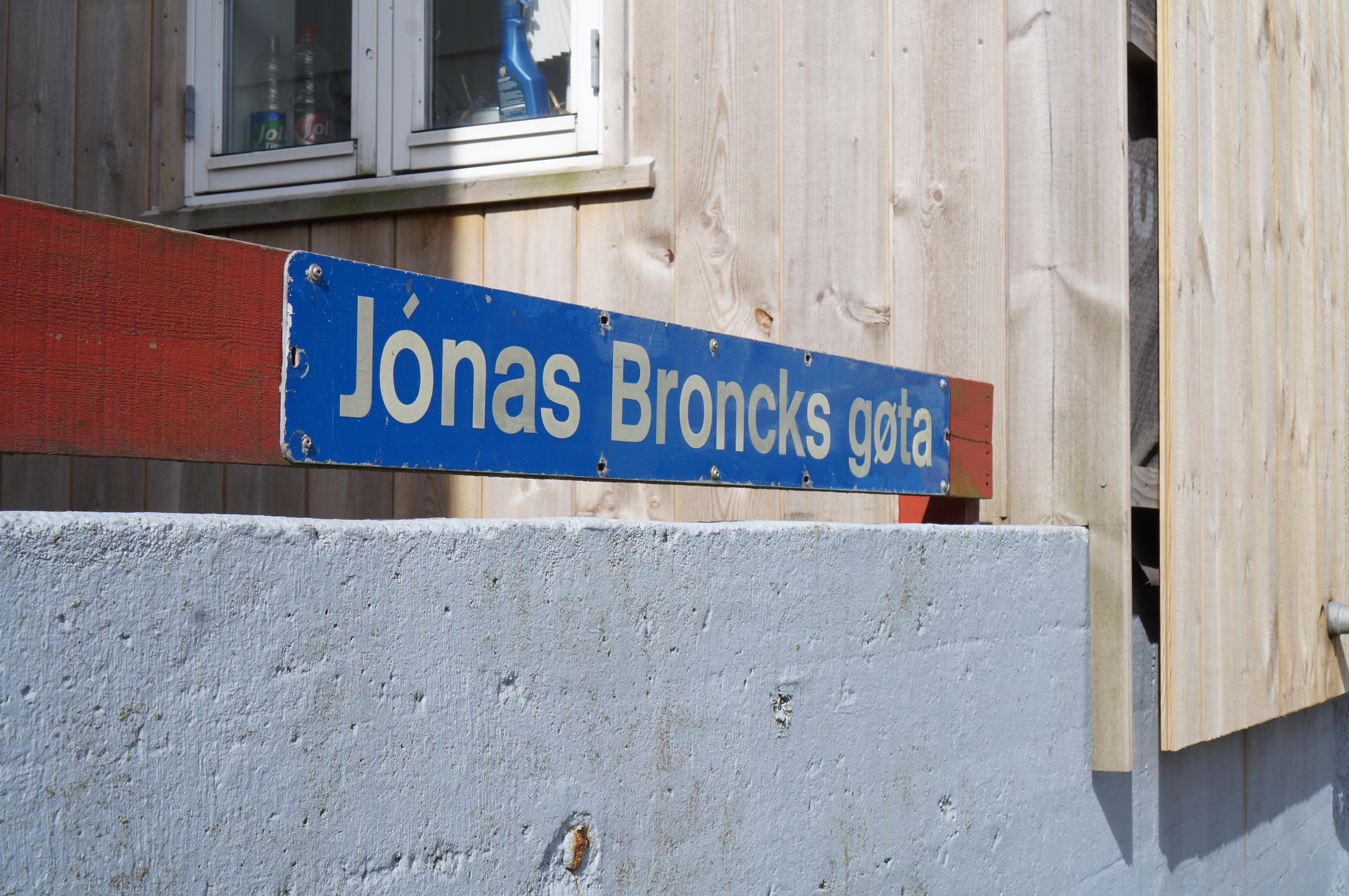
Despite Bronck's brief residency, the area was known as 'Broncksland' through the end of the seventeenth century. The current spelling came into use in 1697. His land passed through successive Dutch traders before an Englishman named Samuel Edsall acquired it in 1664, eventually selling to merchants from Barbados who obtained a royal patent and established the Manor of Morrisania. The Bronx County flag still carries the Bronck family arms: a sun rising from the sea, an eagle facing east, and the Latin motto ne cede malis -- 'yield not to evil.' A mural at the Bronx County Courthouse depicts his arrival. In Torshavn, the capital of the Faroe Islands, a street bears his name. In Savsjo, Sweden, a Jonas Bronck Center celebrated the 375th anniversary of his settlement in 2014. A local Bronx brewery produces Jonas Bronck Beer. The man himself remains elusive -- uncertain in origin, brief in presence, permanent in name.
From the Air
Located at 40.804N, 73.926W in present-day Mott Haven, the Bronx, near the junction of the Harlem River and Bronx Kill. The original homestead site is now part of the Harlem River Intermodal Yard, south of Bruckner Boulevard. Best viewed from low altitude heading north along the East River/Harlem River. Nearby airports: La Guardia (KLGA) 5 nm east, Teterboro (KTEB) 10 nm west.