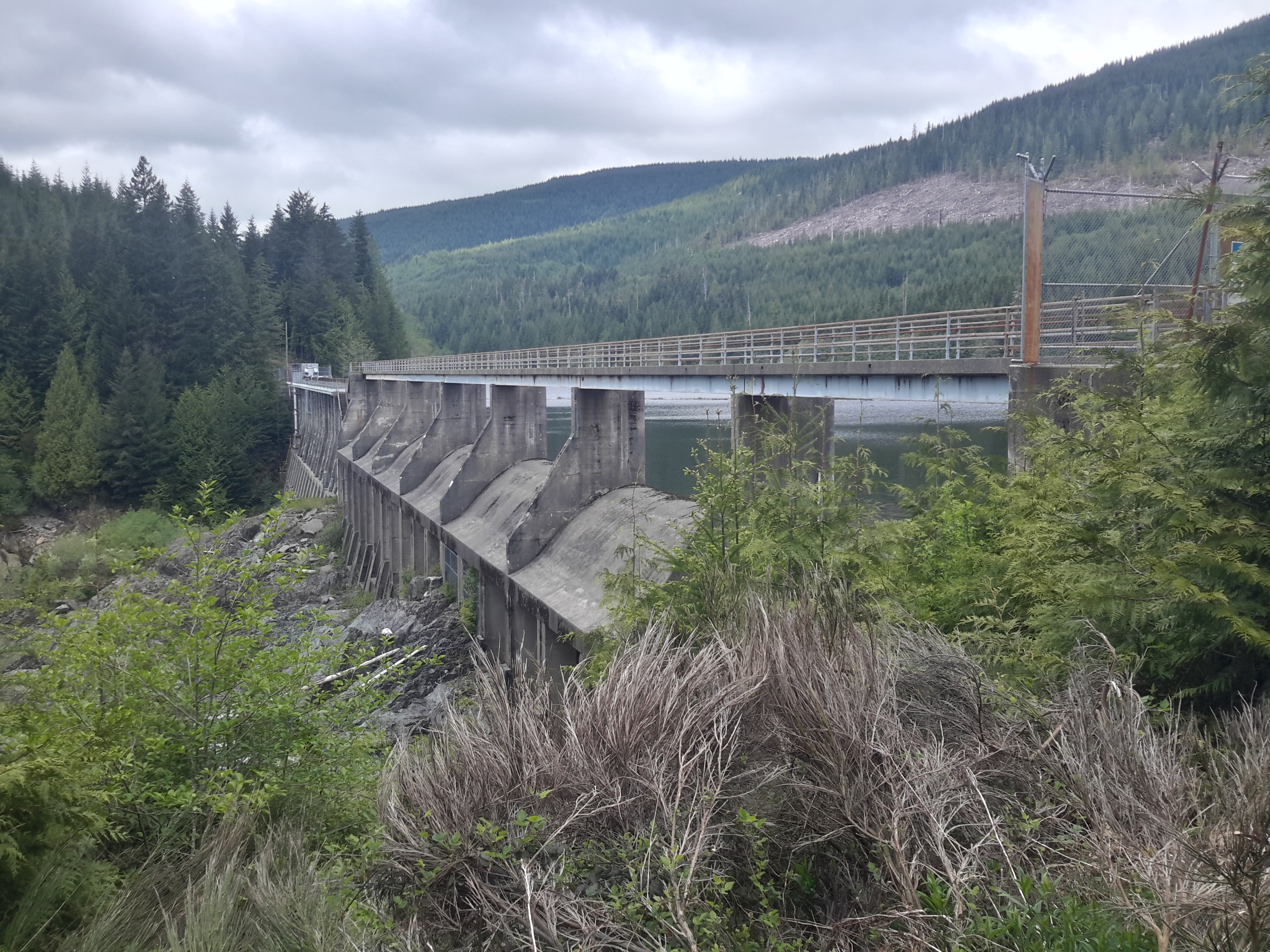
Jordan River Dam
At 126 feet from top to bottom, the Jordan River Diversion Dam was the tallest dam in Canada when it was completed in 1911. That superlative has long since passed to others, but the dam's significance has not diminished. Sitting on the Jordan River on the southwestern coast of Vancouver Island, it was the second hydroelectric development on the island and the project that transformed Victoria from a city powered by the modest Goldstream Powerhouse into one with genuine industrial electricity. More than a century later, the Jordan River system still generates 35% of Vancouver Island's hydroelectric capacity -- a remarkable lifespan for infrastructure built when the province was barely forty years old.
Powering Victoria's Ambitions
Before the Jordan River Dam, Victoria drew its electricity from the Goldstream Powerhouse, a small facility that sufficed for a colonial capital but could not keep pace with a growing city. The Vancouver Island Power Company, a subsidiary of the British Columbia Electric Railway, saw the Jordan River's potential and committed to a two-dam system: a smaller Bear Creek Dam and the main Diversion Dam. Construction began in the rugged, rain-drenched terrain of the island's southwest coast, where the river descends through steep canyons before reaching the sea. When completed, the system channeled water through a wooden flume stretching 31,600 feet to a penstock above the powerhouse. From 1912 to 1931, continual improvements and additional generators pushed the powerhouse capacity to 26 megawatts. A service railway accompanied the flume, threading through the forest on trestles that became landmarks of the Jordan River valley.
The Tunnel Transformation
In 1971, the entire water conveyance system was rebuilt. The aging wooden flume and its accompanying railway were dismantled, replaced by a seven-kilometer tunnel bored through the rock. A new penstock fed a new powerhouse, built across the river from the original. A Japanese-built generator replaced the old equipment, and in a single modernization, power output jumped from 26 megawatts to 175 megawatts -- nearly a sevenfold increase. The abandoned railway trestles, once essential infrastructure, became slowly decaying monuments in the forest. Today, water collected at Bear Creek Dam and the Diversion Dam fills the Jack Elliott equalization reservoir on demand, then flows through an 8.8-kilometer tunnel before dropping 330 feet through a steel penstock to the turbines below. The system's elegance is in its simplicity: gravity and water volume, channeled through engineered rock.
Fish, Water, and Competing Claims
In 1996, the provincial government initiated a Water Use Planning program, requiring British Columbia's water licence holders to demonstrate they could manage the environmental impact of their reservoirs. The Jordan River's planning process, launched in 2001, placed fish habitat restoration at the top of the agenda. Dams interrupt the natural flow regime that salmon and steelhead depend on for spawning, rearing, and migration, and the Jordan River is no exception. Balancing hydroelectric generation with the ecological needs of the river became a defining challenge for BC Hydro, which operates the facility. The tension between energy production and environmental stewardship is not unique to the Jordan River, but the dam's outsized contribution to the island's power grid -- 35% of total generating capacity -- raises the stakes of every decision about water allocation.
Living in the Evacuation Zone
A 2014 BC Hydro study delivered sobering news: the Jordan River Dam faces a high risk of seismic dam failure. Vancouver Island sits in one of North America's most active seismic zones, where the Juan de Fuca tectonic plate is being forced beneath the North American plate in a subduction zone capable of producing magnitude 9 earthquakes. A dam built in 1911, before modern seismic engineering standards existed, is particularly vulnerable. BC Hydro has offered to purchase the nine residences in the evacuation zone downstream of the dam -- a small number of homes, but each one represents a family living with the knowledge that the ground beneath them could, in a major earthquake, release a wall of water from the reservoir above. The offer is a quiet acknowledgment that some of the Pacific Northwest's oldest infrastructure may not survive the next Big One.
From the Air
Located at 48.50N, 123.99W on the Jordan River, southwestern Vancouver Island. The dam and reservoir are visible in the forested river valley, roughly midway between Sooke and Port Renfrew along the coast road. Nearest major airport: Victoria International (CYYJ), about 70 km east. Look for the reservoir and cleared penstock corridor descending to the powerhouse near the river mouth at the community of Jordan River.