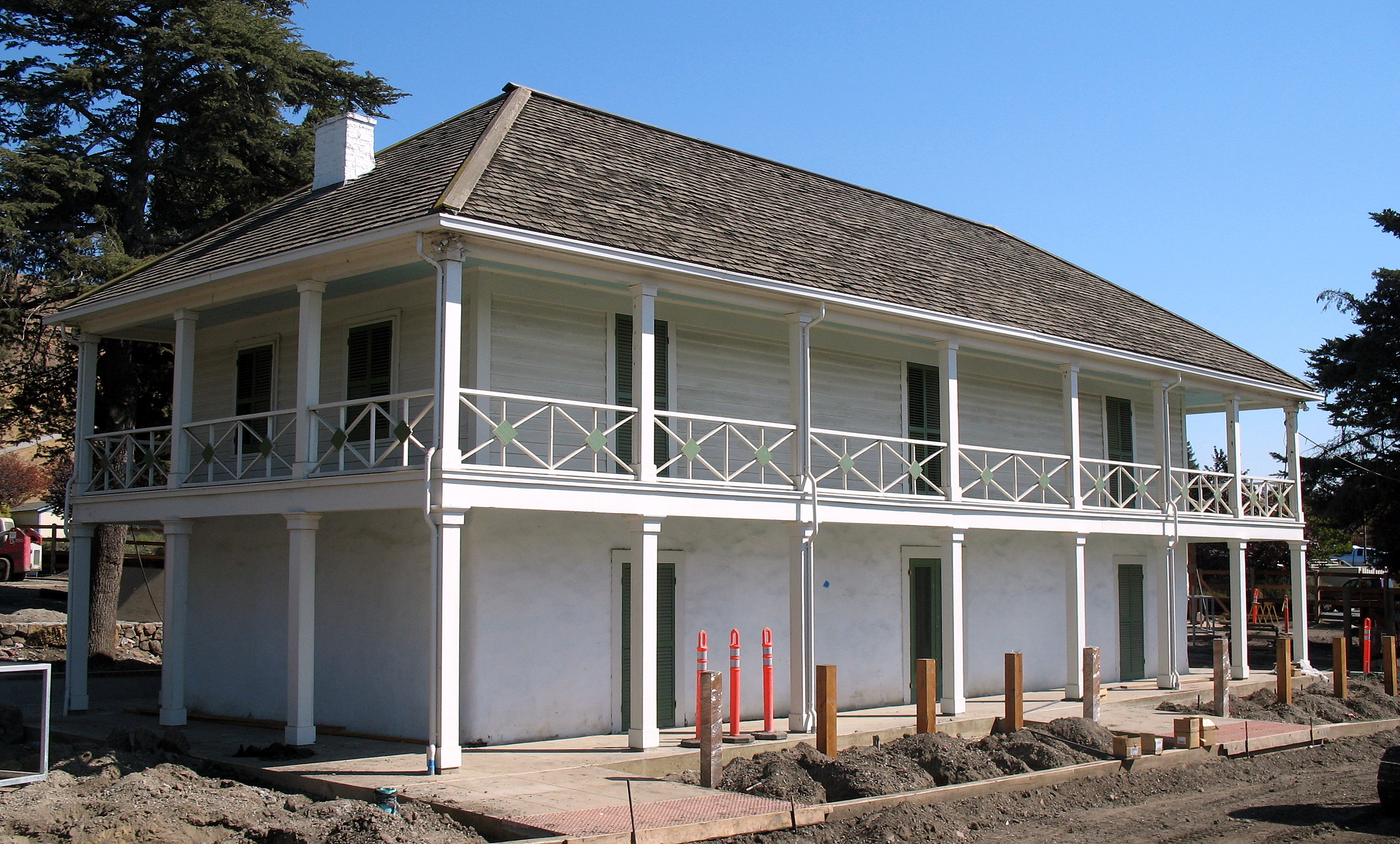
Jose Maria Alviso Adobe
The walls are nearly two hundred years old. Not the building -- the walls themselves, thick adobe bricks formed from the valley's own clay sometime around 1837, when California was still Mexican territory and Jose Maria Alviso served as alcalde of the Pueblo de San Jose. Everything built on top of those walls tells a different chapter: a wood-frame second story added in the 1850s, hardware and French doors from 1853, a kitchen remodeled in the 1920s and never touched again. The Alviso Adobe in Milpitas is the last Monterey Colonial structure in the Santa Clara Valley, and it has survived not by being frozen in time but by accumulating it.
The Alcalde's House
Jose Maria Alviso was among the early leaders of the Pueblo de San Jose, serving as its alcalde -- the Spanish colonial term for mayor and magistrate combined. Around 1837, he built a one-story adobe house on land that would eventually become part of Milpitas. The location made sense for a man of his position: close enough to the pueblo to conduct business, far enough out to work the surrounding land. Adobe construction was standard for California's Mexican period, and the thick earthen walls served double duty -- structural support and insulation against the valley's dry summers and cool winters. The house was modest by the standards of its era, a practical dwelling for a practical official. What made it extraordinary was what came next.
A Second Story Rises
By 1853, the Alviso family had transformed the building. They added an entire wood-frame second floor on top of the original adobe walls, creating a two-story residence with a hipped roof and balconies wrapping three sides. This was the Monterey Colonial style -- a distinctly Californian hybrid that merged Spanish adobe construction with the wood-framing techniques brought by American settlers. Paired French doors opened to the outside from both levels. Multi-paned windows let in light. Interior fireplaces warmed the symmetrical floor plan: three rooms downstairs, three upstairs. The result was a house that looked east and west at the same time, its lower half rooted in Mexican California and its upper half reaching toward the American era that was rapidly arriving. It remains the only surviving example of this architectural style in the entire Santa Clara Valley.
Layers Beneath Layers
What makes the Alviso Adobe remarkable to historians is how little has been altered. The adobe walls from the 1830s are intact. Door frames, windows, and hardware from the 1853 renovation remain in place. A kitchen remodeled in the 1920s survives virtually untouched -- its fixtures and layout a time capsule of domestic life between the wars. Finding a building this little changed over a span of nearly two centuries is exceptionally rare, especially in a region that has reinvented itself as aggressively as Silicon Valley. A barn on the property contained timbers dating to the 1840s before it was recently demolished. Archaeological surveys have documented both historic and prehistoric subsurface cultural remains in the vicinity, suggesting the site was significant long before the Alviso family built on it.
Restoration and What Remains
The property is currently under renovation, with plans to restore it as a working ranch and orchard reflecting its appearance in the 1920s. Mature trees still shade the grounds, and the building's character-defining features are intact: the wood-shingled hipped roof, the three-sided balconies, the symmetrical layout that makes the house feel orderly and deliberate from any angle. Listed on the National Register of Historic Places, the Alviso Adobe sits in a part of Milpitas that has changed beyond recognition since 1837. Subdivisions and commercial development press in on all sides. But the adobe walls hold their ground, the same clay that Jose Maria Alviso's workers shaped by hand nearly two hundred years ago -- a fragment of Mexican California persisting in the heart of Silicon Valley.
From the Air
Located at 37.44N, 121.87W in Milpitas, California, between San Jose and the southern shores of San Francisco Bay. The historic adobe is a small structure surrounded by modern suburban development, difficult to spot from altitude but located in an area where the transition from valley floor to bay wetlands is visible. Nearest airports: Reid-Hillview (KRHV, 8nm S), San Jose International (KSJC, 6nm W), Moffett Federal Airfield (KNUQ, 6nm NW). Best viewed below 1,500 feet AGL, though the surrounding residential grid makes it challenging to distinguish from the air.