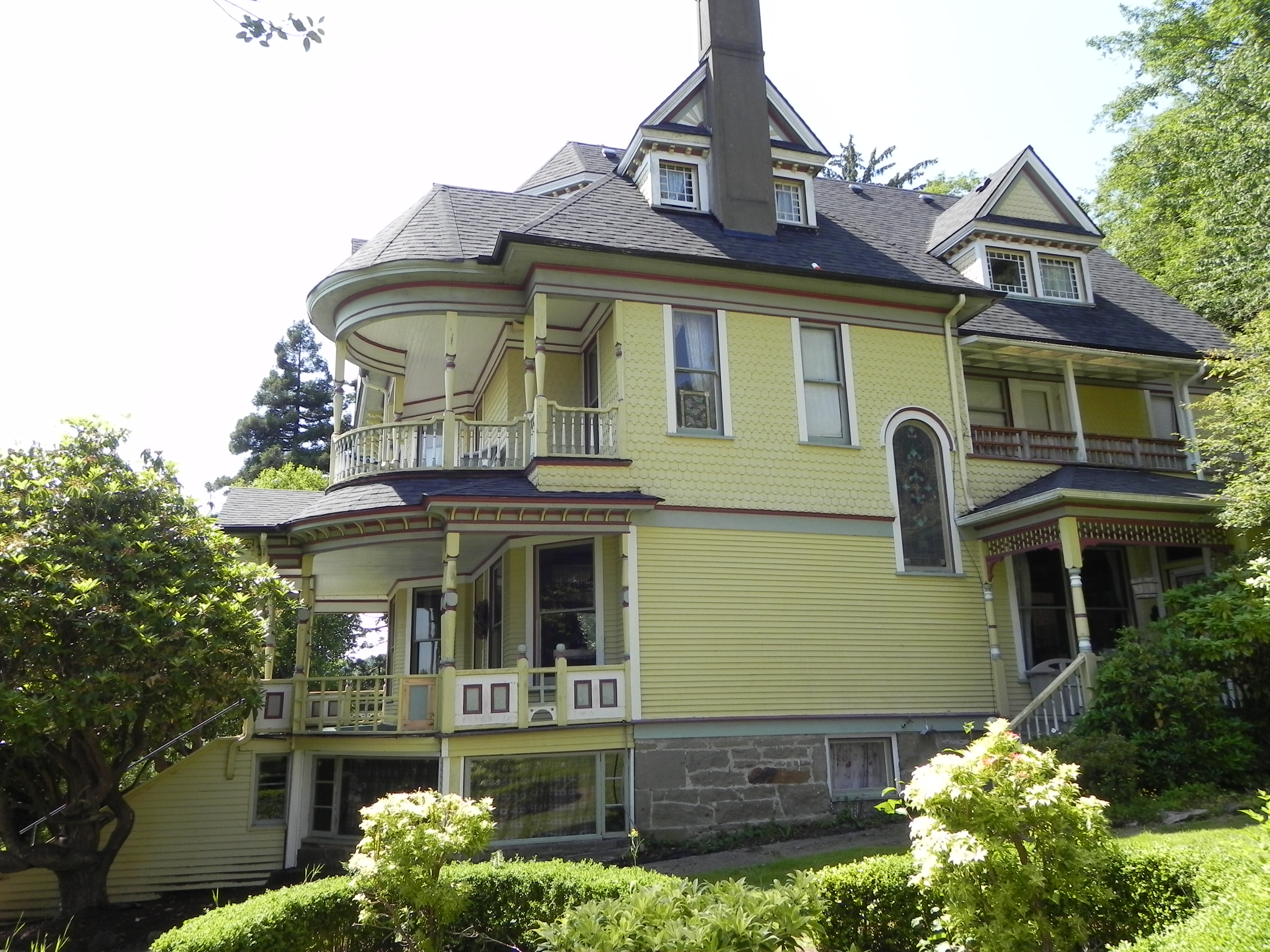
Joseph Lytle House
Next door to the grandest mansion in Hoquiam, Joseph Lytle built something more restrained -- but no less revealing. Where his brother Robert raised a 10,000-square-foot castle with sandstone stairs and cement lions, Joseph chose a four-bedroom Queen Anne designed by George F. Barber, the Tennessee architect whose mail-order catalogs shipped house plans to clients across the country and as far away as Japan. The contrast between the two homes, separated by a shared property line and a shared fortune, says something about the brothers who built them: same money, same timber, different temperaments.
A Catalog House for a Lumber Baron
George Franklin Barber was one of the most successful architects in turn-of-the-century America, though most of his clients never met him. Operating from Knoxville, Tennessee, Barber published catalogs of house designs -- his Cottage Souvenir No. 2 offered 59 plans, mostly Queen Anne -- and shipped blueprints to anyone who could pay the fee. He encouraged customization: "Write to us concerning any changes wanted in plans, and keep writing till you get what you want." Joseph Lytle took him up on it. The result, completed in 1900 at a cost exceeding six thousand dollars, was a Queen Anne with irregular massing, projecting porches, window bays, and a variety of exterior textures. Inside, the woodwork was golden oak. An opening celebration was held in March 1901 to show it off.
The Brothers Who Built Hoquiam
Robert and Joseph Lytle arrived in Hoquiam as grocers, having moved their business from Fairhaven. The pivotal moment came when a customer settled his account by handing over a logging operation -- reportedly one of the rougher camps in the region. The brothers parlayed that accidental acquisition into an empire. They built the Hoquiam Lumber and Shingle Company in 1902, and within four years it was among the world's leading cedar shingle manufacturers, producing 275 million shingles annually. They owned the Panama-Eastern Lumber Company sawmill, the Woodland Mill and Boom Company, the Lytle Dock, and the Lytle Building downtown. Both brothers built their homes on Chenault Avenue in 1900, side by side, as if the street itself were a ledger of their success.
The Carriage House and the Cottage
Behind the main house stand two outbuildings that complete the picture of a lumber-era household: a carriage house, connected to the residence by a breezeway, and a caretaker's cottage. These were not decorative flourishes. A home of this scale required staff, horses, and storage, and the outbuildings reflect the practical infrastructure of wealth in a town where the nearest city of any size was a hard journey away. The property's layout -- main house, breezeway, carriage house, cottage -- maps the daily rhythms of a family whose fortune depended on the forests visible from their windows.
After the Timber
Joseph Lytle died in 1914. His widow Mary continued to live in the house through the early 1930s, long enough to watch Hoquiam's lumber economy begin its long contraction. By the 1940s, the home had been converted to apartments -- a common fate for grand houses in towns where the industry that built them had moved on. The conversion was a practical concession: the house was too large for a single family in a shrinking economy, but too well-built to abandon. Listed on the National Register of Historic Places in 1990, the Joseph Lytle House survives as a quieter monument to the same fortune that raised the castle next door. One brother built to impress; the other, it seems, built to live in.
From the Air
Located at 46.984N, 123.890W in Hoquiam, Washington, on Chenault Avenue immediately adjacent to Hoquiam's Castle (the Robert Lytle Mansion). Nearest airport is Bowerman Field (KHQM), approximately 3 miles southeast. The two Lytle homes are visible side by side on the hillside above central Hoquiam. Grays Harbor provides a prominent water reference to the south. Recommended viewing altitude: 1,500-2,500 feet AGL for residential context.