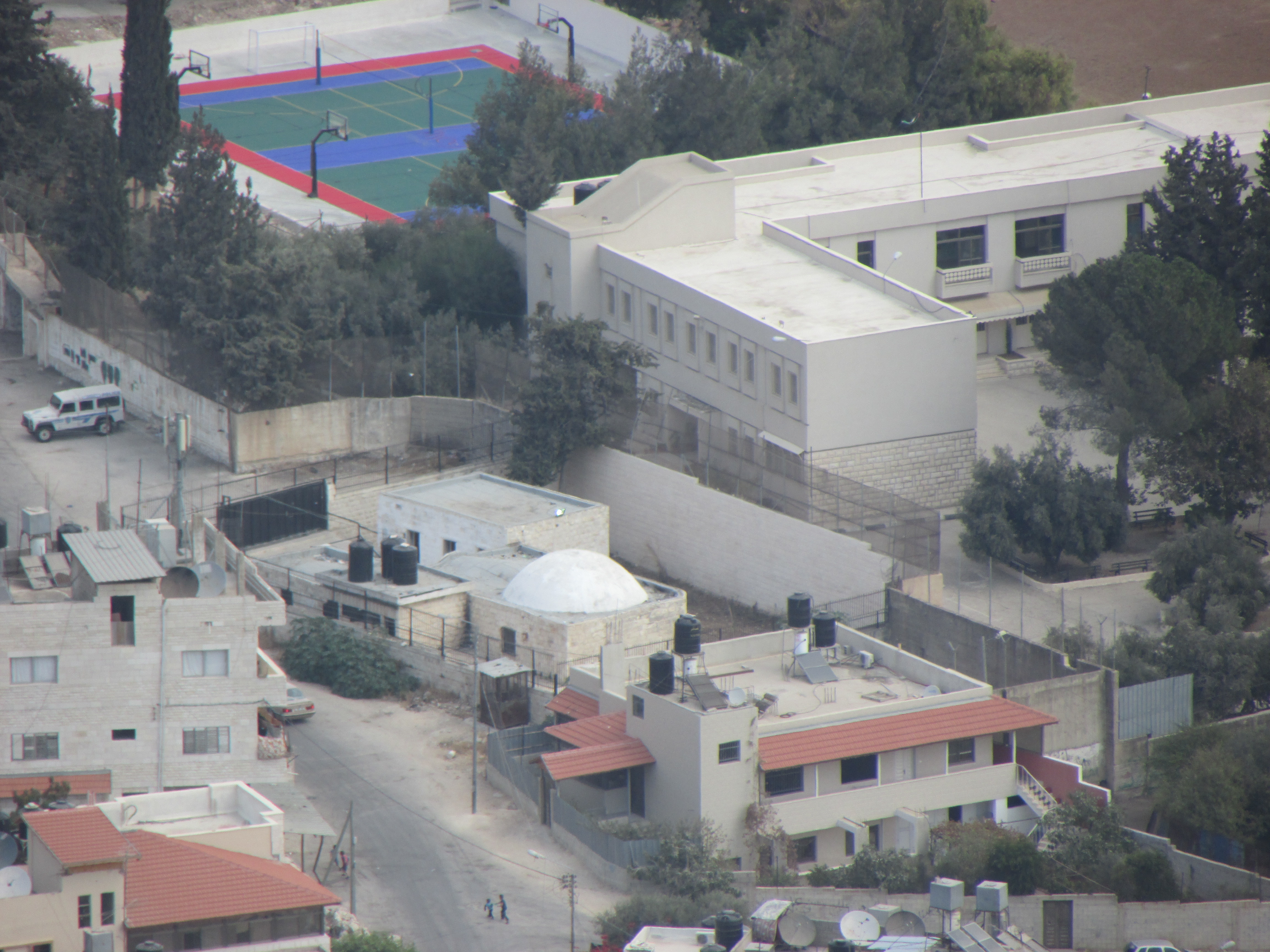
Joseph's Tomb
Mark Twain visited in the 1860s and found it "not very imposing." The small rectangular room with its cenotaph, rebuilt in 1868, sits at the eastern entrance to the valley separating Mounts Gerizim and Ebal, 300 meters northwest of Jacob's Well, on the outskirts of the West Bank city of Nablus. Whether the biblical patriarch Joseph is actually buried here is a question that scholars, pilgrims, and the various religious communities who venerate the site have answered differently for centuries. What is not in doubt is that this modest structure has become one of the most bitterly contested holy sites in the Israeli-Palestinian conflict, attacked and rebuilt so many times that its physical form has become almost secondary to what it represents.
Whose Bones Lie Here?
The site sits near Tell Balata, the location of ancient Shechem, and one biblical tradition identifies this general area as the resting place of the patriarch Joseph and his sons Ephraim and Manasseh. The Book of Joshua records that the bones of Joseph, brought from Egypt during the Exodus, were buried at Shechem. Post-biblical records placing Joseph's tomb somewhere in this vicinity date from the early 4th century CE, when the Bordeaux Pilgrim wrote in 333 CE: "At the foot of the mountain itself, is a place called Sichem. Here is a tomb in which Joseph is laid." Eusebius of Caesarea confirmed the location in his Onomasticon. But the identification has always been contested. Samaritans, for whom the site is their second holiest place, venerate it on their own terms. Some Muslims associate it not with the biblical Joseph but with a local 18th-century sheikh, Yusef al-Dwaik. Jerome, visiting in the 4th century, wrote of seeing "the tombs of the twelve patriarchs" in the area, suggesting multiple traditions were already competing.
A Survey of What Remains
Claude R. Conder of the Royal Engineers provided the most detailed 19th-century survey of the site in his works Tent Work in Palestine (1878) and Survey of Western Palestine (1881). He found an open courtyard measuring about 18 feet square, with plastered whitewashed walls roughly 10 feet high and one foot thick. The entrance from the north passed through the ruin of a small domed building. Two Hebrew inscriptions marked the south wall. The cenotaph itself, a plastered stone structure about five feet long and two feet wide, occupied a small vaulted room. Conder noted that the site was a place of regular pilgrimage for Jews, Samaritans, Christians, and Muslims alike, each group claiming the tomb for its own tradition. The present structure dates from an 1868 reconstruction, though it has been damaged and repaired repeatedly since.
A Microcosm of Conflict
Under the Oslo Accords, Joseph's Tomb remained under Israeli military control even as the surrounding area was transferred to the Palestinian Authority. The site became a flashpoint. In October 2000, during the Second Intifada, Israeli-Druze Border Police corporal Madhat Yusuf was shot and bled to death at the compound after a ceasefire for his evacuation was not arranged in time, and the IDF withdrew under fire, transferring control to the Palestinian Authority. Almost immediately, a crowd ransacked and burned the site. The dome was demolished, and the interior was gutted. Over the following years, the cycle repeated: unauthorized Jewish pilgrimages under cover of darkness, Palestinian attacks on the visitors and the structure, Israeli military incursions to facilitate visits, and renewed vandalism. The tomb was set on fire in 2008, 2011, 2014, 2015, and again multiple times thereafter. Each destruction was followed by repair, each repair by another attack.
Night Pilgrimages and Armed Escorts
After the 2000 withdrawal, groups of Breslov Hasidim and other religious Jews began clandestine nighttime visits, evading army and police checkpoints to pray at the site. The IDF eventually began facilitating monthly escorted visits, typically arriving after midnight with military protection. These visits themselves became sources of friction. In 2011, a Palestinian Authority police officer shot and killed an Israeli man during a pilgrimage. Several PA security officers were later charged with the crime. The site exists in a kind of twilight: under Palestinian civil authority but subject to periodic Israeli military operations, venerated by multiple traditions but controlled fully by none. Clashes near the tomb have become so routine that they barely register as news, even as each incident deepens the scars on an already battered landscape.
What Persists
The tomb's physical modesty stands in stark contrast to its symbolic weight. It is a small room, rebuilt and whitewashed over and over, situated on the edge of a city of nearly 200,000 people. Nablus, the ancient Shechem, spreads through the valley below Mounts Gerizim and Ebal. Jacob's Well is 300 meters to the southeast. The landscape is rich with biblical association and contemporary tension in equal measure. For Samaritans, numbering only about 800 people worldwide, Joseph's Tomb is second in sanctity only to Mount Gerizim itself. For religious Jews, it connects them to the patriarch whose bones were carried out of Egypt. For Palestinians, repeated military incursions around the site represent the broader reality of occupation. The tomb endures not because anyone has agreed on what it means, but because each community's claim is too deeply held to abandon.
From the Air
Located at 32.213N, 35.285E on the eastern outskirts of Nablus (ancient Shechem) in the West Bank, in the valley between Mount Gerizim (881 m) to the south and Mount Ebal (938 m) to the north. The site is a small structure not easily visible from altitude, but the valley setting between the two prominent mountains is a distinctive geographic feature. Ben Gurion International Airport (LLBG) is approximately 75 km to the southwest. Best viewed from 5,000-8,000 ft AGL to appreciate the valley geography. Jacob's Well is 300 m to the southeast.