Juan de Fuca Provincial Park
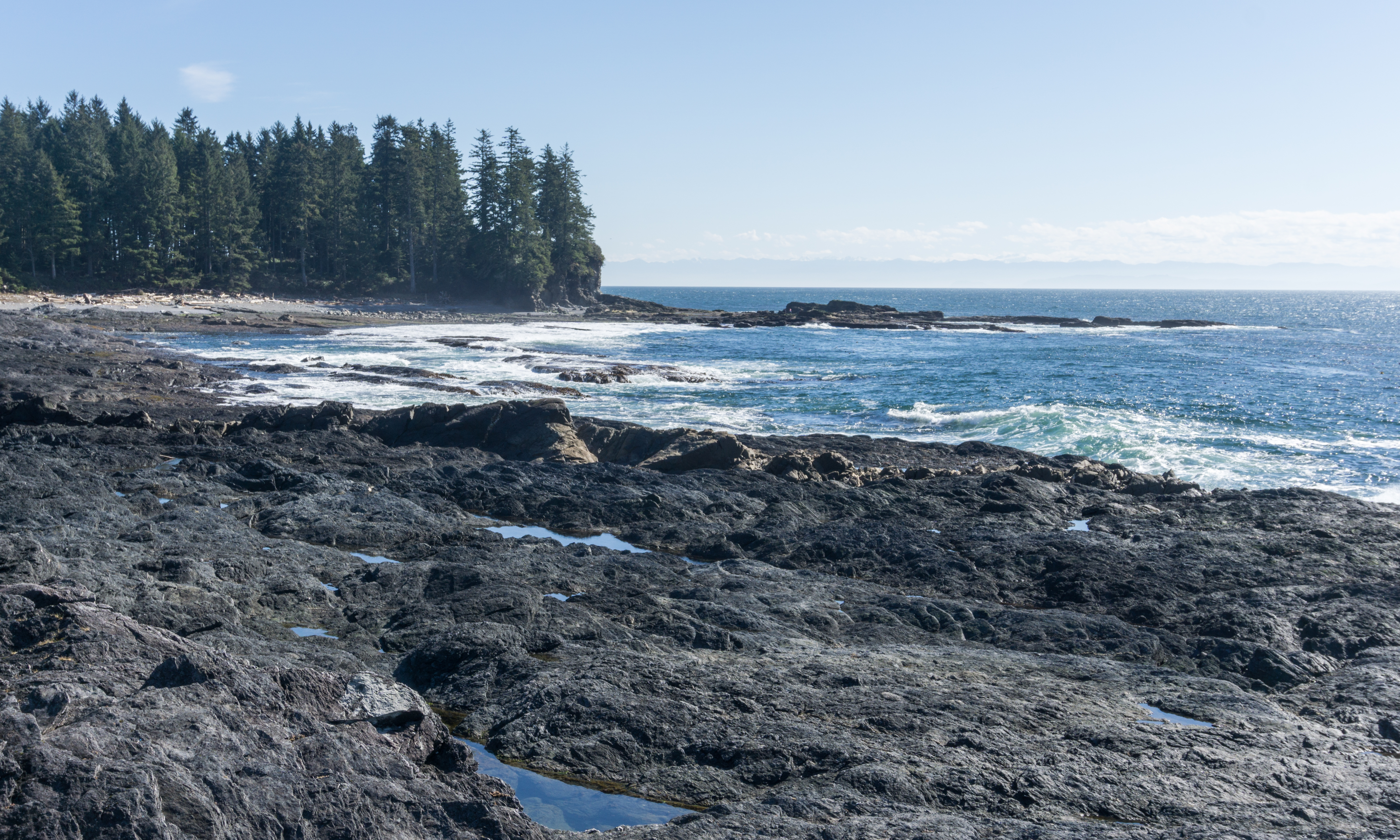
In 1901, Josephine Tilden of the University of Minnesota traveled to the far southwestern tip of Vancouver Island and established the first marine research station in the Pacific Northwest. The location she chose was Botanical Beach, a stretch of wave-carved sandstone shelves near Port Renfrew where the tidepools held a density and diversity of marine life unlike anything she had found closer to home. Minnesota maintained the station for five years before withdrawing in 1906, after the university refused to take ownership of land in a foreign country. The researcher who had recruited Tilden, Conway MacMillan, resigned over the decision. But the scientific interest Tilden ignited never faded -- the Universities of British Columbia, Washington, Victoria, and Simon Fraser all eventually conducted research at Botanical Beach, drawn by the same extraordinary intertidal ecosystem that had attracted a botanist from the prairies.
Three Parks Become One
For decades, the coast between Sooke and Port Renfrew was protected by a patchwork of small, disconnected parks. Loss Creek Provincial Park, established in 1959, was the smallest at just 21 hectares -- barely more than a bridge crossing over its namesake creek. China Beach Provincial Park, created in 1967 at 61 hectares, was the most developed, with a campground and day-use area. Its creation involved a trade: the provincial government allowed logging in the Bedwell Valley of Strathcona Provincial Park, and in return, the forestry company surrendered the China Beach land. Botanical Beach Provincial Park, at 351 hectares, was the largest, established in 1989 to protect both the terrestrial landscape and 120 hectares of foreshore. On April 4, 1996, these three parks were consolidated into Juan de Fuca Provincial Park, creating a continuous protected corridor along one of Vancouver Island's most scenic and ecologically significant coastlines.
The Graveyard of the Pacific's Living Edge
The park protects the shore where Vancouver Island meets the Strait of Juan de Fuca, a coastline known historically as part of the Graveyard of the Pacific for the number of ships it has claimed. But the park's primary role is not commemorative -- it is ecological. The intertidal zone here is spectacularly alive. Red, purple, and orange starfish cling to the rocks alongside sea urchins. White gooseneck barnacles cluster in the surge channels. Blue mussels, green sea anemones, and sea cucumbers crowd the tidepools in a display of color that seems designed to rebuke the gray Pacific sky. The best time to visit is at low tide, when the retreating water reveals pools and shelves that form a living mosaic stretching hundreds of meters along the shore.
Corridor of the Big Predators
The park's forested interior serves as a natural corridor for the larger mammals of the west coast. Cougars move through the understory, hunting the black-tailed deer that browse the edges of the trail. Black bears forage in the berry thickets. Wolves -- the coastal subspecies that hunts both on land and along the shore -- patrol territories that extend beyond the park boundaries. Offshore, harbor seals and Steller's sea lions haul out on the rocks, and river otters work the estuaries where small creeks empty into the strait. The park's 47-kilometer Juan de Fuca Marine Trail runs the full length of this corridor, connecting China Beach in the southeast to Botanical Beach in the northwest. Hikers on the trail share this landscape with predators that have used the same coastal route for millennia.
A Park Born From Bargains
The history of Juan de Fuca Provincial Park is a history of negotiation -- between conservation and industry, between federal and provincial authority, between scientific aspiration and bureaucratic caution. The China Beach land was purchased with logging concessions elsewhere. Botanical Beach's nature reserve started at 47 hectares in 1961, expanded in 1966 to include 2,200 meters of shoreline, and spent two decades in planning before the full park was established. The Juan de Fuca Marine Trail was funded by Parks Canada, built by private contractors, then handed to BC Parks when federal interest shifted. Each step involved compromise. The result is a park that protects a coastline Josephine Tilden recognized as extraordinary more than a century ago, in a landscape where the tension between extraction and preservation has never fully resolved.
From the Air
Located at 48.48N, 124.28W on the southwestern coast of Vancouver Island, between Sooke (35 km east) and Port Renfrew (36 km west). The park stretches along the Strait of Juan de Fuca coast. Nearest major airport: Victoria International (CYYJ), about 90 km east. From altitude, look for the narrow strip of forest between Highway 14 and the rocky Pacific shoreline, with Botanical Beach's distinctive tidepool shelves visible at the northwestern end near Port Renfrew.