Juche Tower
Count the blocks. There are 25,550 of them, stacked into a tapering granite spire that rises 150 meters above the east bank of the Taedong River. The number is not arbitrary: it is 365 multiplied by 70, one block for each day of the first seventy years of Kim Il Sung's life, excluding leap days. Capped with a 20-meter, 45-ton metal torch that burns permanently against the Pyongyang sky, the Tower of the Juche Idea is both a monument to an ideology and a feat of obsessive arithmetic, the kind of structure that only a state with absolute control over its labor force and an unwavering commitment to symbolic precision could produce.
Seventy Dividers, One Birthday
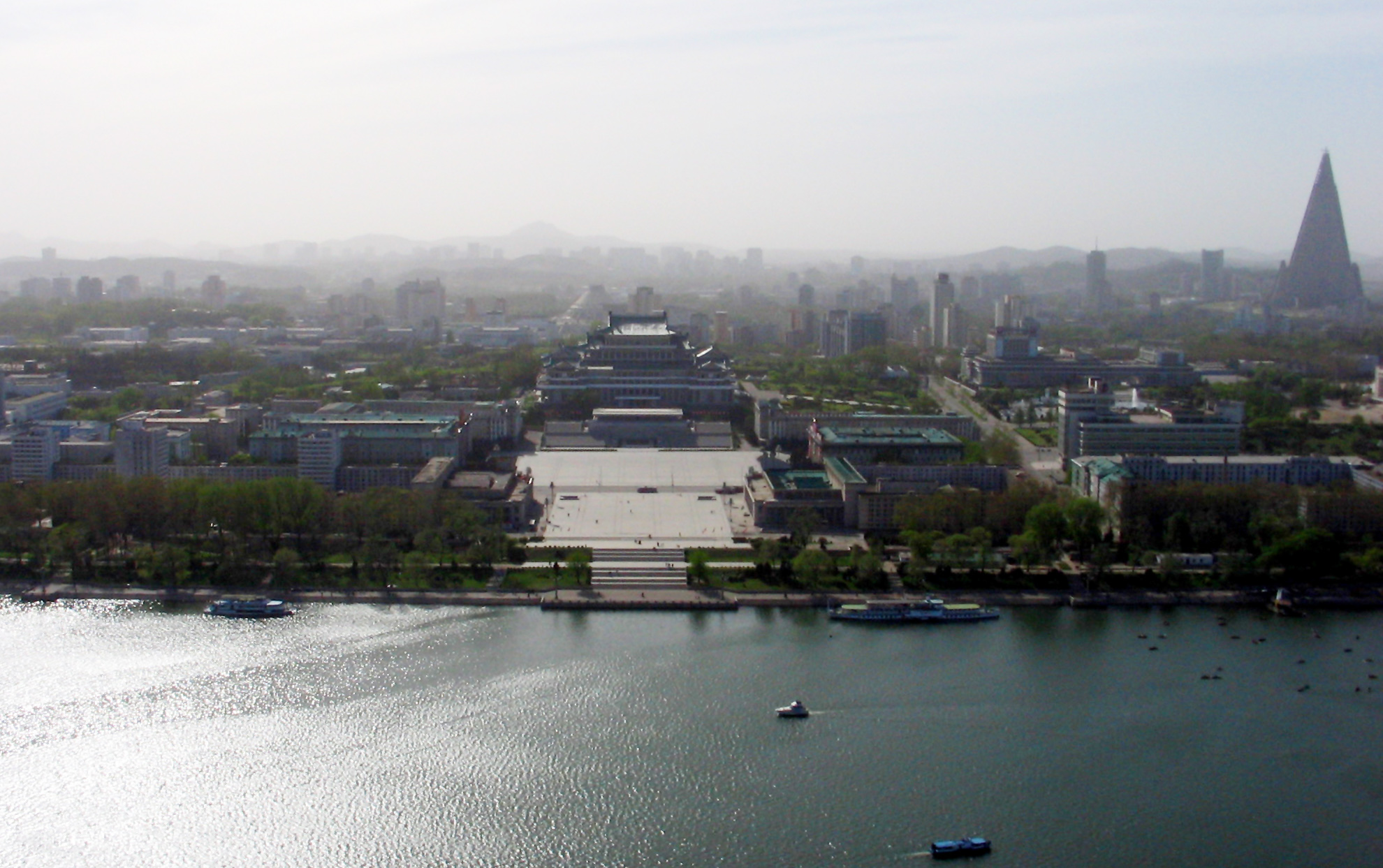
The Juche Tower was completed in 1982 to commemorate Kim Il Sung's seventieth birthday. Although his son and successor Kim Jong Il is officially credited as the tower's designer, interviews with former North Korean officials have cast doubt on that claim. The tower stands on the east bank of the Taedong River, directly across from Kim Il Sung Square on the west bank -- a deliberate positioning that creates a visual axis between the state's political center and its ideological monument. The architectural style draws on the tradition of Korean stone pagodas, scaled up to a height that makes the Juche Tower the second-tallest monumental column in the world, surpassed only by the San Jacinto Monument in Texas by a margin of just 2.9 meters. An elevator carries visitors to an observation platform just below the torch, offering wide views across Pyongyang's grid of broad avenues and monumental buildings.
Hammer, Sickle, and Brush
At the base of the tower stands a 30-meter bronze sculpture that distills North Korea's self-image into three figures. A worker holds a hammer. A peasant holds a sickle. A "working intellectual" holds a writing brush -- the traditional East Asian ink brush, elevated here to the status of a tool of production equal to those of manual labor. Together, the three instruments form the emblem of the Workers' Party of Korea, and their arrangement echoes the Soviet Union's iconic Worker and Kolkhoz Woman statue, though with the distinctly Korean addition of the intellectual. Six smaller sculptural groups, each ten meters high, surround the main composition, depicting other aspects of Juche ideology. The overall effect is Stalinist monumental art translated into Korean visual language -- imposing, idealized, and engineered to make the individual viewer feel very small.
Self-Reliance in Granite
Juche -- variously translated as "self-reliance" or "subject" -- is the state ideology that Kim Il Sung articulated beginning in the 1950s as North Korea's philosophical foundation. It posits that man is the master of his own destiny and that a nation must be politically independent, economically self-sufficient, and militarily self-reliant. In practice, it has served as the ideological justification for North Korea's isolation, its personality cult, and its rejection of outside influence. The tower makes the ideology physical. White stone dresses the granite blocks, seventy horizontal dividers mark the years of Kim Il Sung's life like rings in a tree, and the permanently lit torch at the summit symbolizes the eternal flame of revolutionary thought. At the tower's base, reception rooms screen videos explaining the structure's ideological significance to visitors.
Eighty-Two Nations on a Wall
A wall surrounding the tower complex carries 82 friendship plaques from foreign supporters and Juche study groups around the world -- a physical catalog of the ideology's international reach during the Cold War era, when North Korea actively cultivated sympathetic organizations in developing nations and among Western leftist movements. The plaques represent countries and organizations that established Juche study committees, a phenomenon that peaked in the 1970s and 1980s. Today, the wall reads as a time capsule of a particular moment in geopolitics, when competing ideological systems vied for global allegiance and even a small, isolated state could project intellectual influence through dedicated organizing. The tower itself remains Pyongyang's most recognizable landmark -- visible from almost everywhere in the city, its torch burning above the Taedong River day and night, a granite exclamation point on the North Korean skyline.
From the Air
Located at 39.02N, 125.76E on the east bank of the Taedong River in central Pyongyang. The 170-meter tower is the tallest structure in the city and is visible from considerable distance. It stands directly across the river from Kim Il Sung Square. Pyongyang Sunan International Airport (ZKPY) is approximately 20 km to the north. The tower's permanently illuminated torch is a distinctive feature visible even in low-light conditions. Pyongyang's monumental architecture -- including the Arch of Triumph and the Ryugyong Hotel -- provides additional orientation landmarks.