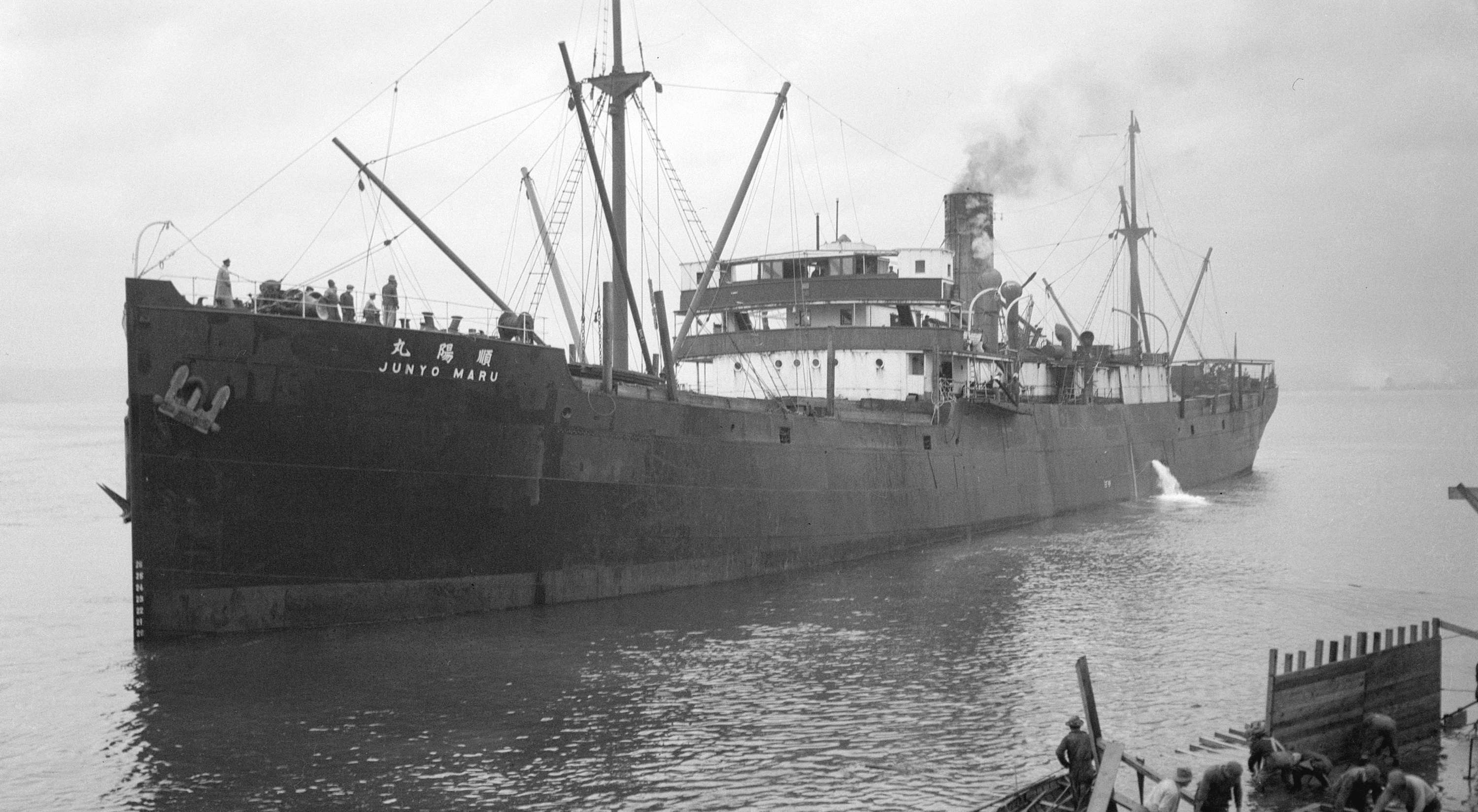
Jun'yō Maru
More than 5,000 people died in waters that offer no marker, no wreath, no memorial stone. On September 18, 1944, two torpedoes from a British submarine struck a rusting cargo ship off the west coast of Sumatra, and within fifteen minutes the Jun'yō Maru took most of her human cargo to the bottom. The dead were Javanese forced laborers and Allied prisoners of war, crammed into bamboo-partitioned holds with almost no latrines, too little water, and only two lifeboats for more than 6,500 souls. It remains one of the highest death tolls of any ship sunk by submarine in history, yet the disaster is barely remembered outside the families who lost someone that day.
Five Names, Five Lives
The ship began life innocently enough. Robert Duncan & Co launched her at Port Glasgow on October 30, 1913, a modest cargo steamer christened Ardgorm by her Scottish owners, Lang & Fulton Ltd, who gave all their tramp ships names beginning with "Ard." Over the next fourteen years she changed hands and names with the frequency of a playing card dealt around a table: Hartland Point under Furness, Withy & Co in 1917, then Hartmore when transferred to their Johnston Line subsidiary in 1918, then Sureway when the Anglo-Oriental Navigation Company bought her in 1921. Each new name came with a new home port -- Greenock, Liverpool, London. In 1927, Sanyo ShaGoshi Kaisha purchased the ship and renamed her Junyo Maru, registering her in Takasago. By 1938, under yet another owner, the registered spelling became Zyunyo Maru. None of these names prepared her for what she would carry in the last months of her existence.
A Floating Prison
By September 1944, bamboo scaffolding had been fitted between her decks, creating bunks stacked three and four deep in her holds. The conversion was efficient in the way that cruelty often is: maximum bodies, minimum accommodation. About 4,200 Javanese rōmushas -- forced laborers conscripted by the Japanese occupation -- were packed into the forward holds. Behind the superstructure, in holds three and four, went an estimated 2,300 Allied prisoners of war, among them at least 1,700 Dutch, 506 Indonesians, and 14 Americans. Many were already sick with malnutrition and dysentery before they even stepped aboard at Tanjung Priok, the port serving Batavia on Java. Some died in the holds before the ship ever reached open water. Others became delirious. The destination was Pekanbaru, on Sumatra, where all of them were to build a railway through the jungle -- another project sustained by expendable lives.
Fifteen Minutes in the Indian Ocean
On September 16, the Jun'yō Maru left Tanjung Priok, threading through the Sunda Strait and passing the volcanic island of Krakatoa. By the 18th she was heading for Padang with two small escort vessels, one on each quarter. She zigzagged defensively, but one of her turns placed her broadside to HMS Tradewind, a British submarine lying submerged and watching through her periscope. At approximately 1600 hours, Tradewind fired four torpedoes from about 1,800 yards. Two struck home -- one in the forward holds where the rōmushas were packed, the other aft among the Allied prisoners. The ship began sinking by the stern immediately. Her Japanese crew launched one of the two lifeboats, but it was already damaged and quickly swamped. When prisoners of war in the water tried to reach it, the occupants used an axe to beat them away.
What the Water Took
Lieutenant Commander H.C. Upton of the Royal Naval Volunteer Reserve, the senior British prisoner aboard, organized what rescue he could in the chaos. He directed men to launch liferafts and throw overboard any loose timber or dunnage that might keep someone afloat. But the rōmushas and prisoners trapped below decks had almost no chance -- the bamboo partitions that divided the holds into sleeping quarters now blocked their escape. The Jun'yō Maru went under in about fifteen minutes. One escort vessel dropped three depth charges at the Tradewind, which dived deep and escaped undamaged. The other picked up Japanese survivors. It was not until the next morning that an escort ship returned for the prisoners. Of the roughly 6,500 people aboard, only 680 survived. A compiled list of names puts Allied prisoner deaths at approximately 1,449. Most estimates place the rōmusha dead between 4,000 and 4,100, though the exact number will never be known -- the forced laborers were not listed by name.
The Railway They Built Anyway
The 680 survivors were taken to Pekanbaru and put to work on the very railway they had been shipped to build. The project consumed lives with an indifference that the transportation of those lives had already demonstrated. The Jun'yō Maru disaster ranks among the deadliest submarine sinkings in history, comparable only to the German prison ships Cap Arcona and Thielbek, which were sunk while carrying concentration camp deportees. Yet the Jun'yō Maru occupies a peculiar silence in public memory. The Tradewind's crew did not know they were firing on a prison ship; no Allied commander ordered the deaths. The Japanese command, which had loaded sick and starving people onto an aging freighter with two lifeboats, bears the weight of what happened. The waters off Sumatra's west coast, near coordinates 2.88 South, 101.18 East, hold no monument. The sea gives nothing back. What remains are names on compiled lists, and even those are incomplete.
From the Air
Located at 2.88S, 101.18E in the Indian Ocean off the west coast of Sumatra, Indonesia. The sinking site lies roughly midway between the Sunda Strait to the south and Padang to the north, in waters that show no surface indication of the wreck. Fly at 2,000-5,000 ft AGL for a sense of the open ocean expanse. The Sumatran coastline is visible to the east. Sultan Thaha Airport in Jambi (WIPA) lies approximately 150 km to the northeast. Minangkabau International Airport in Padang (WIPT) is roughly 200 km to the northwest. Visibility is typically good in this equatorial zone, though tropical squalls can reduce it rapidly.