June 2009 Washington Metro Train Collision
Five days before the crash, a technician replaced a track circuit component on a stretch of the Red Line between the Fort Totten and Takoma stations. The repair introduced a defect -- parasitic oscillations that left the circuit unable to reliably detect whether a train occupied that section of track. On the afternoon of June 22, 2009, that invisible flaw became lethal. A southbound Metro train stopped within the faulty circuit and vanished from the Automatic Train Control system. The train behind it received a full-speed command to proceed. Nine people died. It remains the deadliest accident in Washington Metro history.
Five O'Clock on the Red Line
At 4:57 pm on a Monday afternoon, Train 112 pulled out of the Takoma station, bound from Glenmont to Shady Grove on the Red Line. Rush hour was in full swing. Five minutes later, at 5:02 pm, Train 112 slammed into the rear of Train 214, which had stopped on the tracks ahead. The collision killed nine people, including the operator of Train 112, Jeanice McMillan, 42, of Springfield, Virginia. Eighty others were injured. Among the dead was Major General David F. Wherley Jr. of the District of Columbia Air National Guard -- the officer who had ordered fighter jets into the skies over Washington during the September 11 attacks -- along with his wife, Ann. The other victims were Lavonda King, Veronica DuBose, Cameron Williams, Dennis Hawkins, Mary Doolittle, and Ana Fernandez.
The Ghost Train
The NTSB investigation revealed a chilling sequence. Train 214 had come to a stop entirely within faulty track circuit B2-304. Because the circuit could not detect the train's presence, Train 214 effectively became a ghost -- invisible to the Automatic Train Control system that governed traffic on the line. Other trains passing through this circuit had received zero-speed commands but retained enough momentum to coast into the next functioning circuit and resume normal operations. Train 214 was different: its operator was driving in manual mode, moving slower than usual, and the train came to a complete stop while still within the broken circuit. The ATC system, seeing no obstacle, commanded Train 112 to proceed at full speed. McMillan applied the emergency brake the moment she saw the stopped train ahead, but at that speed and distance, the physics were merciless.
Soldiers and Firefighters
Within minutes of the collision, two passengers from the lead train -- Army soldier Dennis Oglesby and Army contractor Martin Griffith -- climbed from the wreckage unhurt and began pulling survivors to safety. They found six to eight passengers from Train 214 who had been ejected by the force of impact, including one person thrown onto the roof of the stationary train with a severe head wound. Oglesby and Griffith administered first aid and alerted arriving firefighters that the third rail was still electrified. When D.C. Fire and Emergency Medical Services reached the scene, the initial 911 calls had understated the severity. Fire Chief Dennis Rubin quickly escalated to mass casualty protocols. Within two hours, more than 200 firefighters were working the three-alarm scene. Crews labored through the night with cranes and heavy rescue equipment. Five bodies were not recovered until the following morning, found only after cranes began dismantling the telescoped railcars.
What the Wreckage Revealed
The NTSB report, released on July 27, 2010, placed the blame squarely on the faulty track circuit. The investigation also exposed systemic vulnerabilities: the lead car of Train 112, a 1000-series railcar, was two months overdue for scheduled brake maintenance and lacked a data recorder. The 1000-series cars, the oldest in the fleet, were structurally the weakest and most prone to telescoping -- the catastrophic compression that crushed McMillan's cab. WMATA immediately banned 1000-series cars from the lead and trailing positions of any trainset. The aging fleet served in middle positions for another eight years before retirement in 2017. The wrecked cars from the collision were never repaired; they became parts donors to keep the remaining fleet running until the series was fully retired.
A Sacred Grove
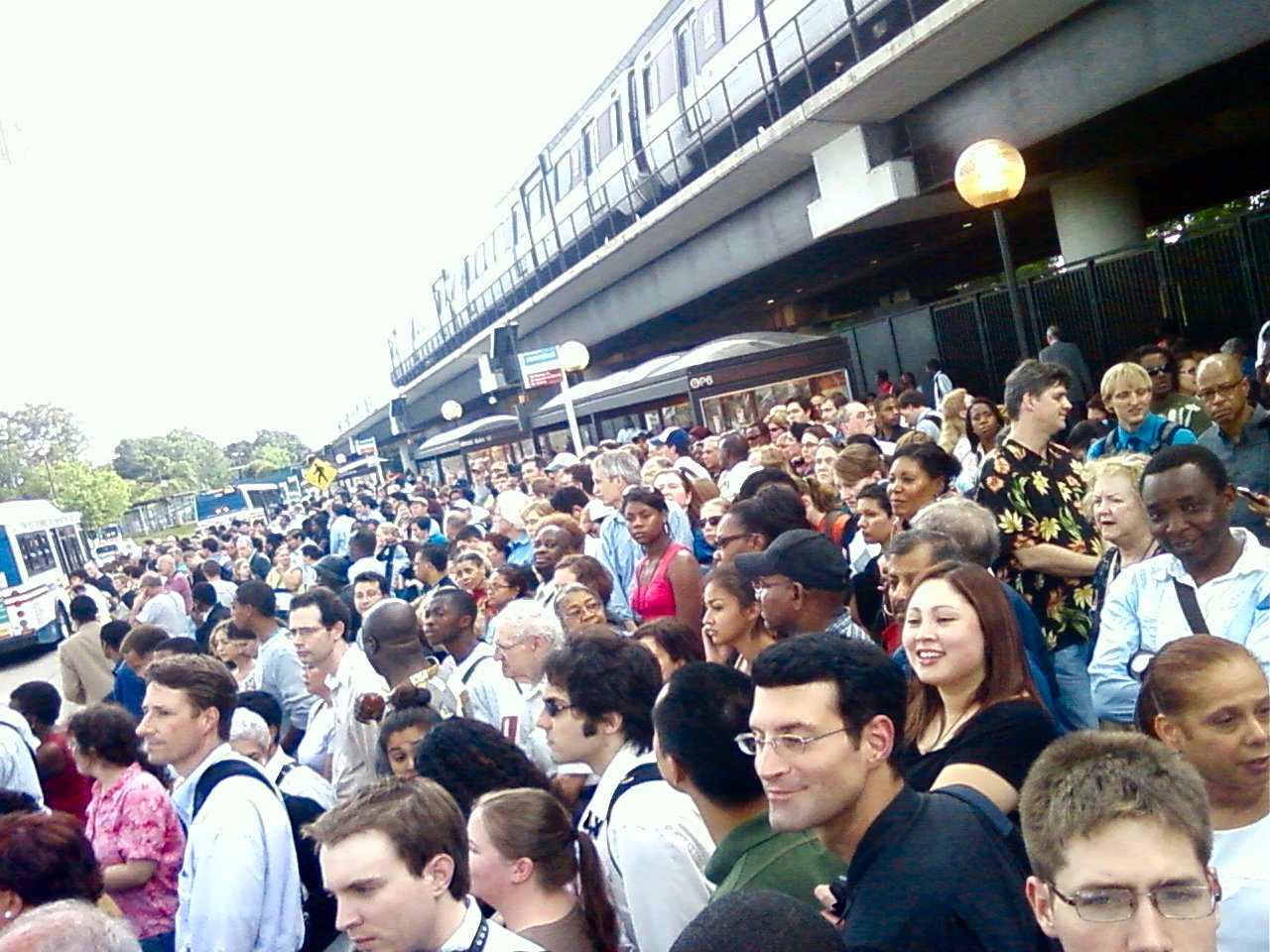
Red Line service between Fort Totten and Silver Spring was suspended for five days after the crash. The federal government urged Washington-area employees to telework. When service resumed on June 27, the entire Red Line operated under reduced speed limits. The scars lasted longer than the disruption. On June 22, 2015, the sixth anniversary of the collision, the Legacy Memorial Park opened near the crash site at the entrance to Blair Memorial Gardens. The park features a memorial wall and nine inscribed sculptures -- one for each victim -- created by sculptor Barbara Liotta. The design, titled A Sacred Grove, was conceived by the firm Hunt Laudi. Families of the victims and city officials attended the dedication. Metro officials did not. A plaque in Fort Totten station's mezzanine also commemorates those who were lost.
From the Air
Located at 38.9603N, 77.0058W on the Red Line tracks between Fort Totten and Takoma stations in Northeast Washington, D.C. The crash site is near the intersection of the Metro tracks and New Hampshire Avenue. The Legacy Memorial Park is visible near Blair Memorial Gardens. Nearest airports: KDCA (Ronald Reagan Washington National, 7 nm south), KIAD (Washington Dulles International, 27 nm west). The Red Line tracks run roughly parallel to the CSX/Amtrak corridor in this area. Best viewed below 2,000 feet AGL.