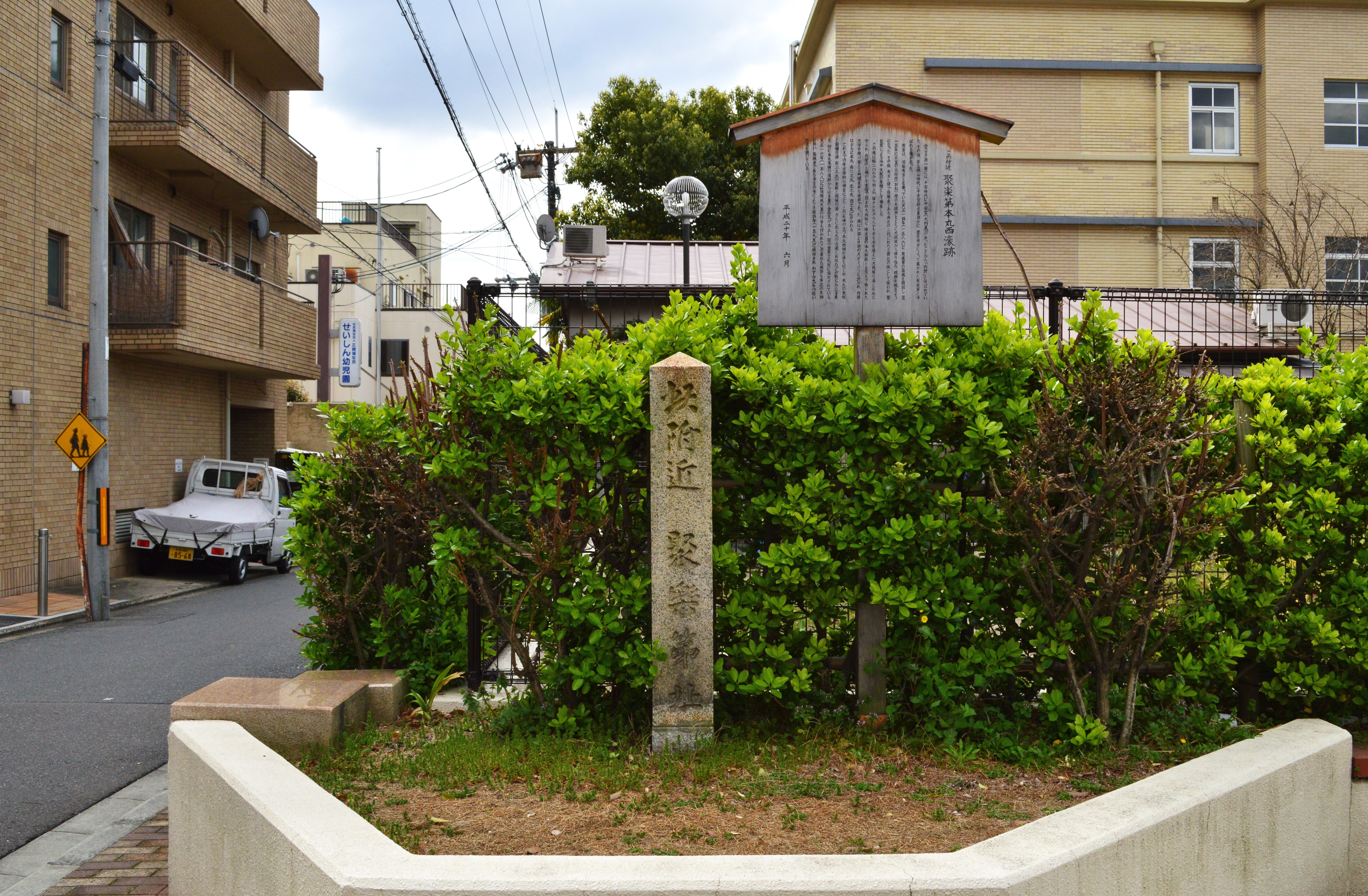
Jurakudai: The Palace That Vanished
For nine years, the most extravagant palace in Japan stood in what is now the quiet Kamigyo ward of Kyoto. Then Toyotomi Hideyoshi -- the peasant who had clawed his way to the top of Japan's feudal hierarchy -- ordered it erased. The Jurakudai was demolished so thoroughly that for centuries its exact footprint was debated. Only recently have excavations turned up gold-leafed roof tiles from the site, glittering fragments of a building that was designed to overwhelm the senses and enforce obedience in equal measure. The man who built it was not interested in subtlety. He wanted the most powerful people in Japan to walk through his gates, see what he had built on the ashes of an older imperial compound, and understand who ruled.
A Peasant's Castle in the Emperor's Backyard
Construction began in 1586, the year Hideyoshi assumed the title of Kampaku -- regent to the emperor, the highest civilian rank in Japan. He chose his site with calculated symbolism: the Kamigyo district where Kyoto's imperial palace had stood during the Heian period, roughly the eighth through twelfth centuries. The project took nineteen months. When completed, the Jurakudai covered an area nearly equal to the Imperial Palace Enclosure itself. But unlike the restrained elegance associated with court architecture, Hideyoshi built something that blurred the line between palace and fortress. The walls were thick, the moat deep, the decorations staggeringly lavish. Gold leaf covered the roof tiles. Interior screens and panels were painted by masters of the Kano school. It was Osaka Castle's military strength dressed in Kyoto's cultural refinement -- a message that the man inside commanded both swords and brushes.
Tears of Gratitude, Oaths of Submission
In early 1588, Hideyoshi invited Emperor Go-Yozei to the palace. The visit was carefully choreographed. Maeda Geni, one of Hideyoshi's Five Commissioners, studied the protocols of previous imperial receptions to ensure that every detail signaled legitimacy. The emperor arrived escorted by court nobles, mounted samurai, and what one diarist recorded as "innumerable men at arms." Hideyoshi rode directly behind the imperial procession -- the highest-ranking court official in the land. Inside the Jurakudai, Japan's most powerful lords waited, including Tokugawa Ieyasu and Oda Nobukatsu. Over five days the assembled lords signed a three-part oath: expressing gratitude for the emperor's presence, pledging to defend crown estates, and swearing obedience to the regent "down to the smallest particular." The diarist Kusunoki Masatora recorded these events. A year later, Hideyoshi invited the court nobles back and displayed a vast quantity of gold and silver heaped on plates, then distributed it among his guests. The gesture was part generosity, part demonstration of inexhaustible wealth.
The Nephew's Ruin
In 1591, Hideyoshi stepped down as Kampaku and installed his nephew Toyotomi Hidetsugu in the role. Hidetsugu moved into the Jurakudai and even hosted a second imperial visit from Emperor Go-Yozei. But Hideyoshi's relationship with his nephew deteriorated rapidly. Hideyoshi had produced a biological son, Toyotomi Hideyori, in 1593, changing the calculus of succession. Suspicion and rivalry poisoned the uncle-nephew bond. In 1595, Hidetsugu was accused of treason and ordered to commit seppuku at Mount Koya. His wives, concubines, and children were executed in Kyoto shortly afterward. With Hidetsugu gone, Hideyoshi ordered the Jurakudai demolished. The building was dismantled systematically -- walls pulled down, gates unhinged, decorative elements carted away. Many parts were transported south to Fushimi, where Hideyoshi was building a new castle, and reassembled there. The site in Kamigyo was left empty, a conspicuous void in the city's fabric.
Scattered Survivors
Though the palace itself vanished, pieces of it were absorbed into Kyoto's surviving architecture. The Hiunkaku pavilion at Nishi Honganji temple -- a three-story structure overlooking a garden pond -- is believed to have originated at the Jurakudai. The ornate Chinese-style karamon gate at Daitokuji, one of Kyoto's great Zen temple complexes, is another attributed fragment. The front gate of Myokakuji temple is considered a third survivor. These buildings carry the aesthetic DNA of Hideyoshi's vanished palace: elaborate carvings, bold ornamentation, the confidence of a patron who wanted every surface to declare power. Archaeological excavations at the original Kamigyo site have uncovered roof tiles still bearing traces of gold leaf -- physical proof that the accounts of the Jurakudai's extravagance were not exaggerated. The palace existed for less than a decade, but its fragments, scattered across Kyoto's temple compounds, have endured for more than four centuries.
From the Air
Located at 35.025°N, 135.746°E in the Kamigyo ward of Kyoto, Japan. The original Jurakudai site is now a residential and commercial neighborhood with no above-ground remains, but surviving architectural fragments can be found at Nishi Honganji (approximately 1.5 km south), Daitokuji (approximately 2 km north), and Myokakuji (approximately 0.5 km south). The Kyoto Imperial Palace lies approximately 1 km to the east. Nearest airports: Osaka Itami (RJOO) approximately 20 nm southwest, Kansai International (RJBB) approximately 45 nm south. Best viewed at 2,000-3,000 feet AGL to appreciate Kyoto's grid layout and the relationship between the historic palace sites.