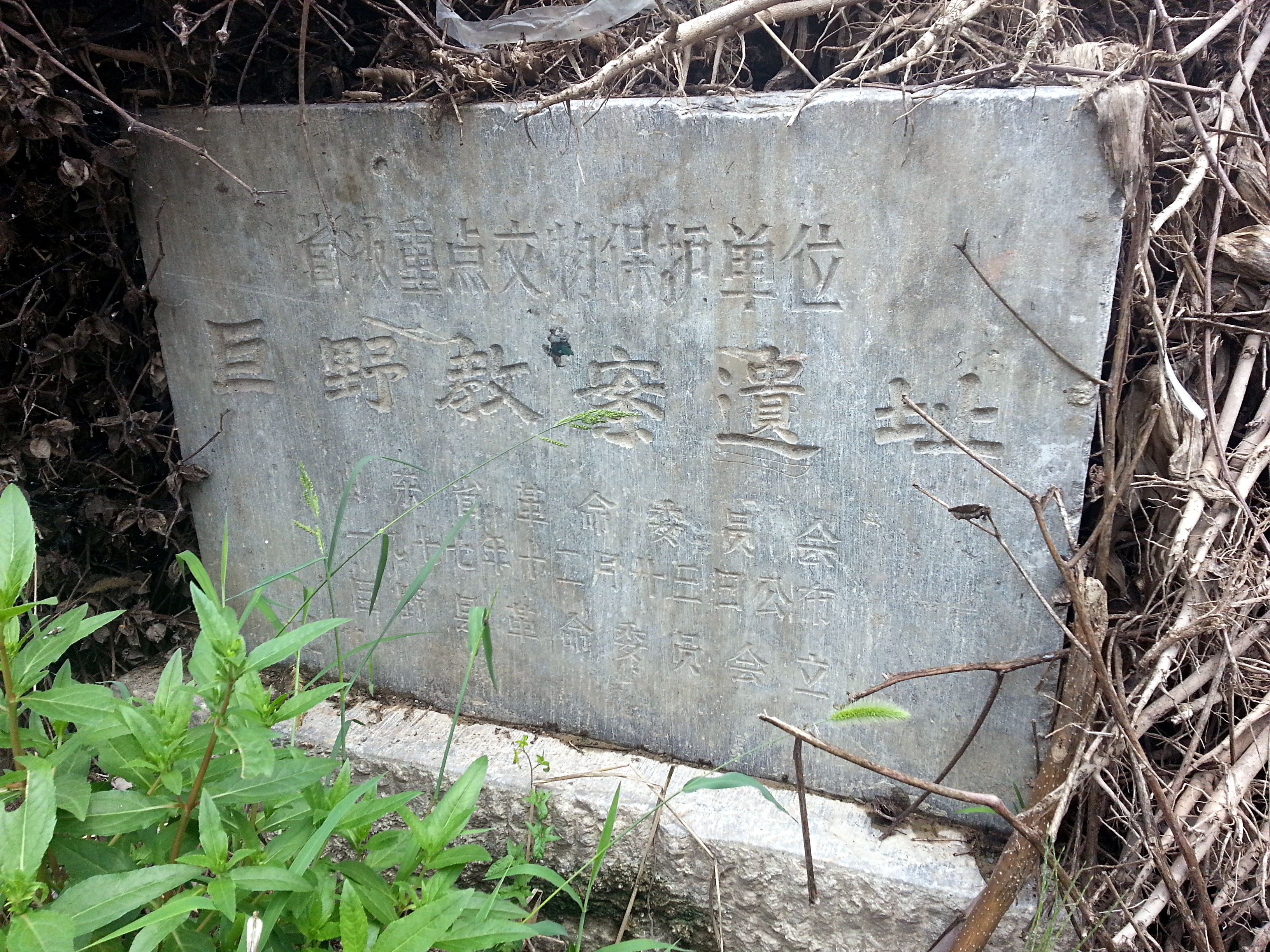
Juye Incident
Shortly before midnight on the night of November 1, 1897, as All Saints' Day turned to All Souls' Day, two German Catholic missionaries lay dead in a village compound in rural Shandong Province. Richard Henle and Franz Xaver Nies, members of the Society of the Divine Word, had been visiting a fellow priest named Georg Maria Stenz at his mission station in Zhang Jia Village, about 10 kilometers northeast of the town of Juye. Minutes earlier, the three missionaries had been rehearsing a Requiem Mass for the following day. Within two weeks, the German Empire would use their deaths to seize Jiaozhou Bay on Shandong's coast, setting off a chain of events that, as historian Joseph W. Esherick later wrote, "radically altered the course of Chinese history."
A Compound in the Dark
Stenz was the intended target. He was the resident priest at Zhang Jia Village, about 25 kilometers northwest of the city of Jining, and he had inserted himself into local conflicts in ways that made enemies. He had denied a neighboring village warden admission to the Catholic church after the man was accused of stealing an ox, while allowing wealthier families from the same village to convert. Those new converts then refused to pay for local temple feasts, citing their adopted religion. The resulting dispute festered. On that November night, Stenz had given his room to his guests and moved to a vacant porter's room. A band of twenty to thirty armed men broke through the compound gates shortly after the missionaries went to bed, forced open the door to the room where Henle and Nies slept, and stabbed both men repeatedly. They searched for Stenz but could not find him. Local Chinese Christians arrived and the attackers withdrew.
Justice That Satisfied No One
The Chinese authorities classified the attack as a robbery, despite the lethal violence used and the fact that only a few clothing items had been taken. About 50 people were arrested, seven convicted: two sentenced to death and beheaded, five given life in prison. Stenz himself believed none of the convicted were actually guilty. The attackers were most commonly assumed to be members of the Big Swords Society, a decentralized network of peasant self-defense groups, but their identities were never established with certainty. The investigation served neither truth nor justice; it served the competing interests of local Chinese officials trying to minimize the incident and German diplomats looking to maximize it.
The Pretext Germany Wanted
Less than two weeks after the murders, the German Empire seized Jiaozhou Bay on Shandong's southern coast. Under German threats, the Qing government was forced to remove numerous Shandong officials, including Governor Li Bingheng, and to build three Catholic churches in Jining, Caozhou, and Juye at government expense. The attacked mission received 3,000 taels of silver in compensation and the right to construct seven fortified residences in the area, also paid for by the Chinese government. The settlement dramatically strengthened missionary work in southern Shandong, which in turn deepened the resentment that fueled the Boxer Uprising of 1899 to 1900. Imitating Germany's territorial grab, Russia, Britain, France, and Japan launched what became known as the Scramble for China, each securing spheres of influence across the weakening Qing empire.
The Wedge That Split an Empire
Historian Paul Cohen called the Juye Incident "the opening wedge in a process of greatly intensified imperialist activity in China." The phrase captures both the event's modesty and its consequences. Two men died in a village compound in the middle of the night, probably killed by local peasants with local grievances. But their deaths arrived at a moment when European powers were looking for exactly such pretexts, and the German response transformed a rural murder into an international crisis. The missionaries themselves had been complicit in the tensions that killed them, taking sides in community disputes and extending the protections of foreign power to Chinese converts who used their new religious status to avoid local obligations. None of this excuses their murder, but it illuminates the volatile mixture of imperial ambition, missionary activity, and peasant resentment that defined late Qing China. The ground where Zhang Jia Village once stood is marked today by a roadside sign, a small gesture toward remembering an event whose ripples reshaped an empire.
From the Air
Located at 35.547N, 115.992E in Juye County, Shandong Province. The terrain is flat agricultural plain typical of the North China Plain. The site of Zhang Jia Village lies approximately 10 km northeast of the town of Juye and 25 km northwest of Jining. Nearest major airport is Jining Da'an Airport (ZSJG). The area is crossed by the Grand Canal and agricultural waterways visible from altitude.