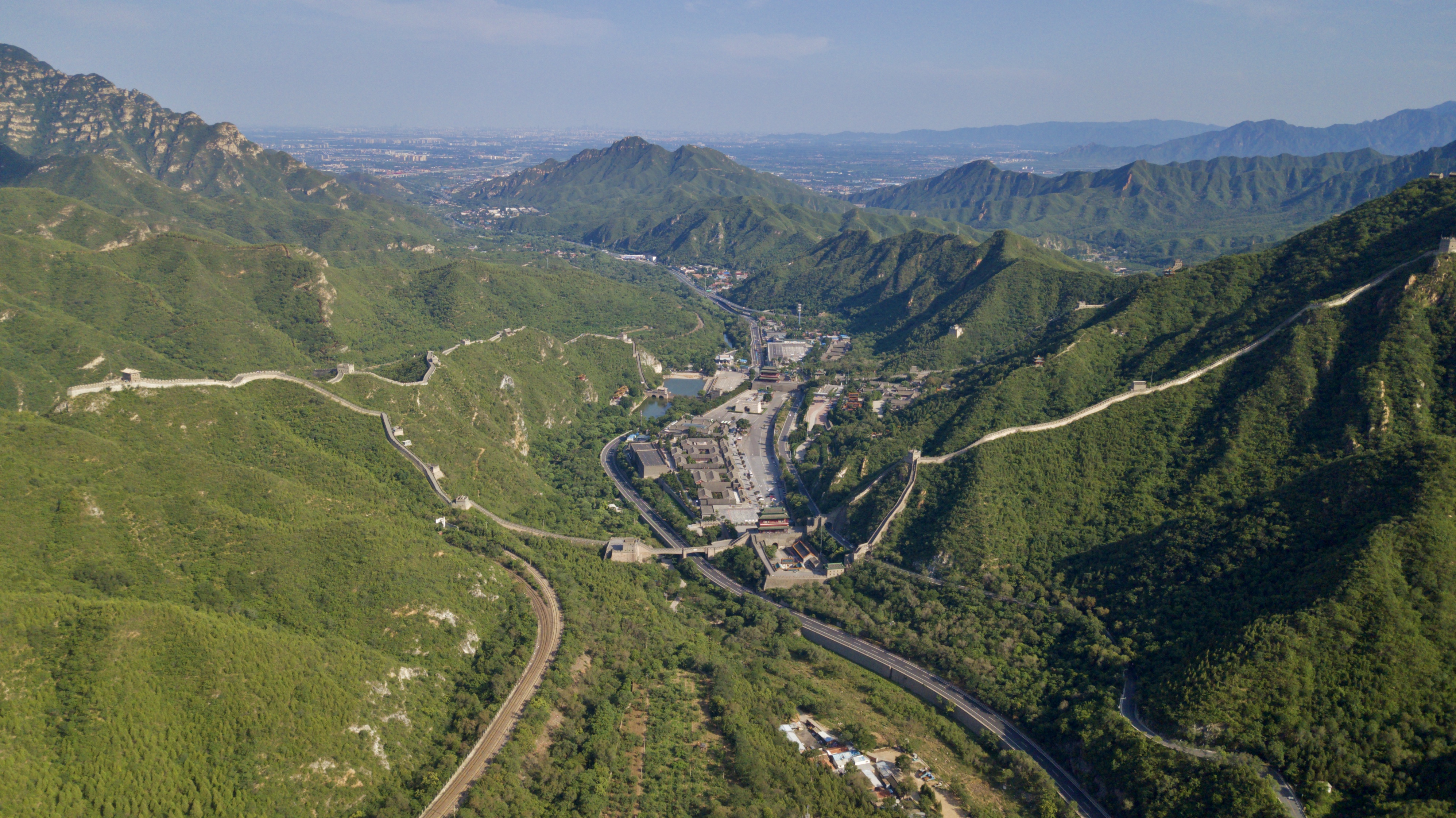
Juyong Pass
Every army that wanted Beijing had to answer the same question: how do you get through the mountains? For over two thousand years, the answer has been Juyong Pass, an 18-kilometer-long valley called Guangou that cuts through the Jundu Mountains like a wound in the landscape. Control this pass and you control the northern approach to the Chinese capital. Lose it and the capital falls.
The Valley of Forced Laborers
The name Juyongguan has been in use since the Qin dynasty, when Emperor Qin Shi Huang ordered the Great Wall's construction in the third century BC. The name itself tells a story: it derives from the forced laborers, the yong, who were gathered, ju, here to build the wall. Thousands of conscripted workers labored in this narrow valley, laying the stones that would funnel future invaders into a killing ground. The pass was connected to the Great Wall proper during the Northern and Southern dynasties era, and by the Ming dynasty, it had been designated one of the Three Inner Passes from Mongolia to Beijing, alongside Daoma Pass and Zijing Pass. It also held the distinction of being one of the three Great Mountain Passes of the entire Great Wall, ranking with Jiayuguan in the far west and Shanhaiguan where the wall meets the sea.
A Fortress in Two Halves
Juyong Pass is not a single gate but a system of interlocking defenses. The pass has two sub-passes: the southern one, simply called Nan, and the northern one, known today as Badaling. Between them, the Guangou Valley narrows to the point where a small garrison could hold off a much larger force. The Ming dynasty rebuilt the present pass route and fortified it extensively, understanding that Juyong was not merely a checkpoint but the hinge on which Beijing's security turned. The walls climb steeply on both sides of the valley, following the ridgeline in the characteristically aggressive Ming style, watchtowers positioned at intervals calculated to overlap their fields of fire. Looking up from the valley floor, the wall appears to defy gravity, ascending nearly vertical slopes with a stubbornness that mirrors the military logic behind its placement.
The Cloud Platform Below
In the middle of the pass stands one of China's most remarkable monuments. The Cloud Platform, built in 1342 during the Yuan dynasty, is a white marble gate rising 9.5 meters above the valley floor. Originally it supported three white pagodas, earning it the name Crossing Street Tower. The pagodas are gone, destroyed in the violent transition between the Yuan and Ming dynasties, and a later Buddhist temple built atop the platform was itself destroyed in 1702. But the platform endures, and its walls carry some of the most significant inscriptions in East Asian epigraphy: Buddhist texts carved in six scripts, including Sanskrit, Tibetan, 'Phags-pa Mongolian, Old Uyghur, Tangut, and Chinese. Inside the arched portal, carved relief figures of humans and animals watch everyone who passes through.
The Pass Today
Modern Juyong Pass is designed to accommodate large numbers of tourists, and the infrastructure reflects that purpose. Yet the geography that made it strategically vital remains unchanged. The mountains still press in from both sides. The valley still funnels movement into a single corridor. Standing on the wall above the pass, looking north toward Mongolia and south toward Beijing, you can feel the topographic logic that made this place matter for two millennia. The same terrain that channeled Mongol cavalry and Ming infantry now channels tour buses and hikers, but the mountains do not distinguish between purposes. They simply compel passage through the narrow way.
From the Air
Located at 40.29N, 116.07E in the Changping District, approximately 55 km northwest of central Beijing. The pass is a prominent terrain feature where the Great Wall crosses through the Jundu Mountains via the narrow Guangou Valley. Nearest major airport is Beijing Capital International Airport (ZBAA/PEK), about 65 km to the southeast. The valley and wall are clearly visible from moderate altitude. Exercise caution for mountain weather conditions and terrain.