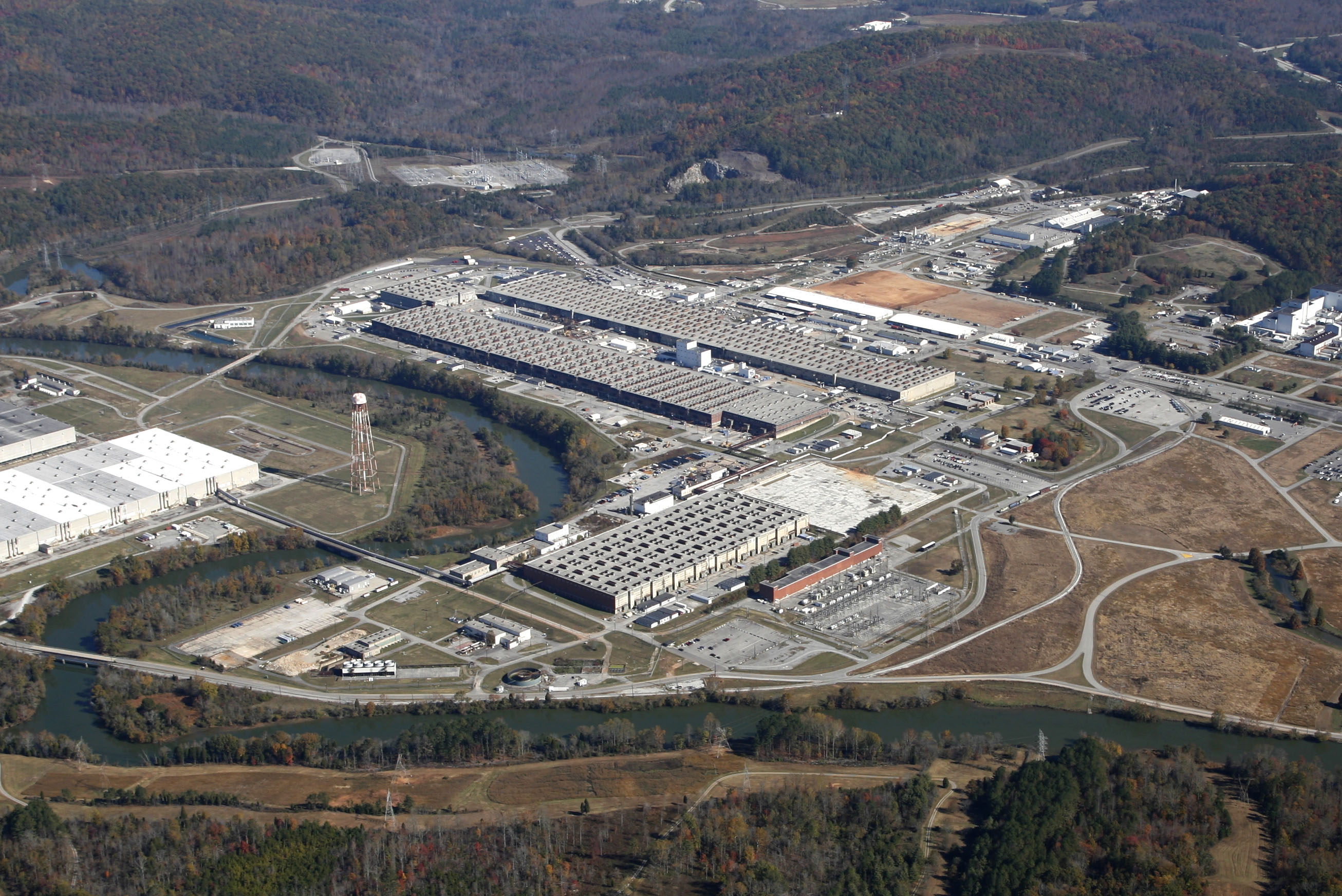
K-25
The building was so enormous that workers rode bicycles down its corridors. Built in 1944 at the Clinton Engineer Works in Oak Ridge, Tennessee, the K-25 gaseous diffusion plant surpassed the Pentagon as the largest building in the world, a four-story U-shaped structure covering over five million square feet. At peak construction, 25,000 workers swarmed the site -- and almost none of them knew what they were building. The codename said nothing: "K" came from Kellex, the engineering subsidiary that designed the plant, and "25" was wartime shorthand for uranium-235, the rare fissile isotope that makes up just 0.7 percent of natural uranium. The K-25 plant's job was to separate that sliver of an atom from its heavier sibling, uranium-238, one microscopic diffusion at a time, until there was enough enriched material to fuel a weapon. The enriched uranium it produced went into Little Boy, the atomic bomb dropped on Hiroshima on August 6, 1945.
Splitting Atoms by the Trillions
Gaseous diffusion exploits a simple physical principle: lighter gas molecules move slightly faster than heavier ones. Convert uranium into uranium hexafluoride gas, push it through a porous barrier with billions of microscopic holes, and the gas that passes through will be fractionally enriched in the lighter uranium-235 isotope. The enrichment factor per stage is tiny -- about 1.0043, meaning each pass yields gas that is less than half a percent richer in U-235. To get from natural uranium's 0.7 percent to weapons-grade concentration required running the gas through thousands of stages connected in an enormous cascade. Each stage needed its own diffuser, pump, and barrier membrane. The barriers had to have holes small enough to separate isotopes but strong enough to withstand pressure, and everything that touched the uranium hexafluoride -- a viciously corrosive compound that reacts with water and attacks most metals -- had to be clad in nickel or resistant fluorocarbons.
The Barrier Nobody Could Build
By August 1943, the entire K-25 project faced cancellation. The reason was the barrier. Without a membrane that could withstand uranium hexafluoride at industrial scale, gaseous diffusion was just a theory. Researchers at Bell Telephone Laboratories experimented with powdered nickel. Edward Norris -- an English interior decorator who had developed fine metal mesh for spray guns -- created an electroplated nickel design with Edward Adler at City College of New York, but it proved too brittle. General Leslie Groves told the Military Policy Committee that gaseous diffusion enrichment above fifty percent was probably impossible. Then Clarence Johnson at Kellex's Jersey City laboratory realized that improvements being developed for the Norris-Adler barrier could be applied to a different nickel powder design from Bakelite Corporation. The result was a barrier better than either predecessor. On January 16, 1944, Groves ruled in favor of Johnson's design. Pilot plants at Columbia University initially produced barriers of acceptable quality only 5 percent of the time. By April 1944, that rate had climbed to 45 percent -- enough to begin mass production.
Chrysler's Secret Assembly Line
The diffusers -- tank-like vessels that held the pressurized gas against the barrier membranes -- presented their own crisis. Building them from solid nickel would have consumed the nation's entire wartime supply of the metal. Groves handed the contract to Chrysler. Company president K.T. Keller assigned Carl Heussner, an electroplating specialist, the challenge of nickel-plating diffusers that were far larger than anything previously electroplated. Heussner discovered it could work, but only if every step of pickling and scaling was performed without any contact with oxygen. Chrysler converted its entire Lynch Road factory in Detroit to the task. The electroplating process used one-thousandth the nickel of a solid vessel. By war's end, Chrysler had manufactured and shipped more than 3,500 diffusers. Meanwhile, the K-25 plant received its own dedicated power station on the Clinch River, connected to the main building by an underground conduit to prevent sabotage. There was one act of sabotage anyway: someone drove a nail through the electric cable. The culprit was never found but was judged more likely a disgruntled employee than an Axis spy.
From Hiroshima to Obsolescence
Production at K-25 began in February 1945. The first shipments of slightly enriched product went to the Y-12 calutrons in March. By June the plant was producing material enriched to 7 percent; by September, 23 percent. The enriched uranium fed into the Little Boy bomb that devastated Hiroshima. After the war, the cascade was reconfigured to produce ever-higher enrichments. On November 28, 1946, K-25 began producing 94 percent product -- weapons grade. An unexpected flaw emerged: gaseous diffusion also concentrated the unwanted uranium-234 isotope, making it difficult to push enrichment past 93.7 percent. Los Alamos accepted that as good enough, and Y-12's enrichment operations were shut down in December 1946. Four additional diffusion buildings -- K-27, K-29, K-31, and K-33 -- were added in the postwar years. In 1964, President Lyndon Johnson ordered a 25 percent cut in enriched uranium production, and K-25 ceased weapons work. Gaseous diffusion on the site ended entirely on August 27, 1985, replaced by the far more efficient gas centrifuge technology.
The Largest Demolition in History
Demolition of the K-25 complex was a project nearly as massive as its construction. Bechtel Jacobs received a $1.48 billion contract in 2008 to dismantle the main building. K-29 came down in 2006. K-33 followed in 2011. K-31 was demolished between 2014 and 2015. The original K-25 building was gone by March 2014. The last of the five plants, K-27, fell on August 30, 2016, when U.S. Senator Lamar Alexander and Congressman Chuck Fleischmann joined 1,500 workers to watch the final wall come down. The demolition was completed in February 2017. Today the site, renamed the East Tennessee Technology Park, is being redeveloped. A general aviation airport is planned to serve Oak Ridge. Small private nuclear facilities are in development. And the K-25 History Center, a 7,500-square-foot museum that opened on February 27, 2020, preserves hundreds of original artifacts from the plant -- a memorial to a building that was once the largest in the world and the most secret, where 25,000 people built something they could not name.
From the Air
Located at 35.93°N, 84.40°W on the western edge of Oak Ridge, Tennessee, along the Clinch River. The former K-25 site, now the East Tennessee Technology Park, occupies a large cleared area visible from altitude. Best viewed at 3,000-6,000 feet AGL. The distinctive U-shaped building footprint is no longer visible, but the cleared industrial site along the river is unmistakable. Nearby airports include Oak Ridge (no towered airport -- closest is Downtown Island Airport (KDKX) in Knoxville approximately 20 nm east) and McGhee Tyson Airport (KTYS) approximately 30 nm southeast. The Clinch River and Poplar Creek confluence marks the western boundary of the site.