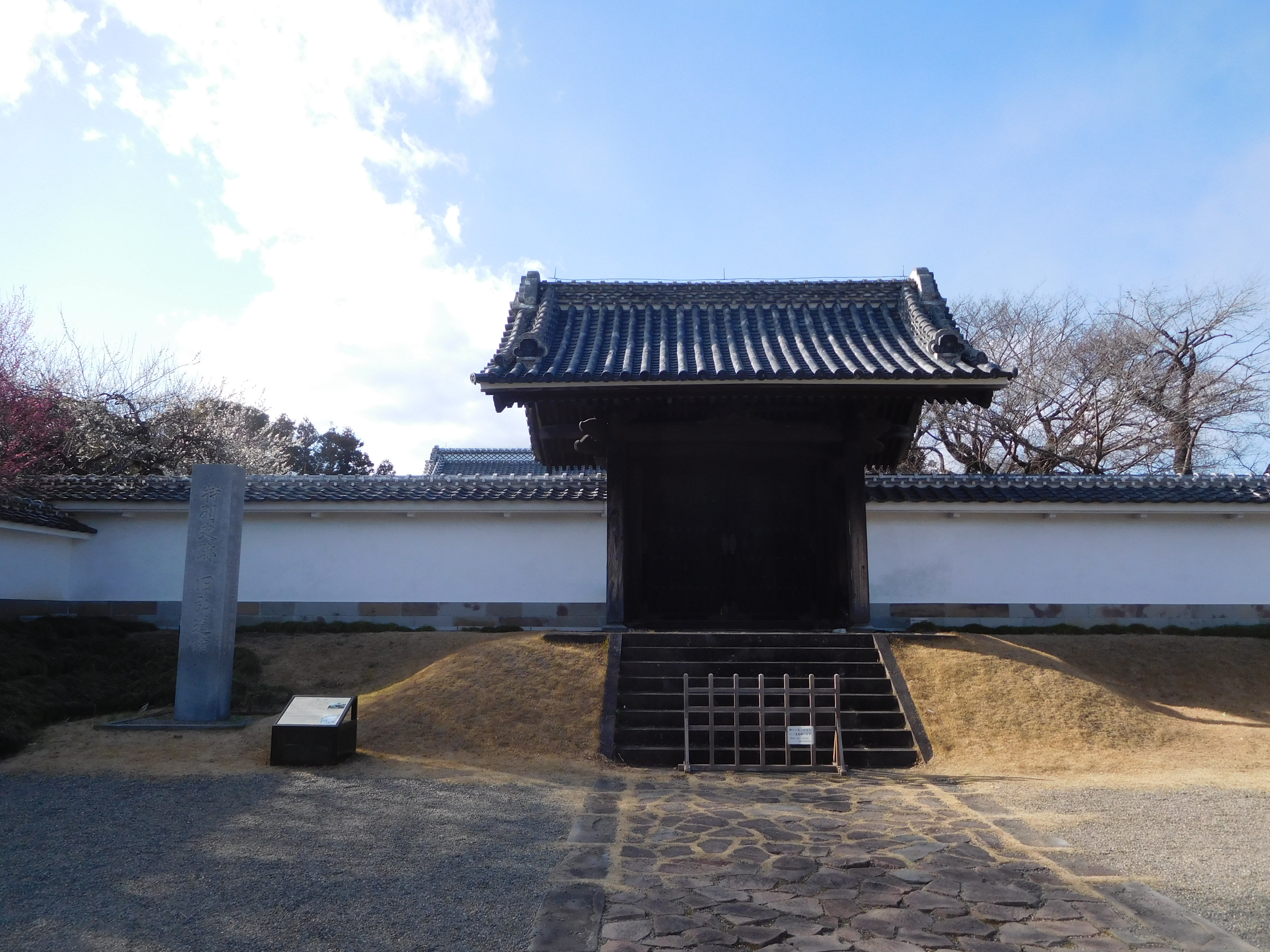
Kodokan (Mito)
The bullet holes are still in the gate pillars. They have been there since 1868, when the forces of a new Japan fought their way through Mito and the old order crumbled around this school that had helped bring the new order into being. The Kodokan, founded in 1841 by Tokugawa Nariaki, ninth lord of Mito Domain, was the largest han school in Bakumatsu-period Japan -- the final, turbulent decades of the Tokugawa shogunate. It was built in the third bailey of Mito Castle as an institution that would teach samurai not just martial arts but medicine, mathematics, astronomy, Confucianism, history, and music. Three of its original buildings survive today as designated Important Cultural Properties, and the school grounds hold the status of Special Historic Site. But what makes the Kodokan more than a well-preserved campus is the extraordinary arc of its story: a school that incubated the very ideas that toppled the government its founder served.
A School Built on Defiance
Tokugawa Nariaki was no ordinary feudal lord. As the ninth daimyo of Mito Domain, he was a member of one of the three elite Tokugawa branch families, yet he spent much of his career in open tension with the shogunate's central authority. His views were shaped by sonno joi -- "revere the Emperor, expel the barbarians" -- a philosophy that called for restoring the Emperor's authority and resisting the Western powers pressing Japan to open its borders. Nariaki was also deeply influenced by kokugaku, the nativist intellectual movement that celebrated Japan's indigenous spiritual traditions over Chinese-derived philosophy. The Kodokan became the institutional expression of these ideas. It promoted Mitogaku, the Mito school of historical thought established earlier by Tokugawa Mitsukuni, which argued that true political legitimacy flowed from the Imperial line, not the Shogun. In founding the academy, Nariaki created a crucible where loyalty, scholarship, and radical politics fermented together.
Where Samurai Learned Everything
Admission to the Kodokan came at age 15, but Mito Domain's philosophy on education was unusually progressive for its time: classes were open to students of any age, provided their academic ability met the standard. The number of days a student attended depended on his social standing within the domain's hierarchy, but the curriculum was remarkably broad for a feudal institution. Alongside traditional martial training -- sword practice on dedicated grounds, martial arts instruction in open courtyards -- students studied medicine, mathematics, and astronomy. They read Confucian classics and Japanese history. They practiced music. The complex itself reflected this breadth, with the Bunkan section containing four dormitories for studying, training, and boarding, plus separate areas for physical and intellectual pursuits. Construction on the full campus stretched from 1841 to 1857, growing alongside the political tensions that would soon tear Japan apart.
Civil War in the Courtyards
The ideas nurtured at the Kodokan did not stay theoretical. From 1863 to 1864, the school became the epicenter of the Mito rebellion, a civil war within Mito Domain itself. Factions of radical loyalists, impatient with the cautious pace of reform, launched an uprising that included terrorist actions against the central authority of the Shogunate. The violence that scarred the Kodokan's gate pillars with bullet holes was both symbolic and literal: the school's own graduates were fighting over the meaning of what they had been taught. The rebellion was eventually suppressed, but the broader movement it represented could not be contained. Four years later, in April 1868, the entire feudal order collapsed. Tokugawa Yoshinobu -- himself a native of Mito Domain and a former student at the Kodokan -- abdicated his position as Shogun. The new Meiji government ordered him to retire under house arrest to a building within the very school where he had once studied.
Standing Through Centuries
The buildings that survive today are the ones Nariaki commissioned in 1841: the main gate with its scarred pillars, the administrative complex with its dormitories and training grounds, and the four rooms in the northeast corner that served as the daimyo's waiting room and his children's schoolhouse. An octagonal chapel, a belfry, and a small Kashima Shrine dedicated to the martial arts deity still stand within the grounds. The 2011 Tohoku earthquake damaged some structures, but restoration work has preserved the campus. Walking through the Kodokan today, the scale of the place communicates what statistics alone cannot -- this was not a modest schoolhouse but a sprawling intellectual and military complex, the physical embodiment of a domain's belief that education could reshape a nation. That belief, for better and for worse, proved correct.
From the Air
Located at 36.375N, 140.477E in the city of Mito, Ibaraki Prefecture, roughly 100 kilometers northeast of Tokyo. The Kodokan sits within the former grounds of Mito Castle, near the center of the modern city. Adjacent to the school is the famous Kairakuen garden, one of Japan's Three Great Gardens, which is clearly visible from the air as a large green space. The Naka River curves through Mito to the north and east. Nearest airport: Ibaraki Airport (RJAH) approximately 15km southeast. Narita International (RJAA) is roughly 100km to the south. Urban area with standard weather patterns for the Kanto plain.