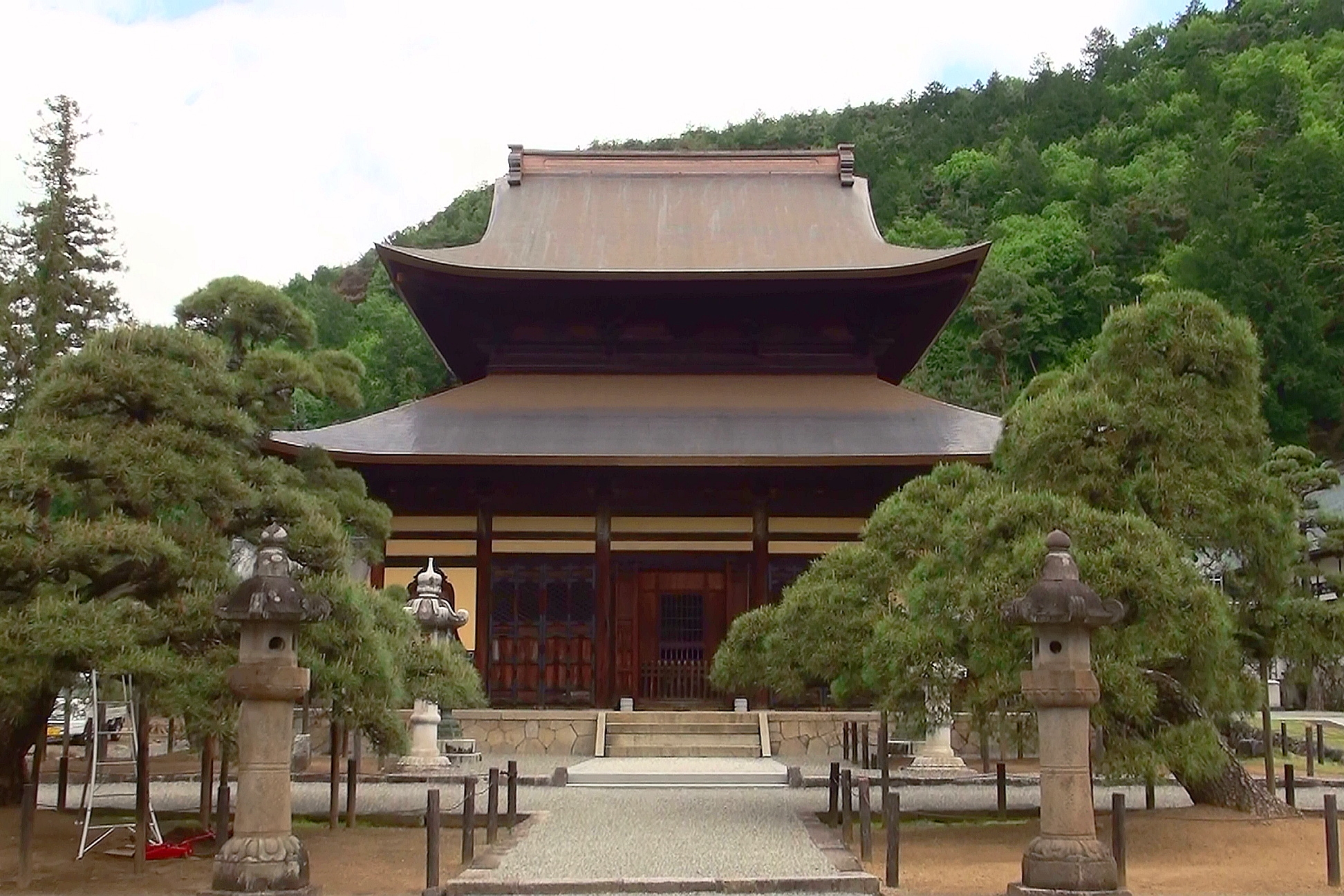
Kogaku-ji
Bassui Tokusho had a problem: people kept finding him. The 14th-century Zen monk, trained across three traditions -- Soto, Rinzai, and Chinese Ch'an -- wanted nothing more than solitude for meditation. He retreated deeper and deeper into the countryside of Kai Province, but students and seekers followed every time. In 1380, he built a small hermitage called Kogaku-an in the mountains near what is now Koshu, Yamanashi, and that hermitage became Kogaku-ji -- a temple that today remains so devoted to its founder's love of seclusion that it is closed to the general public.
The Monk Who Could Not Hide
Bassui Tokusho came from Sagami Province and spent his life pursuing a single question: the nature of the self. His teaching method was disarmingly simple -- when students asked how to see their own true nature, he would reply, "Now! Who is asking?" His popularity only grew after his death in 1387, when his final words became a cornerstone of Zen teaching: "Look directly! What is this? Look in this manner and you won't be fooled." Emperor Go-Kameyama recognized the temple's significance by designating it a chokugan-ji, a "temple to pray for the nation," during the civil wars of the Nanbokucho period. The Takeda clan, rulers of Kai Province, lavished it with estates and subsidiary temples, building Kogaku-ji into a network of dozens of chapels across the region.
Daruma in Red Robes
The temple's greatest possession is a painting most people will never see. A hanging scroll from approximately the 1260s depicts Bodhidharma -- Daruma, the patriarch of Zen Buddhism -- seated in a formal pose, wrapped in vivid red robes. The painting bears an inscription by Lanxi Daolong, the celebrated Chinese priest who served as head abbot of Kenchoji in Kamakura. Measuring 123.3 by 61.2 centimeters, the scroll was created by an unknown Japanese painter working under the strong influence of Southern Song dynasty aesthetics. Designated a National Treasure of Japan in 1953, it is one of the finest Zen figural paintings to survive from medieval Japan. The scroll predates the temple itself by more than a century, a reminder that sacred objects often outlive the institutions that eventually house them.
Portraits and Printing Blocks
Beyond the Daruma scroll, Kogaku-ji preserves a remarkable collection of Important Cultural Properties. Two Muromachi-period portrait paintings on hanging scrolls depict Sanko Kokushi, a Zen prelate who traveled to Yuan-dynasty China to study at Tianmu Mountain before returning to serve as chief priest. A separate portrait, painted in 1393 on the seventh memorial of Bassui Tokusho's death, captures the founder himself seated in contemplation. Perhaps most unusual are the temple's wooden printing blocks -- 37 blocks dated to 1386 that record question-and-answer exchanges between priests, and a single block from 1389 preserving regulations issued by Bassui Tokusho himself. These blocks, designated Important Cultural Properties in 2007, are among the oldest surviving examples of Buddhist printing in the Kanto region.
Stone Garden on the Mountainside
On the north slope of the temple precinct, a stone garden climbs the hillside in arrangements of rock, pond, and waterfall. Believed to date from the early Edo period, the garden was renovated multiple times in the 18th and 19th centuries and partially lost to memory until archaeologists excavated it in 1990, uncovering the original rock formations beneath centuries of accumulated soil. It was designated a National Place of Scenic Beauty in 1994. The temple's fortunes have mirrored the political tides of its region. After the Takeda clan fell and the Tokugawa shogunate rose, many subsidiary temples were abolished or absorbed into other Rinzai branches. A devastating fire in 1782 destroyed much of the original complex. By the Meiji period, Kogaku-ji had been folded into the Nanzen-ji branch. It recovered its independence in 1908, and today it governs eight sub-temples and fifty affiliates -- a quiet empire built by a monk who only ever wanted to be alone.
From the Air
Kogaku-ji sits at 35.71°N, 138.72°E in the mountains east of the Kofu Basin, Yamanashi Prefecture, central Honshu. The temple is just a few kilometers from Erin-ji in the same geohash region. The surrounding terrain is mountainous with deep valleys -- the Chichibu range to the north and the Misaka Mountains to the south frame the basin. The nearest major airport is Matsumoto (RJAF), approximately 90 km northwest. Shizuoka Airport (RJNS) lies roughly 108 km south. At 3,000-5,000 feet AGL, look for the forested mountainside temple compound. The Chuo Main Line rail corridor provides a useful visual reference running east-west through the valley. Mount Fuji is visible to the southeast on clear days.