K. I. Sawyer Air Force Base
The most significant landmarks on the proposed site were a hill of sand and a wealth of blueberry patches. That was 1941, when Kenneth Ingalls Sawyer, a civil engineer and Marquette County road commissioner, presented his plan for a new airport in Michigan's Upper Peninsula. The blueberry fields would eventually disappear under concrete thick enough to support B-52 Stratofortress bombers loaded with nuclear weapons. For nearly forty years, K. I. Sawyer Air Force Base was one of the northernmost links in America's Cold War defense chain -- a place where fighter-interceptors scrambled against phantom Soviet bombers, where tanker crews kept engines turning around the clock, and where 12,000 people built a community in the North Woods that functioned as the Upper Peninsula's second-largest city. Then, in 1995, the Air Force left, and the blueberry patches started growing back.
A Road Commissioner's Airport
Kenneth Ingalls Sawyer never saw his airport become a military installation. Born in 1884, he spent his career building roads in Marquette County, watching the iron mining industry drive demand for better transportation. By 1937, a county airport was built between Marquette and Negaunee, but Sawyer recognized by 1940 that it could not keep pace with the region's growth. He proposed a new, larger airport. The board approved, but World War II intervened. Local citizens, alarmed about the vulnerability of the Soo Locks at Sault Ste. Marie, proposed handing the new airfield to the U.S. Army Air Forces. The proposal was shelved. Sawyer died in 1944, and the following year the airfield -- a single airstrip surrounded by sand and blueberries -- was completed and named in his honor. It served private fliers until 1948, when Nationwide Airlines began flying shuttles to Detroit.
Interceptors on the Frontier
The Cold War transformed Sawyer's modest airstrip into a frontline installation. In January 1955, the U.S. government signed a 99-year lease and began building a twelve-million-dollar jet base. By 1956, the airfield was operational under Air Defense Command, tasked with intercepting Soviet bombers that might approach over the North Pole and across the Great Lakes. The base operated the Semi-Automatic Ground Environment system -- SAGE -- a network linking radar stations into a centralized air defense center, the computerized nervous system of America's early-warning network. A succession of interceptors called Sawyer home: F-102 Delta Daggers, F-101 Voodoos, and finally the F-106 Delta Darts flown by the 87th Fighter-Interceptor Squadron, the Red Bulls. The 87th maintained 24/7 alert status for fourteen years, scrambling to identify and track any unidentified aircraft that entered the sector. When the squadron was inactivated in 1985 -- one of the last F-106 units on active duty -- its final three Delta Darts flew south to the boneyard at Davis-Monthan AFB in Arizona, where most were eventually converted into target drones.
The Bomber Wing
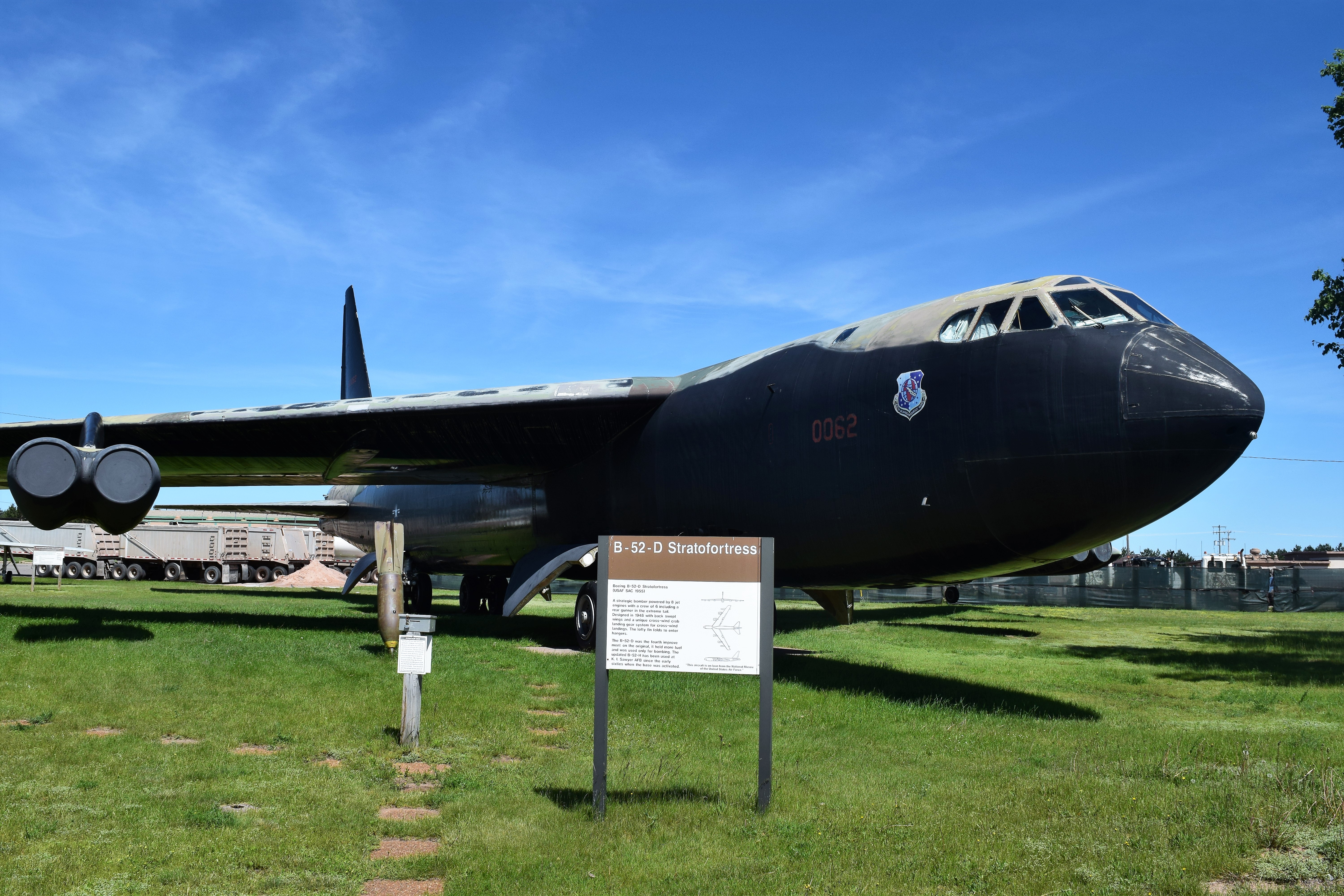
Strategic Air Command arrived at Sawyer in 1958. The runway was extended and reinforced to accommodate B-52H Stratofortress bombers and KC-135A Stratotanker refueling aircraft. The 410th Bombardment Wing, organized in 1963, kept these aircraft in constant readiness as part of SAC's nuclear deterrence mission. Sawyer was one of three Michigan B-52 bases, alongside Kincheloe AFB near Sault Ste. Marie and Wurtsmith AFB near Oscoda. The base produced its share of legends. In 1980, two B-52H crews from the 644th Bomb Squadron won the Mackay Trophy for a nonstop, around-the-world mission to locate and photograph Soviet Navy elements in the Persian Gulf. And one Sawyer KC-135A became famous as the glider when it ran out of fuel on short final. The crew bailed out, but the instructor pilot stayed aboard and dead-sticked the tanker onto the runway. The aircraft was repaired and returned to service. Even the crew entry door, which separated during bailout, was returned by a local farmer.
When the Jets Stopped
The Base Realignment and Closure Commission recommended Sawyer for shutdown in 1993. The KC-135 tankers left that October. The final B-52 departed for Minot AFB in November 1994. K. I. Sawyer AFB officially closed at the end of September 1995. The economic devastation was immediate. The Air Force had been spending 157 million dollars annually in the region. Marquette County lost an estimated twenty percent of its economy. Five thousand jobs vanished. Fourteen thousand residents left. The community that remained inherited rows of empty housing, boarded-up buildings, and the enormous runway -- still one of the longest in the state, now mostly silent. A portion of the base became Sawyer International Airport, opening its passenger terminal in September 1999 as the region's primary civilian airport. But the town around it struggled for years with poverty and abandonment.
Blueberries and Bombers
Veterans who served at Sawyer remember it with unusual affection. The base earned nicknames like K. I. Siberia and The Rock, and lake-effect snow from Lake Superior was relentless. But the North Woods setting offered hunting, fishing, boating, and skiing at Marquette Mountain. Berry patches survived on many parts of the base, and families picked blueberries near the alert barracks where aircrew slept with one ear tuned to the klaxon. Today, the K. I. Sawyer Heritage Air Museum preserves six aircraft in a collection known as the Sawyer 6, displayed near the airport alongside exhibits in the former Silver Wings Recreation Center. The runway still stretches into the forest. Locals still say it was built over the best picking grounds in the state. The bombers are gone, the interceptors are gone, the twelve thousand people are mostly gone. But the blueberries, at least, have found their way back.
From the Air
Located at 46.35N, 87.40W in Marquette County, Michigan's Upper Peninsula. The former base is now Marquette Sawyer Regional Airport (KSAW), with a massive 12,366-foot runway (01/19) originally built for B-52 operations -- one of the longest runways in the Upper Peninsula and easily visible from altitude. The runway's scale is striking compared to the surrounding North Woods landscape. From cruising altitude, look for the distinctive long runway clearing in dense forest approximately 17nm south of Marquette. Lake Superior is visible to the north. Other nearby airports include Marquette County Airport (defunct, but the site is visible just southwest of Marquette) and Escanaba Delta County Airport (KESC) approximately 65nm to the south. The K. I. Sawyer Heritage Air Museum aircraft display is visible near the terminal area. Elevation approximately 1,220 feet MSL. Lake-effect snow from Lake Superior is common in winter months, creating challenging approach conditions.