Kotoku-in
The sign at the entrance sets the tone before you even see it: "Stranger, whosoever thou art and whatsoever be thy creed, when thou enterest this sanctuary remember thou treadest upon ground hallowed by the worship of ages." Then you round the corner, and there it sits -- 13.35 meters of green-patinated bronze, cross-legged and half-lidded, radiating the kind of stillness that makes crowds go quiet. The Great Buddha of Kamakura has held this pose since roughly 1252, and for the last seven centuries, it has done so under the open sky.
From Wood to Bronze
The current statue was not the first attempt. In 1233, Lady Inada no Tsubone and the Buddhist priest Joko of Totomi began raising funds for a monumental wooden Buddha. It took ten years of continuous labor to complete. Five years later, a storm tore into the wooden figure and destroyed the hall that housed it. Joko, undeterred, proposed something more permanent: a statue of bronze. The enormous sums required were raised, and around 1252, master casters -- likely Ono Goroemon or Tanji Hisatomo, the leading bronze workers of the Kamakura period -- poured molten metal into what would become one of Japan's most enduring works of art. The finished figure was gilded in gold leaf. Traces of that original gilding still cling near the statue's ears, visible to anyone who looks closely enough.
The Hall That Kept Disappearing
For its first century, the Great Buddha sat inside a grand temple hall. Nature had other ideas. A storm demolished the structure in 1334. Workers rebuilt it. Another storm damaged the replacement in 1369. They rebuilt again. Then, according to tradition, a massive tsunami -- possibly the one triggered by the Meio earthquake of 1498 -- swept through the low-lying temple grounds and carried the hall away for good. Since then, the Daibutsu has remained outdoors, exposed to typhoons, salt air, earthquakes, and centuries of Sagami Bay weather. Paradoxically, the loss of its shelter became its defining characteristic. The open-air setting gives the statue a dramatic presence that no enclosed hall could match, the Buddha framed against shifting clouds and seasonal foliage rather than timber walls.
Hollow at the Heart
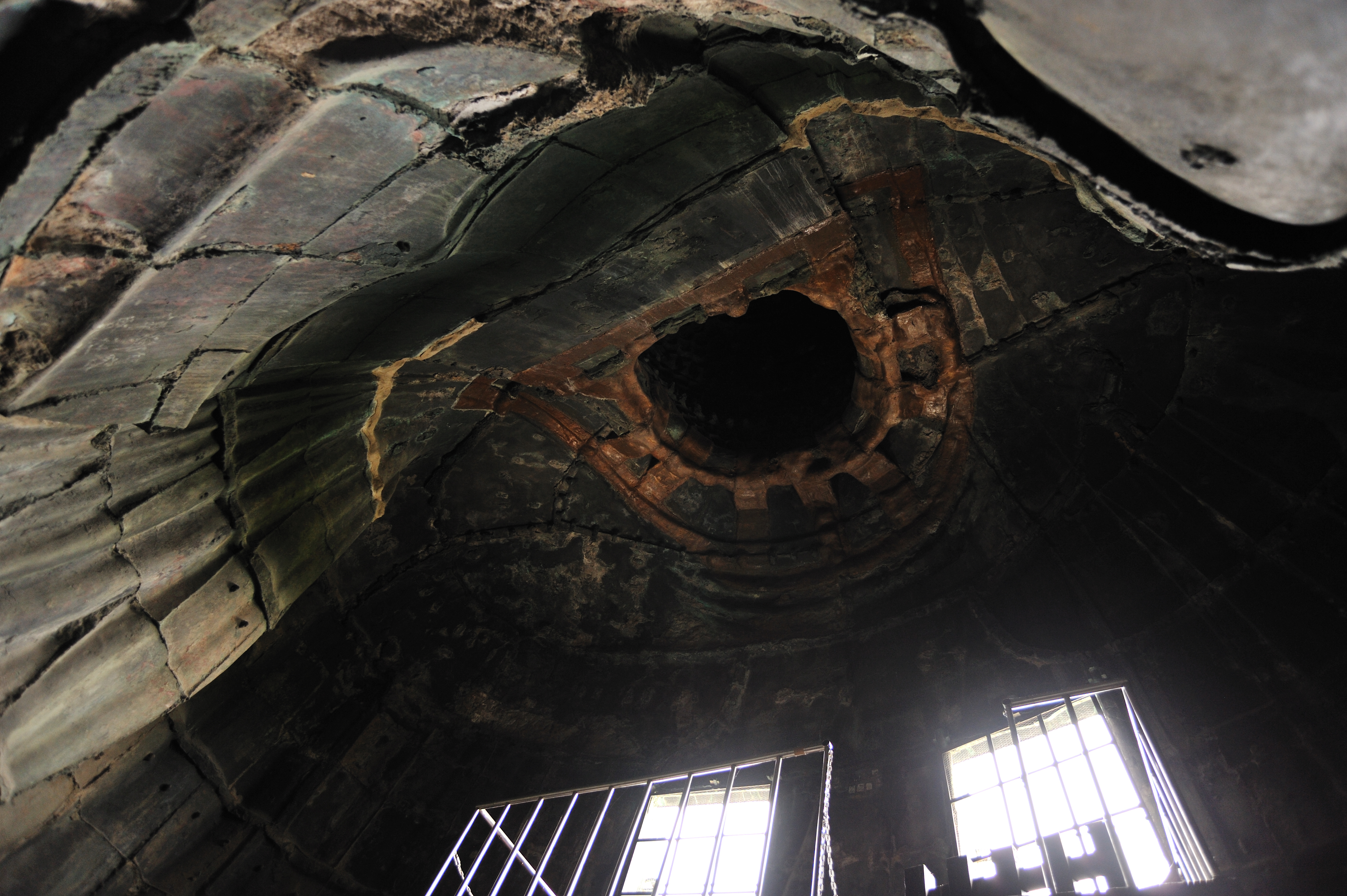
Weighing approximately 93 tonnes, the statue is hollow -- and you can go inside. A small doorway in the back leads into a dim, cavernous interior where the bronze walls curve overhead like the inside of a bell. Visitors peer upward at seams where the casting sections were joined and at the crude graffiti left by centuries of tourists. The engineering is remarkable for the 13th century: the statue was cast in separate sections and assembled on site, its proportions calculated so that it appears perfectly balanced when viewed from below. The face alone measures 2.35 meters long, the ears stretch 1.9 meters, and the distance from knee to knee spans 9.1 meters. For sense of scale, a rock pigeon perched on the Buddha's shoulder looks no larger than a bronze rivet.
Kipling's Pilgrimage
Rudyard Kipling visited Kamakura in 1892 and was moved enough to write "Buddha at Kamakura," a poem that later prefaced chapters of his novel Kim. The American painter John La Farge captured the statue in watercolor in 1887, and Italian-British photographer Adolfo Farsari photographed it in the 1880s, helping introduce the image to Western audiences. By the early 20th century, the Great Buddha had become shorthand for Japan itself in the Western imagination -- an icon as recognizable as Mount Fuji. Today Kotoku-in, the Jodo-shu Buddhist temple that maintains the grounds, draws visitors from every continent. The statue remains a designated National Treasure and one of twenty-two historic sites in Kamakura's proposal for UNESCO World Heritage status.
Summer Evenings in Bronze Light
Most visitors come during the day, but those who time it right witness something different. On select summer evenings, the temple stages a light-up event, bathing the bronze figure in warm illumination against the darkened hillside. The green patina takes on golden tones under the spotlights, and for a few hours the Daibutsu looks almost as it did when its gold leaf was fresh -- a gleaming figure sitting alone under the stars, unbothered by the passage of 770 years.
From the Air
Located at 35.317N, 139.536E in the coastal city of Kamakura, approximately 50 km southwest of central Tokyo. The temple sits in a narrow valley between forested hills about 800 meters inland from Yuigahama Beach. From the air, the statue is not individually visible at cruising altitude, but the Kamakura coastline and the distinctive valley layout are identifiable. Nearest airports: Tokyo Haneda (RJTT) approximately 30nm northeast, Atsugi Naval Air Facility (RJTA) approximately 15nm northwest. The Shonan coastline running east-west provides a strong visual reference. Sagami Bay lies to the south, and the forested Kamakura Hills form a natural amphitheater around the city.