Ka Loko Reservoir
On March 14, 2006, the earthen dam holding back Ka Loko Reservoir on Kauai's north shore gave way without warning. A wall of water and mud surged down the hillside, tearing through Waiakalua Stream toward the Pacific Ocean. Seven people died. The breach exposed a problem that had been building for decades: Hawaii had too many aging dams and too few inspectors to monitor them. The reservoir, which had served the island's sugar plantation era, became a case study in what happens when infrastructure outlives the industry that built it but not the communities that live below it.
A Plantation Relic
Ka Loko Reservoir sits on the north side of Kauai, an earthen impoundment that once served the agricultural needs of the island's sugar industry. Like dozens of similar dams across Hawaii, it was constructed during the plantation era when sugarcane required vast quantities of irrigation water and the islands' steep terrain made reservoir construction both necessary and precarious. The dam held back water that flowed down to Waiakalua Reservoir and then through Waiakalua Stream to the ocean. By the time the sugar industry had largely departed Hawaii, many of these dams had passed into private ownership without the engineering oversight they required. Ka Loko was one of them. The reservoir's earthen walls, built to standards of an earlier century, deteriorated incrementally in the tropical climate, subject to the erosion and seepage that affect all earthen dams over time.
The Day the Dam Broke
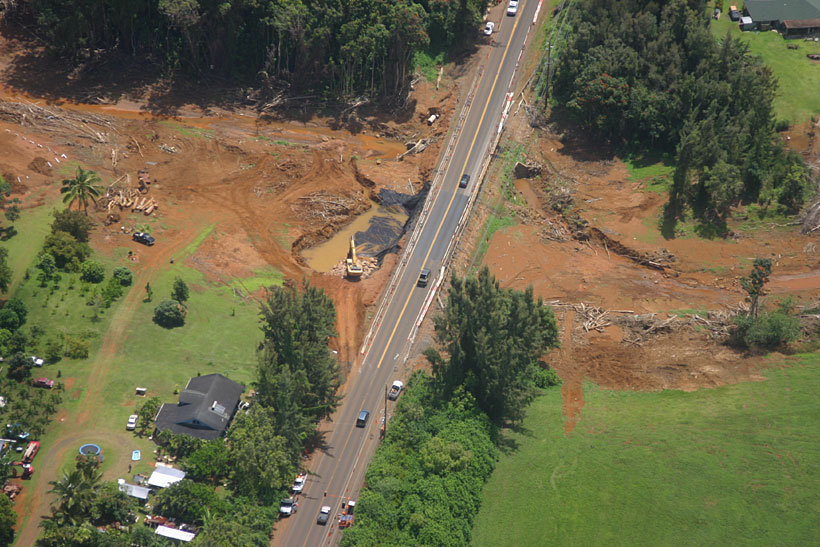
The breach on March 14, 2006, released a torrent that carved a path of destruction through the landscape below the reservoir. Aerial photographs taken afterward showed highway damage where rushing floodwaters had torn across roads, ripped out vegetation, and deposited debris across a wide swath of the coastal lowlands. Seven people lost their lives, caught in the path of water that arrived with almost no warning. The independent civil investigation published in January 2007 documented the failures that led to the disaster. The State of Hawaii had not adequately inspected the dam. The state did not have enough dam inspectors to cover all of the aging dams under its jurisdiction, many of them relics from the plantation era that had received little maintenance in decades. The reservoir's owner, James Pflueger, was indicted in November 2008 over the breach. His attorney argued that the indictment was an attempt by the state to deflect its own responsibility.
Accountability and Aftermath
The legal proceedings following the Ka Loko disaster stretched on for years. Pflueger faced both criminal charges and multiple civil lawsuits from the families of those killed. On August 4, 2009, a settlement between the parties in all civil cases was reported, pending judicial review. The criminal case continued separately. The breach forced Hawaii to confront the broader problem of dam safety across the islands. Dozens of earthen dams built during the sugar era remained in various states of repair, many on private land where owners lacked the engineering expertise or financial resources to maintain them properly. The state's inspection regime had been underfunded for years, a familiar pattern in infrastructure maintenance where the consequences of neglect remain invisible until they become catastrophic. Ka Loko was not the only vulnerable dam in Hawaii; it was simply the one that failed first.
New Ownership, Old Questions
In December 2021, Meta founder Mark Zuckerberg purchased 110 acres surrounding Ka Loko Reservoir, adding to his substantial land holdings on Kauai's north shore. Zuckerberg stated his intention to fulfill the legal requirements for the property, which include compliance with dam safety regulations. His purchases on Kauai have drawn both support and criticism, part of a larger conversation about land ownership, wealth, and Hawaiian sovereignty that plays out across the island. The reservoir itself remains a scar on the landscape and in the memory of the north shore community. The floodpath is visible from the air, a lighter trace through the green hillside where vegetation has regrown but not yet fully concealed the damage. For the families of the seven people who died, and for the communities downstream of Hawaii's other aging dams, Ka Loko is a reminder that infrastructure does not maintain itself, and that the cost of neglect is always paid by someone.
From the Air
Located at 22.18°N, 159.38°W on Kauai's north shore, inland from Kilauea town. The reservoir site and the flood damage path may be visible from 1,500-2,000 feet AGL as a lighter trace through the vegetation running downhill toward the coast. Nearby airport: Lihue Airport (PHLI), approximately 12 nm south-southeast. The area is inland from the coast with gradually rising terrain to the west toward the island's interior mountains. Standard trade wind conditions prevail.