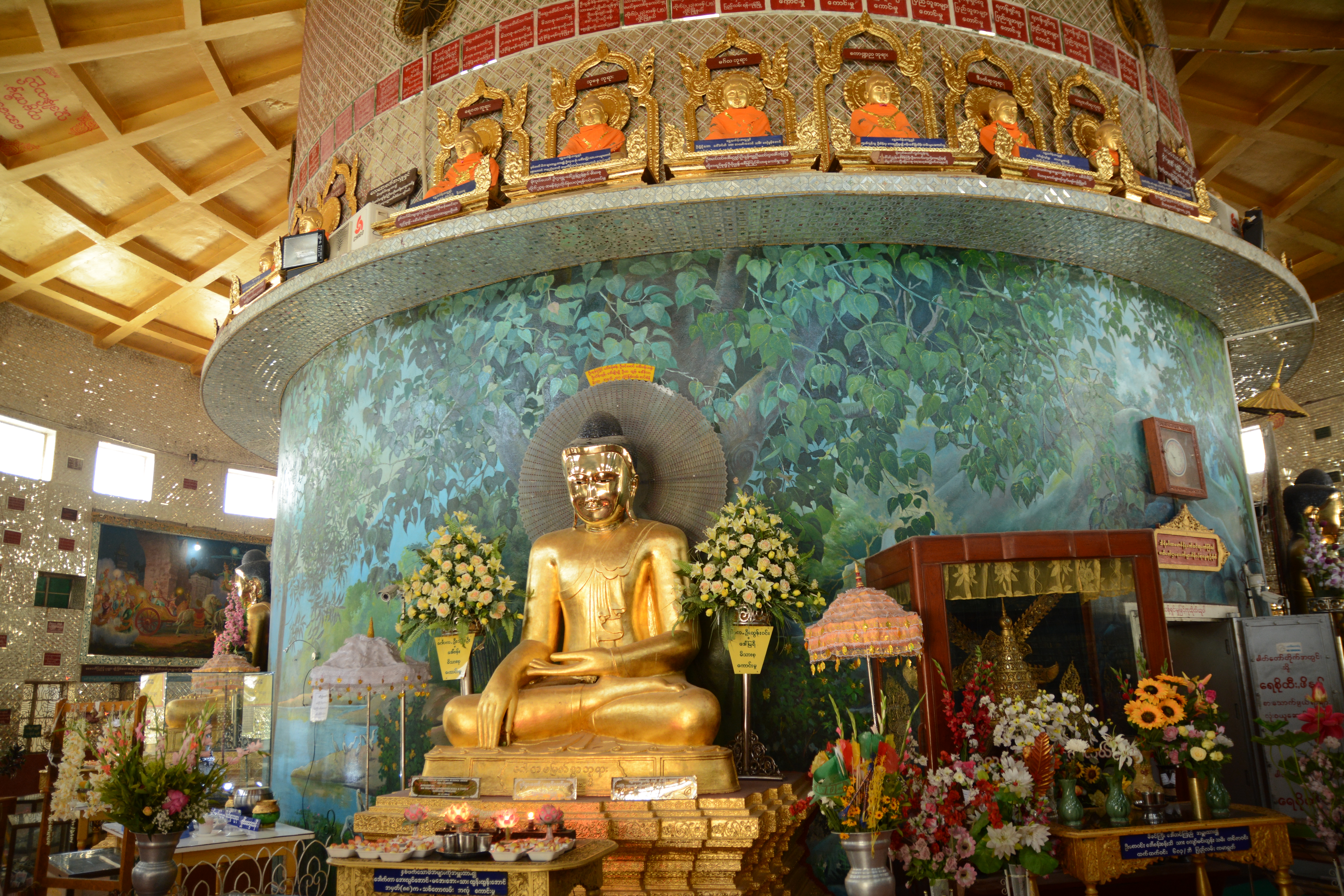
Kaba Aye Pagoda
The name means "World Peace," but the Kaba Aye Pagoda has witnessed more turmoil than tranquility. Built in 1952 by U Nu, Burma's first prime minister after independence, the pagoda and its companion cave were designed to host 2,500 monks for the Sixth Buddhist Council. Alongside the cave, U Nu constructed a political project: the attempt to make Buddhism the official state religion of a nation whose ethnic and religious minorities had no interest in being conscripted into someone else's faith. The pagoda still stands, 111 feet tall and 111 feet around its base, a monument to devotion and to the unintended consequences that followed.
A Prime Minister's Grand Design
U Nu was a devout Buddhist who saw no contradiction between piety and politics. As the first leader of independent Burma following the 1947 constitution, he conceived the Kaba Aye complex as more than a place of worship. It was the physical embodiment of his vision for a Buddhist nation. Construction of both the pagoda and the Maha Pasana Guha, a massive artificial cave, began in 1952. The cave was modeled after the Saptaparni Cave in India, where the First Buddhist Council had been held shortly after the Buddha's death. U Nu's replica measured 455 feet long and 370 feet wide, with an interior assembly hall of 220 by 140 feet. The six entrances symbolized the Sixth Great Synod. In Burmese royal tradition, kings built pagodas to mark their reigns. U Nu, a prime minister in a constitutional republic, was following that tradition whether he acknowledged the implication or not.
Twenty-Five Hundred Monks in a Man-Made Cave
From 1954 to 1956, the Sixth Buddhist Council convened in the Maha Pasana Guha. The timing was deliberate: the council coincided with the 2,500th anniversary of the Buddha's Parinibbana -- his passing into final nirvana. Twenty-five hundred monks gathered inside the artificial cave to recite, edit, and approve the entire Tipitaka -- the complete body of Theravada Buddhist scripture -- in Pali. The scale of the undertaking was extraordinary. For two years, the assembled monks worked through every word of the Three Pitakat, the canonical texts that form the foundation of Theravada Buddhism. The Kaba Aye pagoda itself, hollow on the inside, houses four great Buddha figures commemorating the four Buddhas believed to have already appeared in the world, along with a silver Buddha statue over eight feet tall. Its circular platform is enclosed in cave-temple style, with five porches decorated with colorful arched pediments, lotus flowers, and swastika motifs carved in stucco, an ancient Buddhist symbol of auspiciousness.
The Politics of Faith
On August 29, 1961, the Burmese parliament declared Buddhism the official state religion, largely due to U Nu's persistent campaigning. Cow slaughter was officially banned. But the victory was hollow. Ethnic Kachins, Karens, and other minorities who were not Buddhist felt alienated and threatened by a national identity built around a religion they did not share. Even many Buddhists objected, arguing that faith should remain a social practice separate from government power. Monks worried that monasteries affiliated with state-built pagodas would lose their autonomy, captured by the very government that claimed to serve them. In 1962, General Ne Win seized power in a coup, repealed the state religion laws, and ended U Nu's Buddhist state project. The Kaba Aye complex endured as a monument to an aspiration that its own beneficiaries rejected. Ne Win, following the same royal tradition of pagoda building, later constructed the Maha Wizaya Pagoda in his own honor.
Christmas Night, 1996
On December 25, 1996, two bombs exploded at the Kaba Aye complex. The first detonated at the pagoda at 8:20 in the evening, but caused no injuries because pilgrims were not using that entrance. Two hours later, as security forces investigated the first blast, a second bomb exploded inside the Maha Pasana Guha, which was crowded with worshippers. Five people were killed and seventeen wounded. A tooth relic of the Buddha, on loan from China and believed to be one of only two surviving since the Buddha's death, was on display that night, drawing far larger crowds than usual. The relic survived the bombing undamaged. The military government accused student democracy activists and the Karen National Union of planting the bombs. Both denied involvement, and the ABSDF's foreign affairs officer publicly suggested the regime had staged the attack to justify a crackdown. The truth remains unresolved, one more layer of contested history at a site where religion and politics have never been separable.
From the Air
Located at 16.86°N, 96.15°E in Mayangon Township, northern Yangon, Myanmar, approximately 11 km north of the city center. The pagoda complex sits along Kaba Aye Road, near Inya Lake, which is visible from the air as a large body of water. Shwedagon Pagoda, the city's most prominent aerial landmark, lies approximately 5 km to the south. Nearest major airport is Yangon International Airport (VYYY), roughly 8 km to the north. Recommended viewing altitude: 2,000-3,000 feet AGL.