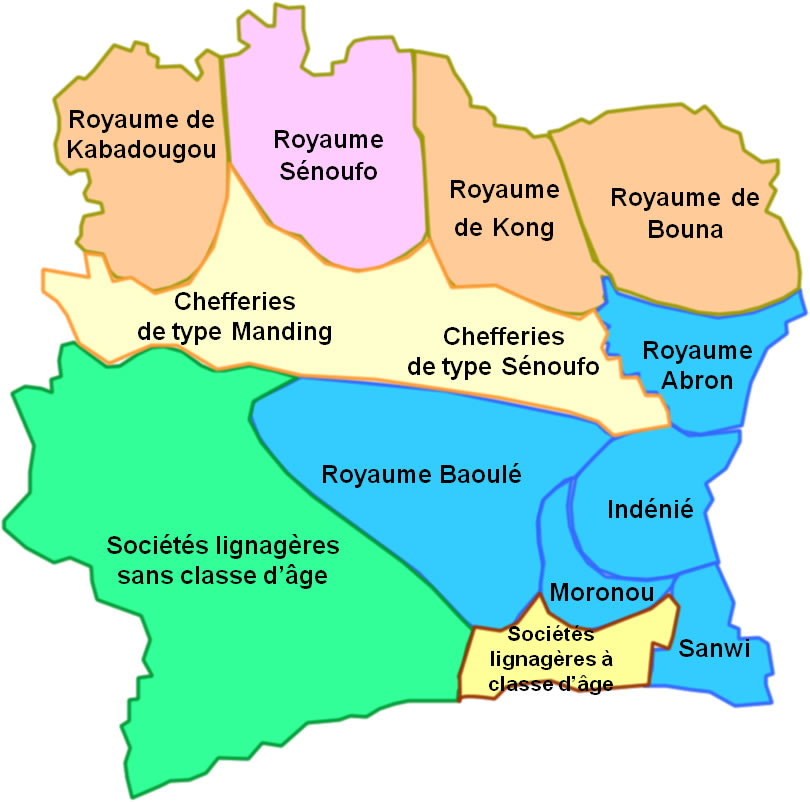
Kabadougou Kingdom
An infected ant bite killed the founder. That is the local tradition, at least -- that Vakaba Toure, the former dyula trader who had fought and connived his way to kingship over northwest Ivory Coast, died in 1858 from something as trivial as a swollen insect wound. The kingdom he built around the town of Odienne would outlast him by four decades, but the manner of his death captures something essential about the Kabadougou Kingdom: it was a state forged by one man's ruthless will, always vulnerable to the fragility that will entails.
A Trader Takes Up the Gun
Before he was a king, Vakaba Toure was a dyula -- a long-distance merchant in the Mande trading networks that crisscrossed West Africa. Sometime around 1845, he made a fateful pivot. Alongside his cousin Vasanissi, he intervened in a local conflict at Kulukoro, where Vasanissi killed the warlord Mori Wali Cisse in an ambush. The cousins then turned the dead man's soldiers against the Diarrasouba Kingdom of Nafana, drove out its rulers, and established Odienne as the capital of a new state. Vakaba adopted the title of marfatigi -- gun-wielding warrior -- and began absorbing neighboring territories. The local kafu of Massala allied willingly, but Folon and Bodougou were taken by force. By 1848, the Kabadougou Kingdom was a fact on the ground, and Vakaba sat at its center as faama.
The Architecture of Captivity
What distinguished Kabadougou from its neighbors was not its size but its social engineering. Vakaba restructured the kingdom's entire population around a military-slave economy. The traditional horonyi, or freemen, were divided into an elite warrior class and a subordinate trader class, with everyone else pushed downward in status. At the top of the military hierarchy sat the faama himself, commanding through sofakuntigiyi -- slave generals who were his personal property. Below them, ordinary sofayi soldiers alternated between combat duty and agricultural labor. Nearly every village within military reach was subjugated to the level of jonya, a state of enslavement that was already present in the region but which Vakaba expanded dramatically. In theory, children born to enslaved people were supposed to be free. In practice, the constant demand for soldiers and laborers to sustain the kingdom's wars meant that promise was never honored.
Alliance with Samori
After Vakaba's death in 1858, the kingdom passed through turbulent successions. His son Ibrahima died in battle at Korumba in 1859, barely a year into his reign. Ibrahima's brother VaMuktar ruled until 1875, struggling to hold the kingdom together. The arrival of Samori Ture's envoys in July 1881 changed the equation. Samori, then building his own expanding Wassoulou Empire to the north, proposed an alliance, and Kabadougou's rulers accepted. The arrangement granted Kabadougou a degree of independence as a peripheral state within Samori's orbit, sealed by the marriage of Samori's favorite daughter to the Kabadougou ruler Madou. For the next seventeen years, the two states fought French colonial expansion together -- Kabadougou providing a strategic buffer zone, Samori providing military weight.
The French Arrive to Stay
By the late 1890s, the alliance could no longer hold. Samori Ture's empire was collapsing under relentless French pressure, and Kabadougou stood exposed. When French forces finally reached Odienne, they moved swiftly to dismantle the old order. Commandant Bertin ordered a military post constructed on December 29, 1898, with Lieutenant Woeffel taking command. A carefully managed election placed Mody Sware Toure as chief on April 15, 1899 -- a ruler the French could work with. In 1903, Ibrahima Toure II was installed and governed until 1934, presiding over a Kabadougou that existed in name but answered to Paris. The warrior kingdom that Vakaba had built from a single ambush and a trading network had become an administrative unit in French West Africa. Today, Odienne remains the regional center of northwest Ivory Coast, its streets still tracing the outline of the capital a trader-turned-warlord chose nearly two centuries ago.
From the Air
Centered at 9.50N, 7.56W near Odienne in northwestern Cote d'Ivoire. The terrain is gently rolling savannah transitioning to denser vegetation to the south. Odienne Airport (DIOD) serves the town directly. Korhogo Airport (DIKO) lies to the southeast, and Kankan (GUXN) in Guinea to the north. Best viewed from 8,000-12,000 feet where the northwest Ivorian savannah stretches toward the Guinea and Mali borders.