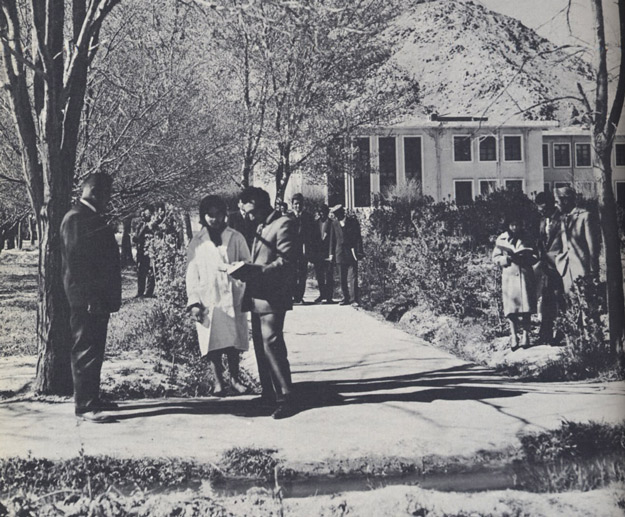
Kabul University
In March 2023, a group of women gathered outside the gates of Kabul University and opened their books. They sat on the pavement and read, quietly, deliberately, in protest of a decree that had barred them from the classrooms behind those gates three months earlier. It was a small act and a dangerous one. The university they were locked out of had been educating Afghan women since 1950 -- and by August 2021, nearly half its 22,000 students were female. That a place founded to modernize Afghanistan could become the site of such a protest tells you everything about the country's tortured relationship with its own ambitions.
Turkish Surgeons in Aliabad
Kabul University owes its existence to a king's modernizing impulse and a group of foreign professors willing to work at the edge of the known academic world. King Mohammed Nadir Shah established the institution in 1932, and its first faculty -- medicine -- was built by Turkish physicians led by the surgeon and anatomist Kamil Rifki Urga, who served as both the university's first rector and the dean of medicine for seventeen years. The Aliabad Hospital rose on campus under Turkish architectural supervision, becoming Afghanistan's first teaching hospital. A Faculty of Law followed in 1936, also established by a Turkish scholar, Mehmed Ali Dagpinar. French, German, and American partnerships broadened the offerings over the following decades. When Urga's first nine medical graduates entered Afghan public life, two of them -- Muhammad Yusuf and Fattah Najeem -- went on to shape the country's political future, Yusuf eventually becoming prime minister. The university was, from its first graduating class, a factory for national leaders.
The Campus as Crucible
By the 1960s, Kabul University had become something its founders may not have intended: a political pressure cooker. Foreign-educated scholars filled the faculty, and students absorbed ideologies that ranged across the entire spectrum. Ahmad Shah Massoud, who would become the legendary resistance commander, walked the same campus as Gulbuddin Hekmatyar, who would become one of Afghanistan's most ruthless warlords. Khalqists debated Parchamites; Marxists clashed with Islamists. In the 1970s, that tension turned lethal when Hekmatyar shot and killed the poet Saydal Sokhandan during an argument between rival factions. The university's alumni list reads like a roster of Afghanistan's conflicts: four future presidents -- Babrak Karmal, Nur Muhammad Taraki, Mohammad Najibullah, and Burhanuddin Rabbani -- plus the head of state Hafizullah Amin, whose seizure of power in 1979 triggered the Soviet invasion. The campus that produced them did not survive their wars unscathed. The Karte Char neighborhood surrounding the university became a major battleground during the civil war of 1992 to 1996, and most of the faculty fled the country during a decade of fighting.
200,000 Books, Then Ashes
Before the civil war, the university's library held 200,000 books, 5,000 manuscripts, 3,000 rare books, along with periodicals, photographs, and calligraphic specimens. It doubled as the National Library of Afghanistan. After the fighting, most of those materials were gone -- sold in Kabul's book markets, burned, or simply lost in the chaos of a city under siege. The destruction of that collection was not just a loss for scholarship; it was the erasure of a national memory. When the international community began rebuilding after the fall of the Taliban government in 2001, they found a campus with 24 computers. Recovery came through partnerships with Purdue University, the University of Arizona, the German Academic Exchange Service, and Technische Universitat Berlin. Iran donated 25,000 books and funded a dentistry faculty. By 2008, enrollment had climbed to 9,660 students, with women making up 24 percent. The numbers kept rising until the university reached approximately 22,000 students before the next collapse.
Under Attack, Again
Even during the republic years, the university could not escape the violence that defined Afghan daily life. On July 19, 2019, a car bomb detonated outside the campus, killing eight people and injuring 33. The following year was worse. On November 2, 2020, three gunmen affiliated with ISIL stormed the university at around 11 in the morning, methodically moving through the grounds and opening fire. They killed 35 people and wounded 56 before Afghan and American forces ended the attack by killing all three assailants. Afghan security officials later arrested the person they said had instigated the assault. Each time the campus was attacked, it reopened. Each time, students returned.
The Gate Closes
The Fall of Kabul in August 2021 placed Kabul University under Taliban control for the second time in its history. The new administration replaced the university's leadership with Osama Aziz, who held a doctorate in Islamic jurisprudence. Classes were suspended and research ground to a halt. When the university reopened on February 26, 2022, it segregated students by gender -- women in the morning, men in the afternoon -- and closed the music department. Then, in December 2022, the Taliban banned women from attending entirely, aligning Kabul University with the nationwide prohibition on women's higher education. The institution that had opened its doors to women in 1950, that had reached near-parity by 2021, locked them out. The women who gathered outside in March 2023 to read their books in protest were asserting a right that the university itself had recognized for over seven decades. Whether those gates will open again to them remains one of Afghanistan's most consequential unanswered questions.
From the Air
Located at 34.52N, 69.13E in Kabul's 3rd District, near the Ministry of Higher Education. The campus is identifiable as a large institutional compound in the western part of central Kabul. Nearest airport is Kabul International Airport (OAKB), approximately 6 km to the northeast. Elevation roughly 1,800 meters (5,900 feet). The Kabul valley is ringed by mountains on all sides, with the university situated on relatively flat terrain.