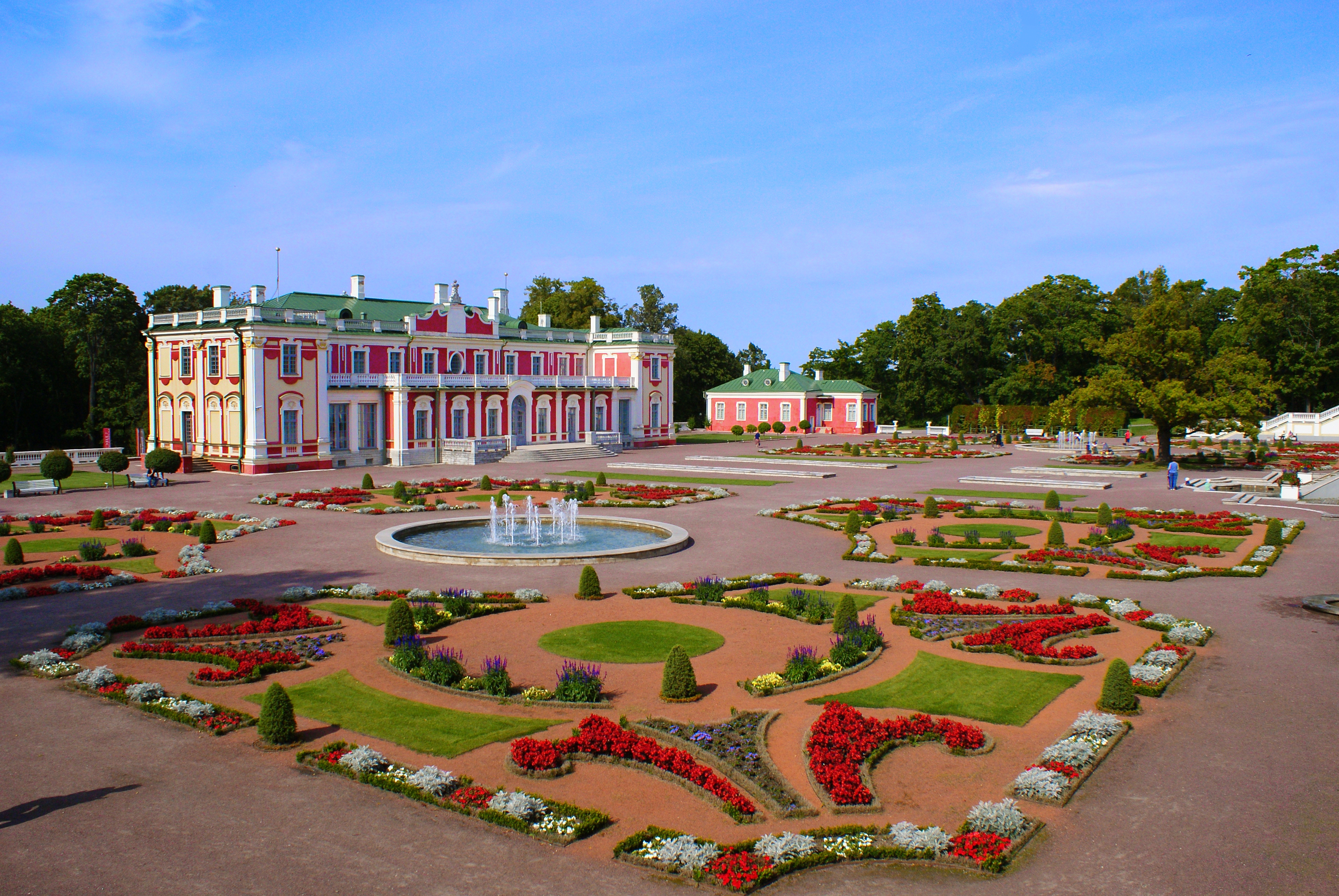
Kadriorg Palace
Peter the Great captured Tallinn in 1710, then bought a small manor house nearby for his wife Catherine. The simple house wasn't enough. By 1718 he had Italian architects laying out something far grander on the wooded slope above the Baltic, a Baroque summer palace with terraced gardens and fountains and a great hall stuccoed with Catherine's intertwined initials. Construction wrapped up in 1725, the same year Peter died. Catherine, suddenly empress in her own right, never came back to Kadriorg. The pink-and-white palace she had inspired sat largely empty by the sea, its rooms waiting for an owner who had moved on.
Peter's Idea, Italian Hands
The siege of Reval in 1710 ended Sweden's hold on Estonia and gave Peter a new harbor on the Baltic. He wanted a residence to mark it, and he wanted it to look European. The Petrine Baroque style he commissioned everywhere borrowed heavily from Italian models, so it was natural that he turned to Roman architect Nicola Michetti for the design. Two builders carried it out: Gaetano Chiaveri, who would later design the Hofkirche in Dresden, and Mikhail Zemtsov, one of the first Russian architects trained in this new western style. The result rises in three stories of warm rendered stucco, framed by symmetrical wings and pavilions. The gardener Ilya Surmin laid out a flower garden with two fountains, and a so-called mirage garden stepping down through several terraces, echoing what Peter had built for himself at Strelna outside Saint Petersburg.
A Hall of Catherine's Initials
Walk into the great hall and you can still read what Peter intended. The stucco decoration, attributed to Heinrich von Bergen, repeats Catherine's monogram in profuse detail across ceiling and cornice. It was a love letter built into plaster. Most of the other interiors have been reworked over the centuries, but this room survived intact, the closest thing to what Peter and Catherine might have seen on the few visits they made together to the unfinished house. After Peter's death the Russian royals largely lost interest. Empress Elizabeth dropped by, Catherine the Great did the same, but neither cared enough to make Kadriorg a destination. From 1741 to 1917 the palace mostly housed the civilian governor of the Governorate of Estonia, a working bureaucratic residence rather than an imperial retreat.
Three Republics, Three Roles
When Estonia declared independence in 1918, the palace passed to the new state. For a few years a wing housed the studio of sculptor August Weizenberg, and the rest hosted art exhibitions for what would become the Art Museum of Estonia. In 1929, on the occasion of a state visit by King Gustaf V of Sweden, the building was promoted to summer residence of the Estonian head of state. A separate purpose-built presidential palace went up on the grounds in 1938, designed by Alar Kotli. Then came the German occupation, and the palace served as the residence of Karl-Siegmund Litzmann, the Nazi-appointed civilian governor. After 1944 the Soviet authorities turned it back into an art museum but let the building deteriorate. By the time Estonia restored independence in 1991, the rooms were close to ruin.
A Swedish Restoration
The government of Sweden funded the restoration that began in 1991, a quiet act of Baltic solidarity from a country whose own empire had once included Tallinn. Work continued for nine years. When the palace reopened to the public in 2000, it housed the Kadriorg Art Museum, the foreign-art branch of the Art Museum of Estonia. The collection inside is the kind that rewards slow looking: paintings by Jacob Jordaens and Bartholomeus van der Helst hang alongside a Burning of Troy by Gillis van Valckenborch, an Adriaen Cornelisz Beeldemaker hunter on horseback, and Ilya Repin's Soldier's Tale. Italian Baroque turns up in works by Bernardo Strozzi and Pietro Liberi. Outside, the Poseidon fountains still play in the formal gardens, and Kadriorg Park spreads around the building, now Tallinn's most beloved green space.
Two Catherines, One Valley
The name Kadriorg means Catherine's valley in Estonian, the same in German. Both languages preserved Peter's tribute long after the woman it honored had stopped visiting. Walk the grounds today and you can still trace the geometry of the original 18th-century plan, the long sight-lines from palace to harbor, the framed views through clipped hedges. The newer Kumu Art Museum stands a short walk away on the limestone slope of Lasnamäe hill, holding the Estonian art collection that Kadriorg can't fit. Together they make Kadriorg Park a single cultural site spanning three centuries: a Baroque shell built by a Russian tsar for an empress who never returned, restored by Swedes for a small republic that has finally gotten to keep what was always built on its soil.
From the Air
Kadriorg Palace sits at 59.4385 degrees north, 24.7910 degrees east, in the Kadriorg neighborhood about 2 km east of central Tallinn. From altitude, look for the wooded green expanse of Kadriorg Park along the Baltic coast just east of the medieval Old Town, with the pink-and-white Baroque facade visible at the inland edge of the park. Tallinn Airport (EETN) lies roughly 5 km southeast. Best viewed at 2,000 to 5,000 feet on a clear day, with the Gulf of Finland providing dramatic backdrop to the north.