Kaichi School
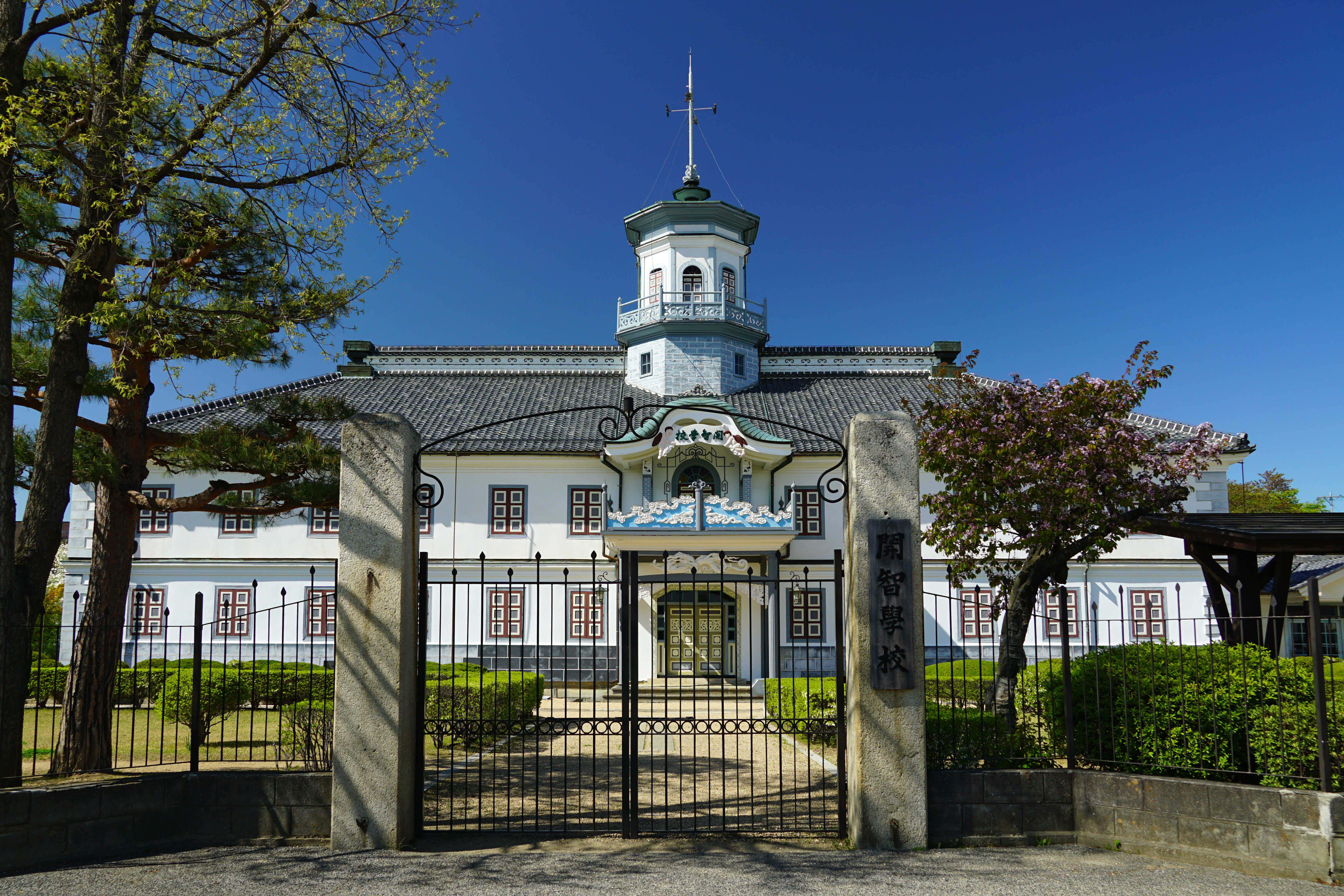
A carved dragon coils above a balcony flanked by classical columns, while a traditional Japanese tiled roof slopes overhead and French glass fills the bay windows. Nothing about the former Kaichi School in Matsumoto should work together, and yet everything does. Built in 1876 by a carpenter who had never left Japan, this improbable building tells the story of a nation reinventing itself in a single generation—and a small mountain city that believed education was the way to do it.
A Carpenter Learns the West
Tateishi Seiju was born in Matsumoto in 1829, trained in traditional Japanese woodworking, and had never seen a Western building until the Meiji government decided Japan needed modern schools. In 1872, the new Ministry of Education issued sweeping reforms that called for compulsory primary education across the country. Matsumoto's leaders wanted a school building that proclaimed their city's commitment to this new era. They chose Tateishi. To prepare, the master carpenter traveled to Tokyo and Yokohama—the cities with the most exposure to foreign architecture—and studied the Western-style buildings he found there. He sketched, measured, and absorbed what he could. He returned to Matsumoto not as a Western architect but as a Japanese craftsman who had looked carefully at another world. The building he created would be neither fully Western nor fully Japanese, but something entirely new.
Giyofu: The Imitation That Became Its Own Thing
The architectural style Tateishi produced is called giyofu—literally "imitation Western style"—but the name undersells the creativity involved. Tateishi modeled the design partly on the Tokyo Kaisei School, the predecessor to the University of Tokyo, but filtered everything through his own training. The result is a two-story wooden structure with symmetrical facades, arched windows, and a central tower topped with an octagonal cupola. Yet the roof tiles are Japanese, the construction techniques are traditional timber-frame, and a carved dragon—a Buddhist symbol of scholarly aspiration—crowns the entrance. French-imported glass fills the bay windows, catching light in ways that no traditional Japanese schoolhouse ever had. Giyofu buildings appeared across Japan during the Meiji period as carpenters everywhere attempted the same cultural translation, but the Kaichi School is widely considered the finest surviving example.
A City That Believed in Education
The Kaichi School opened in a temporary building in May 1873, just a year after the education reforms. When the permanent building was completed in April 1876, more than 1,000 pupils enrolled. That number is remarkable in context: nationally, only about one in three Japanese children attended school in the 1870s. At Kaichi, the ratio was closer to two out of three. The money to build the school came largely from the citizens of Matsumoto themselves. Private donations covered roughly 70 percent of the construction costs—an extraordinary act of civic investment in a town that was not wealthy by the standards of the era. Emperor Meiji took notice, visiting the school during his 1880 tour of Matsumoto. The building served as an active elementary school for nearly nine decades, educating children until 1963.
From Schoolhouse to National Treasure
When the school finally closed, the building was designated an Important Cultural Property in 1961. Two years later, it was physically relocated during construction work on the nearby Metoba River, and in 1965 it reopened as an education museum. Visitors can walk through classrooms preserved from different periods, tracing the evolution of Japanese education from the Meiji era through the 20th century. Then, in 2019, the former Kaichi School received Japan's highest cultural designation: National Treasure. It was the first modern school building in the country to achieve this status, placing it alongside medieval temples and ancient scrolls in the hierarchy of Japanese cultural heritage. The designation recognized not just the building's architectural significance but what it represents—a moment when a small city at the foot of the Alps decided that its children's education was worth building something extraordinary.
Matsumoto's Second Treasure
The Kaichi School stands just a short walk from Matsumoto Castle, one of Japan's twelve surviving original castle keeps and itself a National Treasure. Together, they bracket the city's history: the castle from the feudal age of samurai and fortifications, the school from the modernizing age of education and reform. Matsumoto is one of very few cities in Japan that can claim two National Treasures within walking distance. The juxtaposition is striking—a black-walled fortress built to withstand siege, and a white-trimmed schoolhouse built to welcome children—but both structures share a quality that defines this mountain city: they were built by people who took craftsmanship seriously, who understood that the shape of a building could express the ambitions of an entire community.
From the Air
Located at 36.243N, 137.968E in central Matsumoto, Nagano Prefecture, just north of Matsumoto Castle. The distinctive white building with its octagonal tower is visible at lower altitudes near the castle complex. Nearest airport is Matsumoto Airport (RJAF/MMJ), approximately 7 km to the south-southwest. The Japanese Alps form a dramatic wall to the west. Best approach from the east for a clear view of both the school and the castle, which sit within a few hundred meters of each other along the Metoba River.