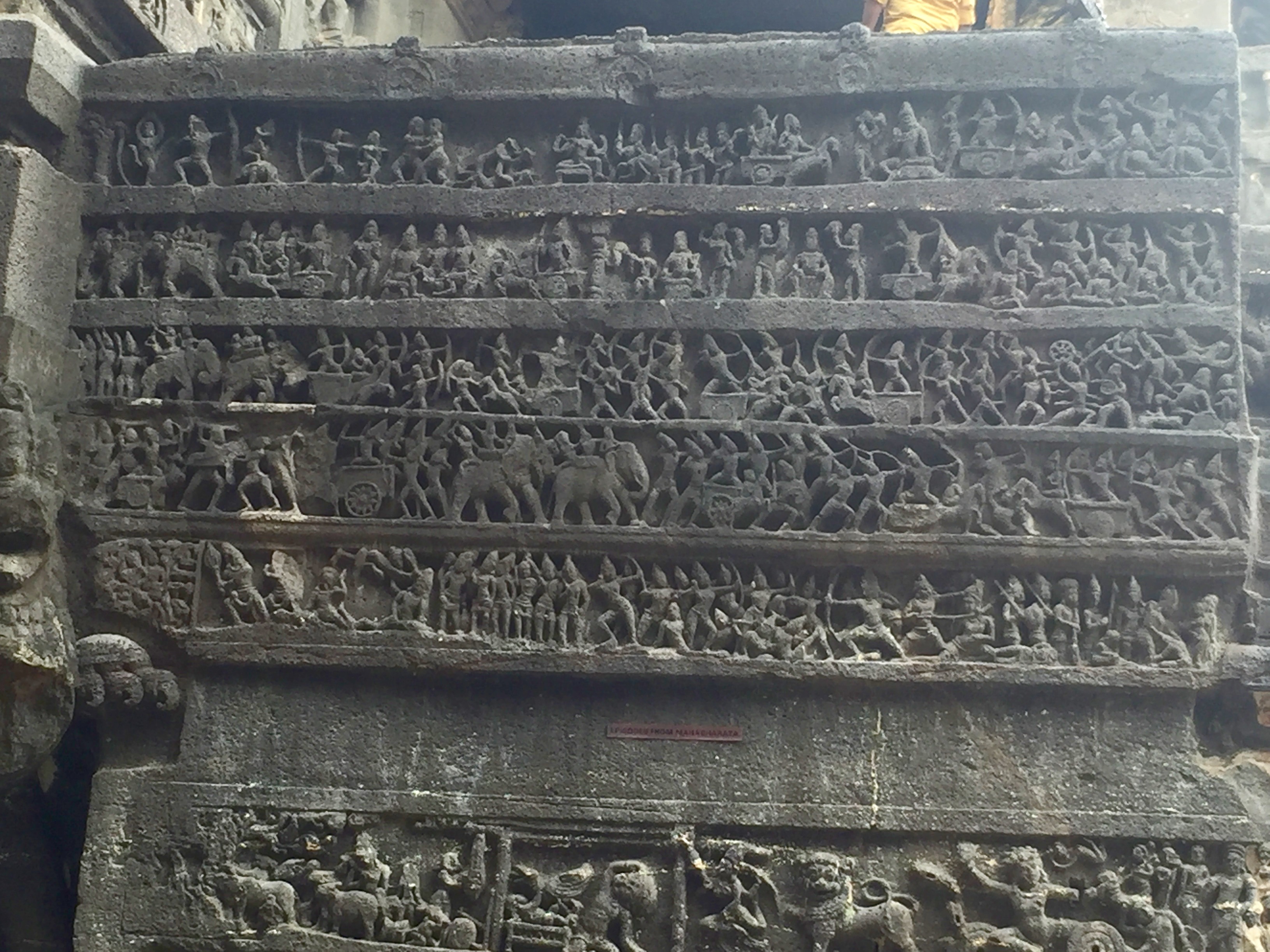
Kailasa Temple, Ellora
Most temples are built from the ground up. The Kailasa Temple at Ellora was carved from the sky down. In the 8th century CE, workers began at the top of a basalt cliff face in what is now Maharashtra and chipped their way toward the earth, removing an estimated 200,000 tons of rock to reveal a structure that had been hiding inside the mountain all along. The result is the largest monolithic rock excavation in the world: a temple 32.6 meters tall, dedicated to Shiva, surrounded by courtyards, galleries, and sculptures that seem less built than born from the stone itself. Even Aurangzeb, the Mughal emperor notorious for destroying Hindu temples across India, could not bring himself to harm it. He called it "one of the wonders of the work of the transcendent Artisan, charming to the eye, and unless one sees it, no written description can correctly picture it."
The Architecture of Subtraction
Building requires addition - stone upon stone, beam upon beam. The Kailasa Temple required the opposite. Its architects conceived the entire structure in negative space, planning every courtyard, pillar, and sculpture before a single chisel struck basalt. One miscalculation and the whole enterprise would have been ruined; there is no patching a monolith. Archaeologist M. K. Dhavalikar estimated that 250 laborers could have completed the work in roughly five and a half years, each cutting about four cubic feet of rock per day. The construction method itself was revolutionary: vertical excavation from the top down, allowing the shikhara - the temple's towering spire - to emerge first. A medieval Marathi legend credits an architect named Kokasa with this ingenious approach, claiming a queen had vowed to fast until she could see a temple's peak, and Kokasa delivered the spire within a week by carving downward from the cliff top.
A Dynasty's Ambition in Stone
The Kailasa Temple is generally attributed to the Rashtrakuta king Krishna I, who reigned from 756 to 773 CE. A copper-plate inscription from Vadodara, dated around 812 CE, records that Krishna constructed a temple so wondrous "that even the gods and the architect were astonished." But the story is more layered than a single patron. Scholars like Hermann Goetz have argued that construction began under Krishna's predecessor Dantidurga and continued under later rulers including Dhruva Dharavarsha and Govinda III. The temple's most celebrated sculpture - Ravana shaking Mount Kailasa, considered one of the finest works in all of Indian art - was likely carved decades after the main shrine, possibly under Krishna III. What makes the attribution debate fascinating is what it reveals about the temple's purpose: it was not merely a place of worship but a statement of imperial power, each king adding to its grandeur to outshine his predecessors.
Borrowed Brilliance
The Kailasa Temple did not emerge from nothing. Its design traces a remarkable chain of artistic inheritance across southern India. When the Rashtrakuta king Krishna I defeated the Chalukyas of Badami, he encountered the Virupaksha Temple at Pattadakal - itself a replica of the Kailasa temple at Kanchipuram built by the Pallavas. Impressed, Krishna brought Chalukya and Pallava sculptors and architects back to Ellora to build something grander than either original. The result blends Pallava elegance with Chalukya solidity, all scaled up to proportions neither tradition had attempted. The entrance features a low gopuram in the Dravidian style. Inside, sixteen pillars support a flat-roofed mandapa housing the sacred lingam. The courtyard holds a Nandi pavilion, life-sized elephants carved in procession along the base, and two towering pillars with flagstaffs. This is not imitation but transformation - southern temple architecture reimagined on a scale that still defies belief.
Survivors of Empire
The temple's survival across a millennium of political upheaval is itself a story. When Alauddin Khalji's troops swept through the Deccan in the early 14th century, they desecrated the Yadava temple at nearby Devagiri and converted it into a mosque. But they left the Ellora caves untouched, and the complex became a sightseeing destination for soldiers. Sufi orders later established camps in the caves, giving the site its alternate name, Rauza. The Bijapur historian Rafi al-Din Shirazi compared the Kailasa Temple to Persepolis and Naqsh-e Rostam, lamenting that his own patrons had destroyed similar marvels at Vijayanagar after the Battle of Talikota. And then came Aurangzeb, a ruler who ordered the demolition of temples across his domain. At Ellora, he paused. He visited repeatedly, calling it "a marvellous place for strolling." Something in the temple's sheer impossibility stayed even his iconoclastic hand.
Cave 16 Among Thirty-Four
The Kailasa Temple is Cave 16 of the Ellora Caves complex, which stretches for over two kilometers along a sloping basalt cliff. The complex contains 34 caves spanning three religions: Hindu, Buddhist, and Jain, carved between the 5th and 10th centuries CE. This coexistence is itself remarkable - temples to competing faiths standing side by side, carved by overlapping generations, suggesting a tolerance unusual for any era. But the Kailasa Temple dominates them all, not just in scale but in ambition. It was meant to represent Mount Kailasa, the Himalayan abode of Shiva - a sacred mountain recreated by removing a mountain. The irony is intentional, the theology embedded in the engineering. To find Shiva's home, the builders seemed to say, you do not add to the world. You strip it away until the divine emerges from what was always there.
From the Air
Located at 20.024N, 75.179E in the Sahyadri Hills of Maharashtra, India. The Ellora Caves complex stretches 2km along a basalt cliff face visible from altitude as a series of dark openings in the escarpment. Nearest airport is Chhatrapati Sambhaji Nagar Airport (VAAU/IXU), approximately 30km southeast. The temple sits at roughly 600m elevation in the Deccan Plateau. From the air, look for the distinctive U-shaped excavation of the Kailasa Temple courtyard - the largest single rock-cut structure in the world. Best visibility in post-monsoon months (October-February) when skies are clear. The region is semi-arid with good visibility most of the year.