Kairaku-en
The name says everything about the garden's radical intent. Kairaku-en means "a park to be enjoyed together," and when the ninth lord of Mito Domain, Tokugawa Nariaki, opened these grounds in 1842, he did something that no other feudal lord in Japan had attempted with a garden of this scale: he invited the public in. While Japan's other two great gardens -- Kenroku-en in Kanazawa and Koraku-en in Okayama -- remained exclusive retreats for their ruling families, Kairaku-en was designed from the first sketch as a shared space. The samurai could come freely, and even ordinary commoners were admitted on designated days, a small but genuine crack in the rigid social order of Tokugawa-era Japan.
Three Thousand Reasons to Visit in February
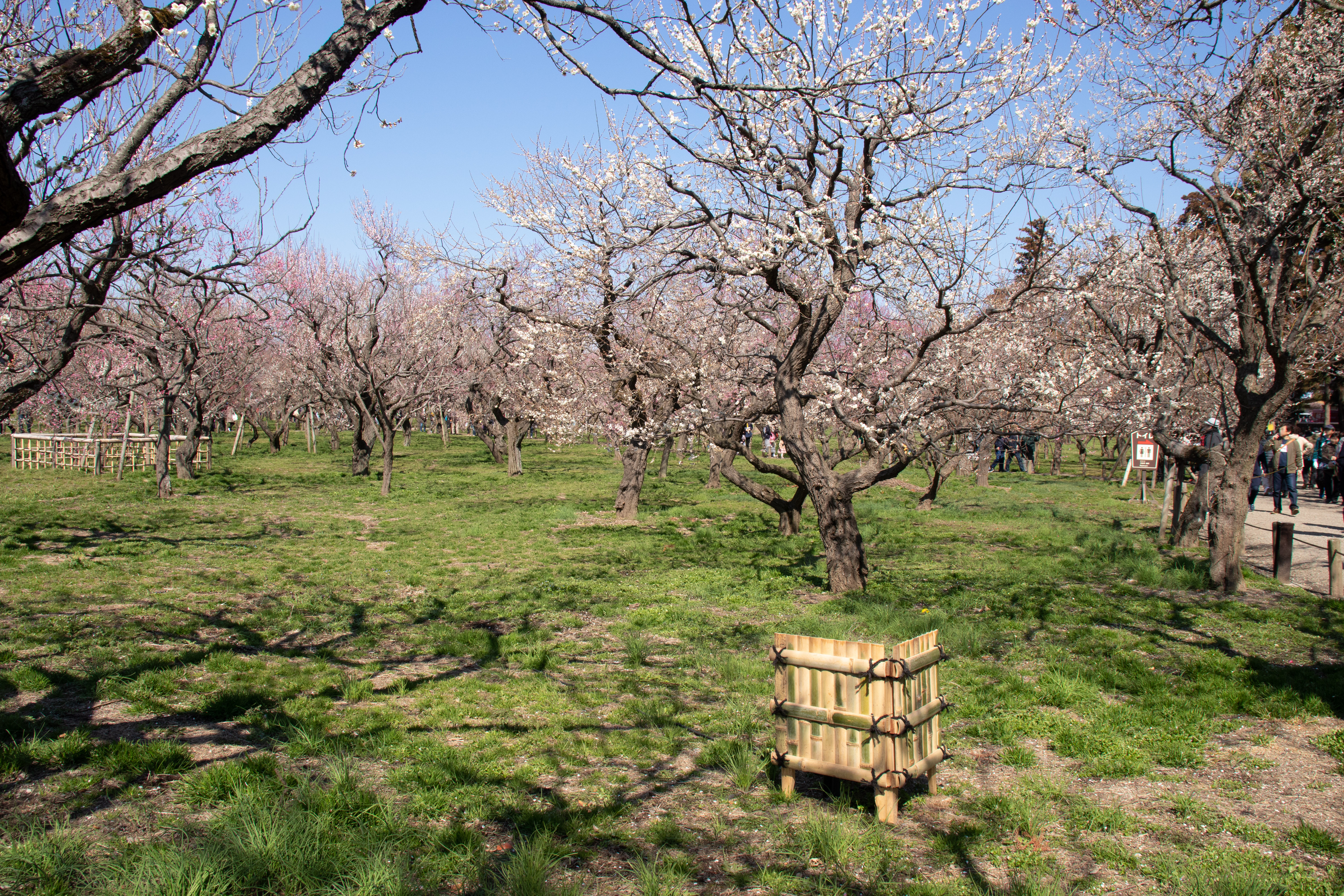
The heart of Kairaku-en is its plum forest -- roughly 3,000 trees representing over a hundred distinct varieties, their blossoms ranging from snow white to deep crimson. When the trees erupt in late February and March, the entire hillside transforms into a pointillist canvas of pink, red, and white, and the air carries a fragrance that draws hundreds of thousands of visitors to the annual Mito Plum Festival. Nariaki chose plums deliberately. Unlike cherry blossoms, which bloom and vanish in days, plum trees flower for weeks, a slow unfurling that rewards patience. Plums also bore fruit that could feed soldiers in wartime -- a practical consideration from a lord who balanced aesthetics with preparedness. The result is a garden that performs differently than any other in Japan: less manicured perfection, more wild abundance.
The Kobuntei and the Art of Looking Down
Rising above the plum forest stands the Kobuntei, a three-story wooden pavilion whose name derives from an ancient word for plum. Nariaki built it as a personal retreat and literary salon, a place to host poetry contests, tea ceremonies, and conversations with artists and scholars. From the top floor, visitors look out over the full sweep of the garden and across to Lake Senba, the view opening up like a landscape painting being slowly unrolled. The original Kobuntei burned in August 1945, when American firebombing devastated Mito along with much of the city's historical architecture. For thirteen years the garden stood without its centerpiece, until a faithful reconstruction was completed in 1958, using period documents and surviving photographs to recover every detail of the original design.
A Lord Who Built Two Schools
Kairaku-en cannot be understood apart from the Kodokan, the domain school that Nariaki founded one year earlier in 1841, just outside the walls of Mito Castle. The Kodokan was the largest feudal school in Japan, teaching everything from Confucianism and history to astronomy, medicine, and martial arts. Japan's last shogun, Tokugawa Yoshinobu, studied there for five years beginning at age six. Nariaki conceived the garden and the school as complementary halves of a single educational vision, inspired by a passage in the Confucian Book of Rites about the necessity of balancing tension with relaxation. The Kodokan was the tension -- rigorous study and military training. Kairaku-en was the relaxation -- beauty, poetry, and shared pleasure. Walk between the two today and you can still feel the logic of that pairing.
Beyond the Plums
Kairaku-en sprawls across 300 hectares, making it far larger than most visitors expect. Beyond the famous plum forest, bamboo groves rustle in corridors of green shadow, and towering Japanese cedars filter the light into cathedral columns. The Tokiwa Jinja, a Shinto shrine built after the Meiji Restoration, sits within the grounds. Across the train tracks lies Sakurayama, where cherry blossoms take over in April, extending the flowering season by weeks. In autumn, the maples ignite into reds and golds. The garden even has its own train station -- Kairaku-en Station on the Joban Line -- though in a detail that perfectly captures the site's seasonal character, the station only opens during the plum blossom festival. The rest of the year, the platform sits quiet, waiting for the trees to bloom again.
A Garden That Outlasted Its Era
Designated a National Historic Site and a Place of Scenic Beauty in 1922, Kairaku-en has survived the fall of the feudal order, wartime destruction, and the pressures of modern development. The garden was briefly renamed Tokiwa Park in 1873 as the Meiji government swept away Tokugawa-era names, but in 1948 the original name was restored -- a quiet acknowledgment that Nariaki's vision of shared enjoyment had outlasted the politics of any single era. Today the garden stands as a living argument for the idea that beauty belongs to the public, a principle that was radical in 1842 and remains worth defending.
From the Air
Kairaku-en is located at 36.373N, 140.456E in Mito, Ibaraki Prefecture, on the Kanto Plain northeast of Tokyo. The garden's 300-hectare grounds and adjacent Lake Senba are identifiable from altitude. The nearest airport is Ibaraki Airport (RJAH), approximately 30 km south, which shares its runway with JASDF Hyakuri Air Base. Narita International Airport (RJAA) lies about 80 km to the southwest. Approach from the south over the Kanto Plain for the best perspective on the garden's relationship to the city and lake.