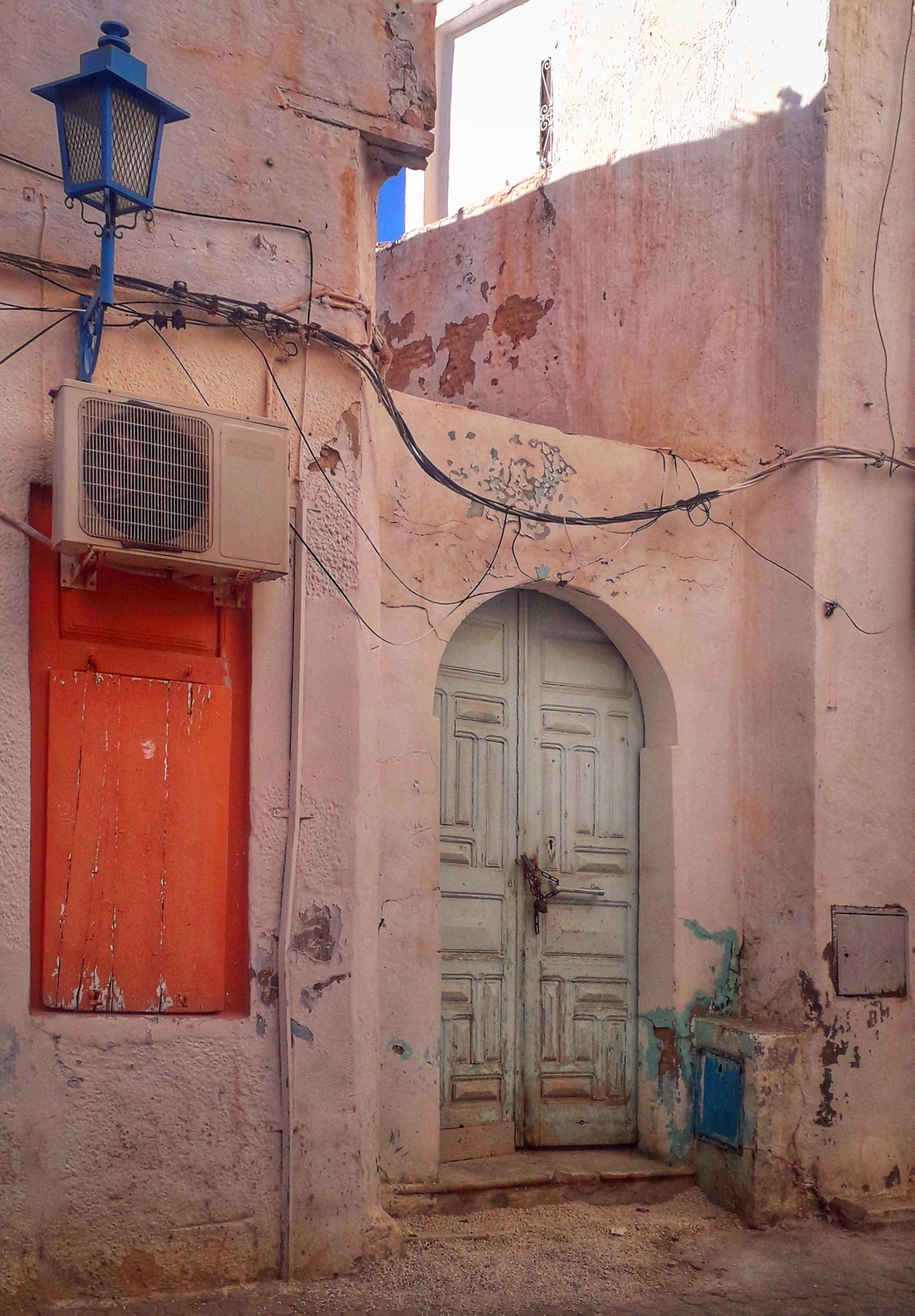
Kairouan Synagogue
For centuries, the city of Kairouan was home to one of the most important Talmudic academies outside of Babylon. The yeshiva of Kairouan drew scholars from across the Mediterranean, and its reputation rivaled the great learning centers of the East. Then the Almohads came, and in the mid-1100s, Jewish life in Kairouan ended abruptly. Those who refused to convert to Islam were killed. Those who survived fled to other Tunisian towns, and for nearly eight hundred years, no synagogue stood in the city.
A Community Rebuilt
When the French Protectorate brought a measure of stability to Tunisia in the early twentieth century, Jewish families began returning to Kairouan. In 1910, the community decided to make a statement. They acquired a plot of land in the heart of the hara, the old quarter, and began planning a synagogue that would announce their presence and reclaim a thread of continuity stretching back to the city's founding. The building opened in 1920 on Salah-Souissi street, and for half a century it served as the center of a revived Jewish community. The synagogue was modest in scale but outsized in its symbolic weight, a physical declaration that Kairouan's Jewish story was not finished.
The Weight of Distance
The second departure came more quietly than the first. After Tunisian independence and the ripple effects of the 1967 Six-Day War, Jewish families across Tunisia began emigrating. In Kairouan, the community that had rebuilt itself over generations dwindled again, and by the 1970s, the synagogue stood empty. The Tunisian authorities repurposed the building as a madrasa, an Islamic school. It was a pragmatic decision, but the transformation carried its own irony: a house of Jewish worship becoming a house of Islamic study, in a city where both traditions had deep and intertwined roots.
Echoes in Stone
What remains in Kairouan is the memory of intellectual brilliance. The yeshiva that once operated here was the first major Talmudic academy in all of North Africa, closely linked to the great yeshivot of Babylonia. Scholars at Kairouan corresponded with the most prominent rabbinical authorities of their age, and the community produced legal opinions and commentaries that circulated throughout the Jewish world. Under the Hafsid dynasty in the late 1200s, conditions improved for those Jews who remained in Tunisia, but Kairouan never regained the scholarly prestige of its golden age. The synagogue on Salah-Souissi street was the last physical testament to that tradition within the city itself.
Between Two Erasures
The story of the Kairouan Synagogue is really the story of two endings. The first was violent, an expulsion driven by religious intolerance in the twelfth century. The second was quieter, a gradual emigration shaped by nationalism, war, and the pull of new homelands. Between those two erasures lies the twentieth-century community that chose, deliberately and with purpose, to rebuild. The building they raised lasted barely fifty years, but it proved that absence is not the same as disappearance. Even now, the former synagogue stands in the old quarter, its walls holding the compressed history of a people who came back, however briefly, to the place where their intellectual tradition first took root on African soil.
From the Air
Located at 35.678N, 10.100E in central Tunisia. The city of Kairouan is visible from altitude as a compact urban center on the semi-arid Tunisian steppe, roughly 160 km south of Tunis. Nearest airport is Monastir Habib Bourguiba International (DTMB), approximately 60 km to the east. The Great Mosque of Kairouan is the most prominent landmark from the air.